

Not long after I watched Akira Kurosawa’s great film “Ikiru” for the first time around 20 years ago, I read a review written by one anonymous but prominent South Korean critic who argued that “Ikiru” is the funniest film ever made by Kurosawa. This argument felt truer to me as I revisited the movie around the beginning and then the end of this year. As a matter of fact, it is quite painfully funny especially during its first act, but then it surprises us as generating a lot more pathos and poignancy than expected while never losing its sense of black humor. And then there comes one of the best narrative leaps I have ever watched, as it becomes all the more amusing and touching around the point where the story arrives at a somber but undeniably powerful moment of little human triumph.
Right from its very first shot, the movie does not pull any punch at all on how its meek and ordinary public servant hero, Kanji Watanabe (Takashi Shimura), will not live that long due to his terminal illness – and how most of his whole life has been quite inconsequential to say the least. For nearly 30 years, he has simply worked and worked at one of the many departments of the city hall, and the sardonic narration in the early part of the film further accentuates how pathetic his existence really is. At his workplace, he merely occupies his desk as the chief of the department without doing much at all just like others working under him, and the most active moment of his job is stamping those incoming documents with his authorization seal. At his house, he resides with his only son and the son’s wife, but he is not particularly close to them even though he has worked and lived for his son’s welfare since his wife died many years ago.
And there comes a grim and devastating news for Watanabe as already announced to us in advance. Feeling not so right about his stomach, he takes a unprecedented day off to the surprise of everyone at his workplace, and we get a darkly humorous moment as Watanabe is waiting at a local clinic along with several other patients. One of these patients cynically explains in detail to him about how the doctor will say if his patient happens to be dying due to stomach cancer, and, what do you know, the doctor subsequently tells Watanabe exactly what that patient warned to Watanabe.
While facing his imminent mortality, Watanabe is naturally scared, confused, and, above all, despaired. As he looks back on his whole life via a series of brief flashbacks, he belatedly comes to realize how meaningless his life has been for years, and that makes him all the more morose and regretful than before. His son and his son’s wife sense something wrong about him, but they are more occupied with the financial matters of their own life, and there is a heartbreaking moment as Watanabe finds himself lonelier than ever for failing to connect with his son again.

What follows next is Watanabe’s hilariously clumsy attempts for fully living at least while he is still alive (“Ikiru” means “To Live” in Japanese, by the way). He drinks a lot even though that is the last thing he should do as a stomach cancer patient. He comes to have a wild night along with a jaded novelist who takes a pity on him after listening to his story. When a young pretty woman working under him later approaches to him for her resignation, he becomes interested in spending more time with her, and she does not mind this at all as lightening him up at times with her plucky cheerfulness.
However, not so surprisingly, none of these new experiences of his does not help Watanabe much. Maybe he could feel a lot better if he were just going through a mid-life crisis, but Watanabe’s approaching death remains an undeniable fact to face. During one particularly haunting scene, he flatly but sorrowfully sings an old song at a nightclub, everyone around him becomes silent as sensing more melancholy and sorrow from him. In one brief but striking visual moment, we see Watanabe’s face filled with more darkness and despair, and the mood between him and that generous novelist becomes far less than joyful than before.
In case of that young woman, she does not have any answer to Watanabe’s urgent life issue either, though she comes to feel more pity and compassion after learning about Watanabe’s terminal illness. However, he eventually gets a small but possible idea as he struggles to understand why he became interested in her from the beginning, and then we are served with a memorably dramatic moment which effectively utilizes a certain well-known song sung in the background. This may look a bit too symbolic on the surface, but Kurosawa skillfully builds up this big moment of personal realization, and you may cheer when Watanabe is virtually congratulated for a sort of rebirth as leaving the scene with a lot of spirit and excitement.
Around that point, the screenplay by Kurosawa and his co-writers Shinobu Hashimoto and Hideo Oguni, which was partially inspired by Leo Tolstoy’s 1886 novella The Death of Ivan Ilyich, does something quite unexpected. Because I still remember how much I was surprised by that, I strongly suggest you that you stop reading this now if you have not watched it yet.
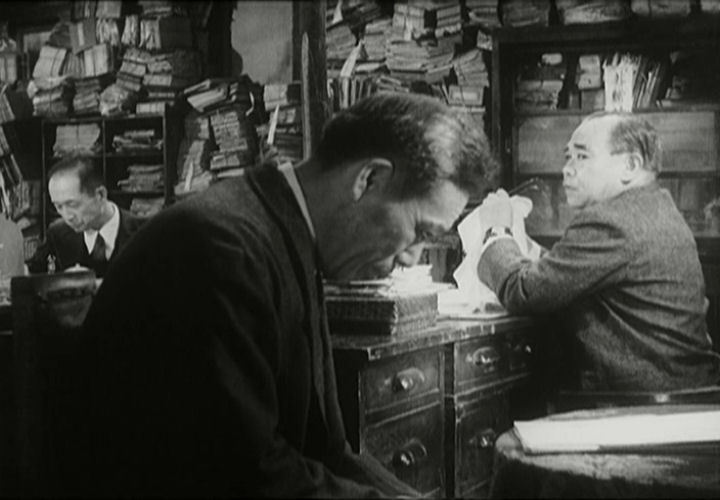
The last act of the movie immediately makes no bone about Watanabe’s eventual death, which happens several months later. At his following funeral, his colleagues gather for showing some condolence and then drinking a lot together, and their gradually drunken conversation comes to focus on how Watanabe suddenly became much more active and determined than before to everyone’s confusion and surprise. It is often hilarious to observe how they try to ignore what has been so obvious to them from the very beginning – and how they end up becoming more aware of that instead while reminded more of how pathetic they have been just like Watanabe once was. They seem to learn something from that, but, to our bitter amusement, things go back to usual business for them on the very next day.
However, this part is also very poignant via a series of flashback scenes showing what Watanabe did during his last several months. While he remains timid and humble as usual on the surface, the sheer patience and determination behind his plain appearance make him into a sort of force to reckon with. He steadily and constantly persists for his goal, and he is not even stopped by those top-ranking figures at the city hall or some criminal people who do not welcome his little project at all.
Throughout the film, Takashi Shimura, who was one of frequent actors in many of Kurosawa’s works including “Seven Samurai” (1954), gives a subtly expressive performance to remember. His usually static face conveys to us his character’s deep sadness and desperation without signifying too much, and it is both compelling and touching to observe how his sensitive low-key acting illustrates his character’s gradual inner change along the story. Around the end of the film, Watanabe does not seem that changed much on the surface, but Shimura’s serene façade is more than enough for us to sense that Watanabe is much more alive than ever as feeling truly happy and satisfied, and the result is definitely one of the greatest moments in the history of cinema.
Kurosawa directed a bunch of great works to remember, and “Ikiru” has firmly stayed around the top of the list. When I watched it for the first time, I was just a little more than 20, the movie reminded me that I should be really serious about how I should live. I become 40 in this year now, and the movie made me reflect more on how I have lived during last two decades. Yes, my life has been occasionally quite messy and trivial to say the least, but I was fortunate enough to have some good people encouraging and supporting me in one way or another. While my current job is sometimes challenging, it is never boring or soul-sucking at least, and I also become more passionate and serious about movies and books in addition to being much more honest about my sexuality. So, am I now as happy as Watanabe is at the end of the movie? I am not so sure even at this point, but I will keep trying for that.
Sidenote: As many of you know, “Ikiru” was recently adapted into British film “Living” (2022), which incidentally garnered Bill Nighy a well-deserved Oscar nomination. This remake version is also worthwhile to watch, and Nighy’s excellent performance will remind you that, as Roger Ebert once said, great actors don’t follow rules but illustrate them.


 Seongyong's Private Place