

The most timeless part of Tim Burton’s “Batman” is that indelible darkness of its superlative Oscar-winning production design by late Anton Furst. Burton and Furst created one of the most visually striking cities in the movie history which deserves to be mentioned along with the ones in Fritz Lang’s “Metropolis” (1927) and Ridley Scott’s “Blade Runner” (1982), and that is almost enough for compensating for several notable weak aspects of the film including its deficient storytelling.
One of the rather curious problems in the film is how its superhero character is often overshadowed by his main opponent, who actually comes to show much more life and personality in comparison. While both of these two contrasting characters surely represent Burton’s neurotic artistic sensibility, Burton seems to be drawn more to the more flamboyant one at times, considering many of the most entertaining moments in the film belong more to that one. What the movie is supposed to be on the surface is your typical superhero origin story, but, let’s face it, it is sometimes more like a villain origin story.
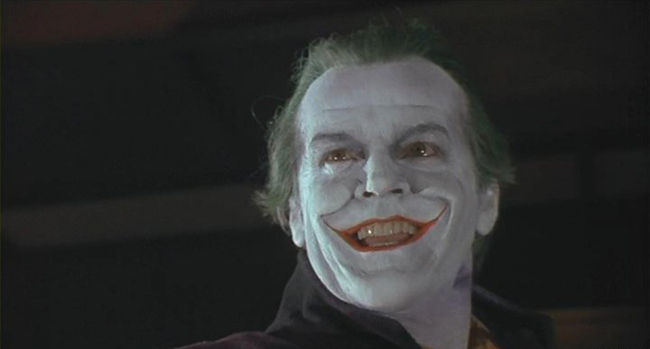
As a criminal who will become, yes, Joker, Jack Nicholson is ready to have a fun right from his very first scene in the film, and he surely goes over the top as required when his character eventually comes to have that fearsome grin on the face mainly thanks to Bruce Wayne / Batman (Micheal Keaton). Once he gets rid of the boss of a big local criminal organization played by Jack Palance, Joker embarks on throwing a series of twisted terrors upon the citizens of Gotham City, and his deranged criminal masterplan eventually culminates to a massive parade along the main street of the city, which is clearly inspired by that annual Thanksgiving Day parade in the New York City.
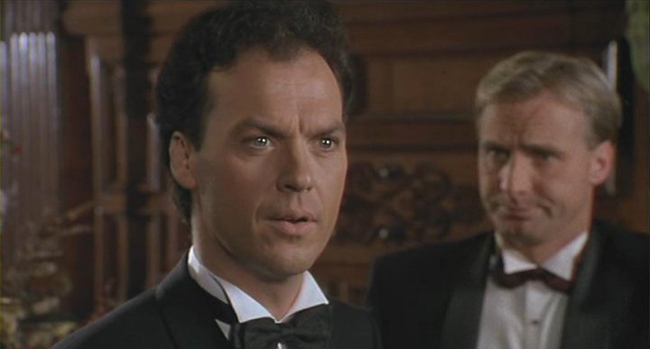
Of course, the only man who can stop Joker is none other than Batman. The story becomes more interesting as his traumatic childhood past turns out to be connected with Joker, but Batman remains as a mere counterpart to his main opponent – even when he is not acting as Batman. Considering his wacky performance in Burton’s previous film “Beetlejuice” (1988), Michael Keaton was an effective case of against-the-type casting, and he did a good job of embodying his character’s hidden darkness and morbidity, but I must point out that his version of Bruce Wayne / Batman is still relatively less compelling compared to what Christian Bale embodied so intensely in Christopher Nolan’s monumental Batman trilogy,
Another problem in the film is a subplot involved with Wayne’s problematic romance with a pretty photographer named Vicky Vale (Kim Basinger). Yes, she surely notices right from their first encounter that there is something odd about him, but I think she should be a bit more surprised when she finally comes to learn about his dual identity later in the story. Stuck with her thankless supporting role, Basinger, who happened to be the last-minute replacement right before the shooting of the film, tries as much as she can, but she and Keaton do not generate much heat or chemistry between them, and that is all the more evident considering how Keaton is a lot more interesting with Michelle Pfeiffer in “Batman Returns” (1992), which is also directed by Burton.
Anyway, the movie is still a visual treat for any moviegoer, and I was glad to absorb every detail of its splendid production design when I revisited it at a local movie theater at last night. In contrast to the hyper-realistic version of Gotham City in Nolan’s Batman trilogy, the Gotham City in “Batman” is a delightfully anachronistic mix of old and new stuffs peppered with lots of gothic/film noir touches to be savored, and it still looks quite impressive with all those tall and dark buildings rising toward the dark night sky.
In addition, the movie is often driven a lot by the great score by Burton’s frequent collaborator Danny Elfman, who became one of the most prominent film music composers working in Hollywood after the immense success of his score. While several original songs by Prince are effectively used in several key scenes including the one where Joker and his goons gleefully vandalize many different artworks in a big museum, Elfman’s score leaves more lasting impressions us on the whole as the emotional center of the film, and it also makes the action scenes in the film feel more thrilling and exciting than they actually are (If you think Nolan is not so good at shooting action scenes, just watch how flatly Burton handle the action scenes here in this film). It is no wonder that his Batman theme has been as famous as John Williams’ Superman theme, which is virtually the yang to the yin of his Batman theme.
Mainly due to what was achieved so well by Nolan’s Batman trilogy, “Batman” is sometimes eclipsed along with “Batman Returns”, which is incidentally much darker and more interesting because Burton pushes his own artistic sensibility further in that film. However, it should be recognized that “Batman” is significant for opening the door for more dark possibilities inside its moody superhero character, and many of subsequent Batman films including Nolan’s Batman trilogy certainly owe a lot to it.
Overall, the movie has much more style and personality than many of recent superhero flicks, and that is why I found it fairly engaging even at present despite those glaring flaws I noticed again during my recent viewing. It could have been better in my humble opinion, but it was indeed one of the major turning points for its genre at least, and, above all, its Gotham City is still pretty awesome to watch on big screen.


 Seongyong's Private Place