

South Korean film “A Letter from Kyoto” is a little family drama revolving around the relationships among three sisters and their aging mother. As these four different women cope with each own daily matters along the story, the movie slowly and earnestly develops each of its main characters, and the result is engaging enough to earn the emotions of its sentimental finale.
The movie, which is mainly set in Busan, opens with the homecoming of Hye-yeong (Han Sunhwa), who returns after having some unspecified problems in her professional career. While she is warmly welcomed by her mother Hwa-ja (Cha Mi-kyung), she does not tell her mother much about why she comes to Busan, and she does not even confide anything to her two siblings Hye-jin (Han Chae-ah) and Hye-joo (Song Ji-hyun).
As Hye-yeong stays at her family home, we get to know more about how her mother and sisters live day by day. While Hwa-ja, who has been a widow for many years ago, works in a little catering factory along with her best friend, Hye-jin works in a small local boutique shop, and Hye-joo, who is still a high school student as the youngest one in the family, has been quite enthusiastic about joining a dance group while hiding that from her family.
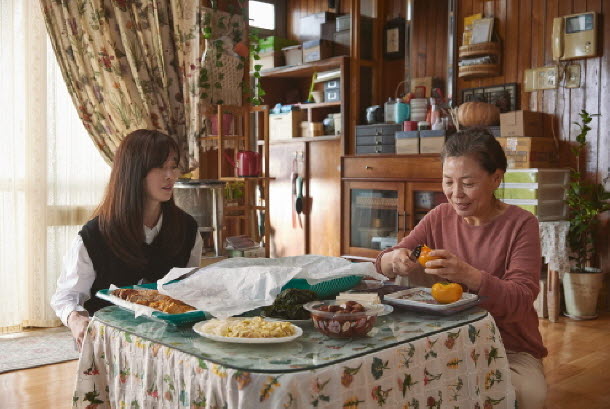
And then Hye-yeong belatedly comes to learn something serious about her mother. Hwa-ja turns out to be in the early stage of dementia, and things will certainly get worse for her even though she gets some medical help for slowing down the progress of this illness of hers. While Hye-yeong is naturally concerned about her mother, there is nothing much she can do for her at present except providing some help and support, and Hye-joo is already considering sending their mother to a facility for old people if her mother’s medical condition gets much worse than now.
Meanwhile, Hye-yeong becomes more curious about her mother’s old past as sorting out all those old stuffs her mother has kept for years. Hwa-ja was actually born in Japan, but she and her Korean father left her Japanese mother for some personal reason not long after that, and it surely took some time for young Hwa-ja to get accustomed to this considerable environmental change. Although her mother sent a letter from Japan from time to time, her mother’s letter eventually stopped coming at some point, and it is still a sad and painful memory which has been silently kept in Hwa-ja’s mind during several decades.
After discovering several old letters from Hwa-ja’s Japanese mother, Hye-yeong does some online research for gathering more information about her unknown grandmother. It seems that Hwa-ja’s mother was in some hospital outside Kyoto after Hwa-ja and her father went to Busan, and that certainly makes Hye-yeong all the more curious about her hidden family history.
Meanwhile, the screenplay by director/writer Kim Min-ju leisurely rolls the individual narratives of its main characters for more character development. Through Hwa-ja and her best friend, we get to know a bit more about many years of their friendship, and the sense of old history becomes more real to us when Hwa-ja happens to have a little private conversation with an old lady who has been incidentally one of the frequent customers of the catering factory. While Hye-joo finds herself attracted to a certain male member of her dance group, Hye-jin accidentally comes to befriend a Russian sailor, and this foreign dude turns out to be more generous and likable despite their rather awkward first encounter.

In the end, the movie arrives at the final act where its main characters go to Kyoto as expected from its very title, and it thankfully avoids any unnecessary sappiness as calmly following its main characters as before. What they eventually discover around the end of their little journey outside Kyoto will not surprise you that much, but you will be touched as Hwa-ja and her three daughters confirm to each other on how much they love and care about each other despite those occasional strains and conflicts among them.
The four main cast members dutifully fill their archetype roles with enough life and personality to hold our attention. While Han Sunhwa earnestly leads the story, Cha Mi-kyung gradually takes the center as the three other performers come to surround her more along the story, Han Chae-ah and Song Ji-hyun are also solid in each own moment to shine. As these four good actresses interact with each other in one way another, we can always sense a long history among their characters, and that is the main reason why the movie engages us despite its rather familiar plot and characters.
On the whole, “A Letter from Kyoto” is another typical family drama about mother and daughter relationship, but it mostly works thanks to its competent direction and the diligent efforts from its four main performers. Right from its first shot, I knew what I was going to get from it, and the movie simply does as much as intended, but it did a good job of handling its story and characters at least. Yes, the overall result is a little too mild for me at times, but I came to care more about its main characters along the story nonetheless, so I recommend you to give it a chance someday.


 Seongyong's Private Place