

Ridley Scott’s new film “Napoleon” is surprisingly flat and bland despite its ambitious intentions. While it tries to be an epic historical drama revolving around one of the most prominent figures in the 19th century Europe, the movie curiously lacks narrative focus and momentum even during its obligatory moments of visual spectacles, and we simply go through a series of big happenings in its real-life hero without getting much understanding on what made him tick.
At first, the movie looks promising as throwing us right into a grim period of fear and chaos right after the French Revolution in 1789. As the country is being shaken inside and outside, Napoleon Bonaparte (Joaquin Phoenix), who was just a mere officer from Corsica at that time, sees an opportunity for his big ambition, and then he quickly rises to prominence when he and his soldiers successfully defeat the British Navy in a local port city of France thanks to his clever strategy.
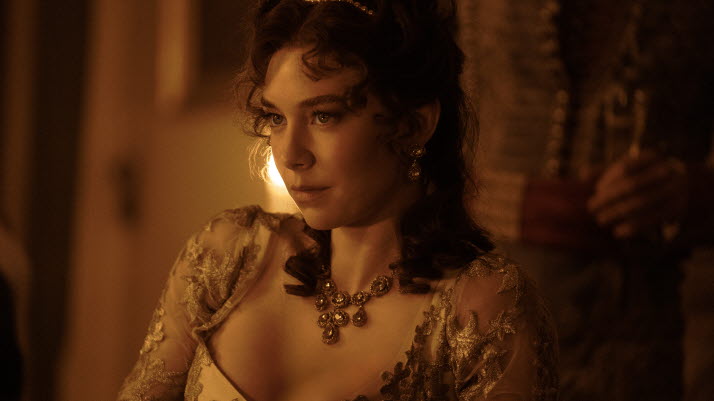
Around that time, Napoleon happens to encounter a widowed woman named Joséphine (Vanessa Kirby). When she later sends one of her kids to Napoleon for a little personal favor, he visits her rather shabby residence for himself, and it does not take much time for them to sense more of the mutual attraction between them. They eventually get married, and things seem to go swell for both of them for a while, but, alas, there come two big problems in their private life. While they keep failing to have any child between them, Joséphine turns out to be not so faithful to her husband, and Napoleon is certainly angry and frustrated about his wife’s infidelity.

Meanwhile, lots of things happen to Napoleon outside. We see him doing some battles in Egypt. We see how there comes more power on his way as he becomes one of the most popular generals in France. We see how he subsequently becomes the Emperor of France, and, yes, we surely get that famous moment when he put the crown on his head for himself without any hesitation.
However, do these and other things in the story actually give any insight on what kind of a man he is? Although Scott and his screenplay writer David Scarpa seem quite willing to present all the human flaws of Napoleon, and the movie becomes a bit amusing whenever it illustrates Napoleon’s pathetic pettiness about his troubled marital relationship with Joséphine, but Scarpa’s screenplay only comes to scratch the surface instead of really delving deep into its hero’s mind or personality. In the end, we only behold how often Napoleon is sour and miserable, and we do not even get to know that much about him as a skillful military leader.
Joaquin Phoenix, who incidentally played a petty Roman emperor when he appeared in Scott’s Oscar-winning film “Gladiator” (2000) more than two decades ago, is also rather disappointing in my humble opinion. While he is surely as intense as required, his acting unfortunately does not convey that much to us as regrettably being stuck in growing monotony, and that may remind you more how he was more compelling in Ari Astor’s flawed but curious horror comedy film “Beau Is Afraid” (2023). Compared to his increasingly unhinged performance in that film, he seems hopelessly straight-jacketed here, and even several supposedly dramatic moments of his in the film feel weirdly lackadaisical as a result.
On the opposite, Vanessa Kirby, who has been more prominent since her Oscar-nominated turn in “Pieces of a Woman” (2020), has a bit more things to do as her character comes to show some will and strength as often clashing with Napoleon, but there is not much heat or chemistry between Kirby and her Phoenix from the beginning. We do not see or feel much of whatever makes their characters attracted to each other to the end, and it is all the more disappointing to see how feebly the movie ends the drama between their characters with an anti-climactic whimper.
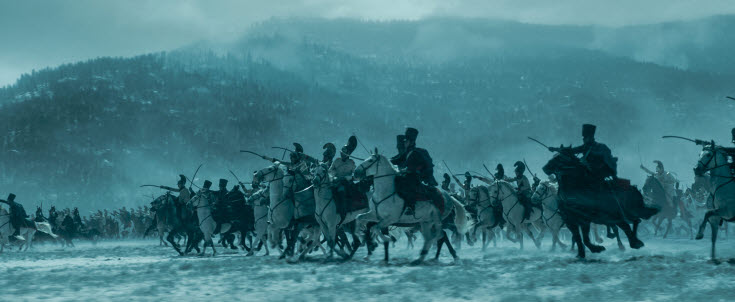
In case of a number of battle sequences, the technical efforts of Scott and his crew members including cinematographer Dariuz Wolski do not disappoint us as giving us some big visual moments to remember, but these moments somehow feel cold and distant while only functioning as the mere plot points of the film. As a matter of fact, this took me back to the detached battle sequence of Stanley Kubrick’s “Barry Lyndon” (1975), and I was also reminded that Kubrick once attempted to make a Napoleon film before making “Barry Lyndon” instead. Is it possible that Scott is trying on “Barry Lyndon” or that unrealized project of Kubrick here?
However, I must tell you that Scott already attempted to emulate “Barry Lyndon” many years ago. In his first feature film “The Duelists” (1977), which incidentally shares the same period background with “Napoleon”, he did a much better job of getting us engaged via not only good mood and visual but also solid story and character, and the tedious failure of “Napoleon” actually makes me want to revisit that modest but fascinating period drama film which has been often eclipsed by Scott’s next film “Alien” (1979).
Overall, “Napoleon” is not a total dud at all, but it feels quite tedious from time to time. I heard that Scott is planning to release the 4-hour version later, but I doubt whether the movie will be improved by a longer running time, considering how I got bored and impatient during my viewing. I am certainly glad to see that Scott is still working despite being over 80 at present, but we all know he can do much better than this, and I sincerely hope that he will soon get back in his usual element.


 Seongyong's Private Place
Pingback: My Prediction on the 96th Academy Awards | Seongyong's Private Place