

Ira Sachs’ latest film “Passages” will definitely make you wince a lot for its utterly unlikable hero – and how much the two other main characters around him struggle with his toxic influence in one way or another. Although you will shake your head more than once for this despicably narcissistic bastard, you will observe his many selfish behaviors with some morbid interest and fascination as feeling sorrier for the two other main characters.
The opening scene quickly establishes how Thomas (Franz Rogowski) often demands and controls others around him a lot. He is a movie director working in Paris, and we see him becoming quite fastidious about how everything on the set looks and feels as right as whatever is envisioned by him for a scene to be shot. First, he points out how one of his performers should enter the scene as exactly as he wants, and then he is quite pissed off about a little mistake in the background. As a matter of fact, you may wonder how the hell the cast and crew members have tolerated this anal-retentive prick.
Anyway, the movie moves forward to the point where the production of Thomas’ new film is eventually finished, and we see him attending a party along with several crew and cast members of his at some nightclub. While he is ready to have some more fun and excitement, his husband Martin (Ben Whishaw) is not so eager about that, and Thomas’ attention soon goes to a young woman named Agathe (Adèle Exarchopoulos). Once Martin leaves, Thomas and Agathe dance together for a while, and we instantly sense some attraction between them, so we are not so surprised when they move forward to the next logical step for their growing attraction.

This merely looks like a one-night fun at first, but then Thomas tells everything to his husband in the next morning without any hesitation. According to Thomas, he felt excited and energized about this new experience, but Martin, who has probably been accustomed to his husband’s infidelity for years, simply does not want to know anything at all, though Thomas keeps talking about his supposedly exciting night with Agathe.
To Martin’s viewpoint, this happening will go away sooner or later, but, what do you know, he and Thomas soon find themselves separated once Thomas decides to end his relationship with Martin and then goes to Agathe. Unlike Thomas, who is already occupied with his relationship development with Agathe, Martin feels hurt quietly inside his heart, but, at least, he subsequently befriends a young French writer recently introduced to him by their mutual acquaintance.
However, of course, things get complicated for both Agathe and Martin. At one point later in the story, there comes a very important happening which is going to influence Agathe and Thomas’ relationship in one way or another, and, not so surprisingly, he cannot accept this that well. As a consequence, he swings back to Martin, and this certainly burdens Martin as well as Agathe.
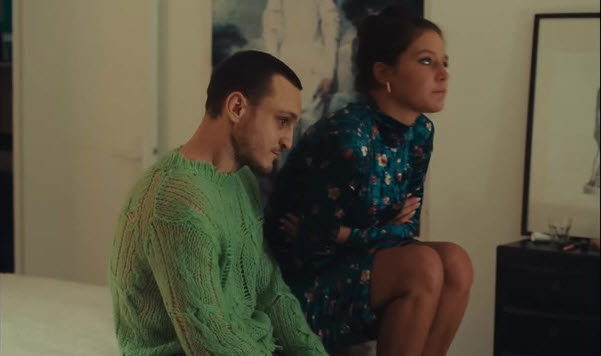
The screenplay, which is written by Sachs and his frequent collaborator Mauricio Zacharias (French screenplay writer/editor Arlette Langmann also provided some additional dialogues, by the way), coldly observes this complex situation among its three main characters from the distance. We never get to know what exactly Thomas feels or thinks about the increasing emotional mess caused by him, and the movie does not give us much insight on whatever Martin and Agathe see or sense from Thomas, except that it is often difficult for them to say no to this prick whenever he begs or pleads in front of them. As frequently getting sexually involved with him (The movie initially received NC-17 rating and then got released while being unrated a few months ago in US), they somehow tolerate him with lots of patience, but then there inevitably comes a point where they must make each own hard decision for themselves, respectively.
To be frank with you, I encountered some truly crummy people since I came out of the closet in 2016 and then met more than 50 guys during last 7 years, and I doubt whether any of those lousy dudes can top the sheer selfishness of Thomas. He is surely not someone easy to play, but Franz Rogowski, a promising German actor who has been more prominent during last several years since I noticed his notable supporting turn in Michael Haneke’s “Happy End” (2017), plays his character as a deplorably fascinating character without any compromise or excuse on many of bad behaviors throughout the film, and he recently received the Best Actor award from the New York Film Critics Circle. Around Rogowski, Ben Whishaw and Adèle Exarchopoulos have each own moments to distinguish themselves, and they are particularly terrific during a somber conversation scene where their characters are reminded together again of what a sh*tty lover Thomas is to both of them.
On the whole, “Passages” is not easy to watch to say the least, but it is worthwhile to watch for its competent handling of story and character as well as a trio of solid performances to admire. Compared to Sachs’ warmer and more sensitive films such as “Love Is Strange” (2014) or “Little Men” (2016), this is surely a tougher and colder stuff in my humble opinion, but it may come to you a meaningful lesson on toxic romantic relationship, and now I am reflecting more on how I have been rather fortunate for not having met someone as virulent as Thomas yet despite my frequent naiveté about sex and relationship.



 Seongyong's Private Place
Pingback: 10 movies of 2023 – and more: Part 2 | Seongyong's Private Place