
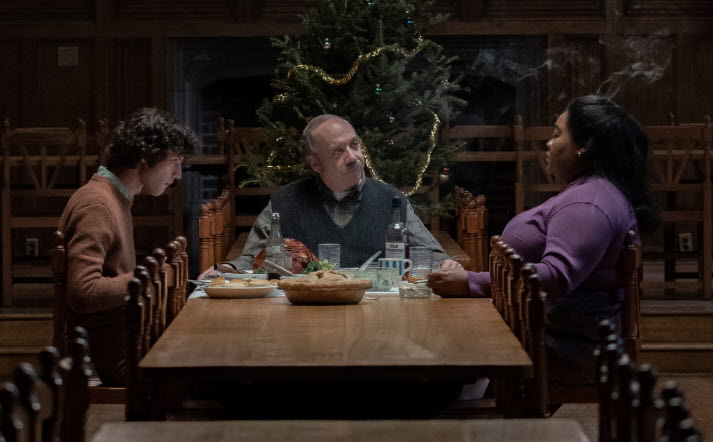
Alexnader Payne’s latest film “The Holdovers”, which will simply be released in South Korea as “Barton Academy”, is a dry but humorous character drama which will grow on you a lot for its excellent mood, performance, and storytelling. While it is often amusing as a sort of comic antithesis to Peter Weir’s “Dead Poets Society” (1989), the movie also shows some genuine care and affection toward its three different main characters who happen to be stuck together during one Christmas season, and it is funny and touching to observe how much they have changed around the end of the story.
As reflected by its deliberately old-fashioned movie studio logos, the story of the movie is set in 1970, and its main background is the Barton Academy, a prestigious private boarding school located in the New England region. The Christmas holiday season is coming with lots of snow, and many of its students and teachers are ready for enjoying the upcoming holiday week, but that is not much of a concern to Paul Hunham (Paul Giamatti), a strict and sardonic curmudgeon who has taught history at the school for many years. He is not so generous to many of his students just because they simply fail to reach to his high standard, and he does not step back at all even when the principal, who was incidentally one of his pupils in the past, chides him for giving a very low grade to the son of some prominent politician.
When he is later forced to supervise a few students who will remain in the school during the holiday season, Hunham does not give a damn about that at all. After all, just like most of those students to be chaperoned by him, he has nowhere else to go, and, above all, the Barton Academy has virtually been his whole world since he began to teach there. We observe how lonely and isolated he is in his little residence, but he does not care much about that as long as he works or reads books.
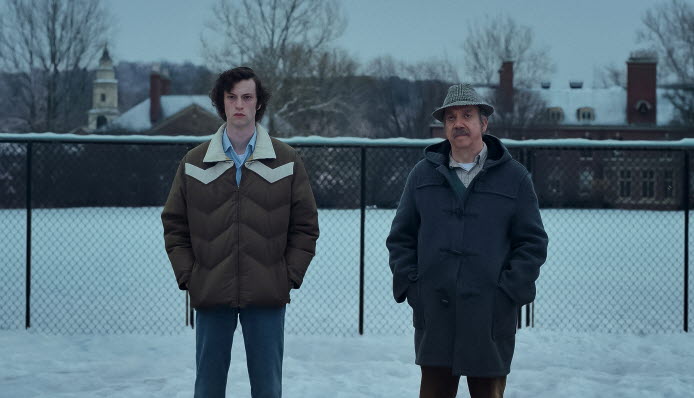
One of those few students to be supervised by Hunham is Angus Tully (Dominic Sessa), who comes to dislike Hunham more as Hunham punishes him and his fellow classmates for his insolent attitude. Tully was actually supposed to spend the holiday outside US along with his newly married mother and her second husband, but, alas, his mother changes the plan at the last minute, and he surely feels quite miserable while being stuck with a few other students under Hunham’s supervision inside the infirmary building of the school.
And then things get all the worse for Tully. A few days later, there comes a good chance for him and other students to leave for some ski resort thanks to the father of one of the students, but, sadly, Tully cannot leave as he cannot contact his parents, who are too busy with enjoying themselves outside US. As a result, he comes to spend more time with Hunham, and he certainly feels more frustrated and exasperated to be with his least favorite teacher.
It goes without saying that these two contrasting main characters slowly gets closer to each other along the story, but the screenplay by David Hemingon takes time for more character development. As we get to know more about both Hunham and Tully, we come to sense how much they have been victimized by their unfair system of class and privilege in each own way, which is the main reason why they come to form an unlikely bond between them. While Tully is actually a very smart kid who is often angry, troubled, and frustrated just like the adolescent hero of J.D. Salinger’s classic novel “The Catcher in the Rye”, Hunham turns out to have a fair share of bitterness and disillusionment behind his rigid and stubborn attitude, and he comes to see a lot of himself from Tully despite many differences between them.

Meanwhile, they also become more aware of the social turmoil of the outside world via Mary Lamb (Da’Vine Joy Randolph), a black woman who has worked as the head cook in the school. She lived and worked for her only son who eventually studied in the Barton Academy thanks to her efforts, but, alas, her son later got drafted to the US Army and then died in the ongoing Vietnam War. As they come to hang around with her later in the story, Tully and Hunham see more of her immense grief behind her seemingly unflappable attitude, and there is a brief but heartbreaking moment where she cannot help but become quite emotional about her son’s death.
The emotional journeys of these three main characters are handled with a somber but sharp sense of humor and thoughtful sensitivity under Payne’s steady direction, and he also draws wonderful performances from his three main cast members. Paul Giamatti, who collaborated with Payne in “Sideways” (2004) many years ago, reminds us again that he is always good at embodying the aching human flaws of his characters just like late Philip Seymour Hoffman, and he did a skillful job of conveying to us Hunham’s softer sides while never compromising his edgier aspects at all. On the opposite, newcomer Dominic Sessa is an effective acting match for Giamatti during their several key scenes, and Da’Vine Joy Randolph, whom I still fondly remember for her scene-stealing supporting turn in Craig Brewer’s overlooked Netflix movie “Dolemite Is My Name” (2019), is simply terrific as bringing a considerable amount of humor and pathos to what could be a pretty thankless role.
On the whole, “The Holdovers” is highly recommendable for many good reasons including the authentic period atmosphere evoking a number of notable American films of the 1970s such as Hal Ashby’s “The Last Detail” (1973), and it is surely much better than Payne’s utterly disappointing previous film “Downsizing” (2017). In short, this is one of major delights around the end of this year besides being one of better works from Payne, and I am certainly glad to report to you that he is back in element now.


 Seongyong's Private Place
Pingback: 10 movies of 2023 – and more: Part 1 | Seongyong's Private Place
Pingback: My Prediction on the 96th Academy Awards | Seongyong's Private Place