
French film “Anatomy of a Fall”, which won the Palme d’Or award at the Cannes Film Festival early in this year, is a compelling courtroom drama film which keeps us guessing for good reasons. Mainly revolving around one seemingly simple case which turns out to be much more complicated, the movie constantly and dexterously sways our assessment on the case in one way or another, and its riveting ambiguity will linger on your mind for a long time after it is over.
During the opening part unfolded on one winter day, we are introduced to a female German novelist named Sandra Voyter (Sandra Hüller). She has lived with her French husband Samuel (Samuel Maleski) and their visually impaired son Daniel (Milo Machado-Graner) for a while at a remote spot located in some rural mountainous area of France, and the movie subtly suggests some tension between her and her husband when her private interview by a young (and attractive) graduate student in their house is interrupted by his deliberate interference from the attic.
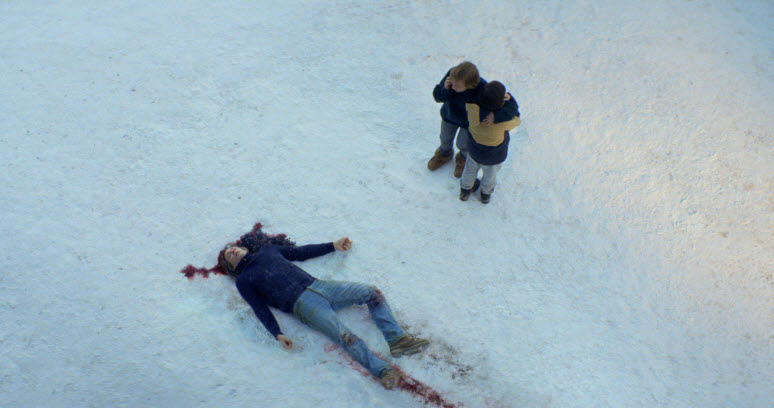
Not long after that young graduate student eventually leaves, Daniel also leaves the house along with his helper dog, so only Sandra and her husband are inside their house, and that is when something quite shocking occurs. Samuel is subsequently found dead on the snowy ground right in front of the house by Daniel shortly after his return to the house, and the local police soon embark on investigating this very unfortunate incident while Sandra looks as devastated as her son.
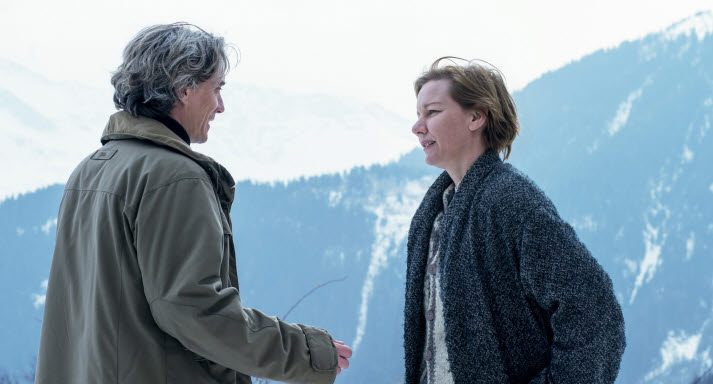
However, is she really as shocked as she seems on the surface? Yes, she called for the ambulance right after hearing her son’s shout and then finding her husband’s dead body, but the police and the investigative judge begin to suspect her due to understandable causes. For example, it looks like her husband just fell over the windowsill of the attic window while he was working in the attic, but there are a number of glaring discrepancies to notice, and, not so surprisingly, Sandra later finds herself becoming the focus of the investigation. She claims that she did not know anything before her discovery of her husband’s body because she worked for a while and then slept around the time of the incident, but there is no definite proof to support her testimony from the beginning.
Daniel’s lawyer Vincent Renzi (Swann Arlaud) is ready to do his best as an old friend of her, but things get more complicated as more things about the incident as well as Sandra and her husband are revealed via the ongoing investigation. While her son’s testimony on whatever was exchanged between her and her husband right before the incident turns out to be not that reliable, there is also a certain undeniable piece of evidence which clearly shows how much her relationship with Samuel was deteriorated around the time of the incident, and that makes Sandra all the more suspicious than before.
Eventually, Sandra is charged for causing her husband’s death, and the screenplay by director Justin Triet and her co-writer/partner Arthur Harari, who previously worked together in “Sybil” (2019), doles out one intense moment after another as Sandra’s lawyer and his fellow lawyer frequently clash with the prosecutor over a series of evidences and testimonies. Yes, many of them show that the death of Sandra’s husband was probably not accidental at all, but there is also a reasonable doubt on whether Sandra was really responsible for this incident. Is she really a cold, selfish, and manipulative woman who did not love her husband much as suggested by the prosecutor? Or, is she simply a conflicted woman who did try her best for handling her increasingly difficult relationship with her husband?

The movie steadily maintains the accumulating ambiguity surrounding the incident, even when it shows us more of what happened between Sandra and her husband while everyone in the court listens to a certain recording presented as one of the prime evidences presented by the prosecution. Under Triet’s skillful direction, Sandra Hüller and Samuel Theis subtly handle this key scene while also vividly conveying to us the emotional intensity generated between their characters, and Hüller, who has been more prominent thanks to her breakout performance in Maren Ade’s “Toni Erdmann” (2016), is fabulous as deftly illustrating her character without never making us sure about her character’s possible culpability.
Around Hüller, several supporting performers have each moment to shine. Swann Arlaud and Antoine Reinartz, who plays the prosecutor, are superlative as their respective characters frequently argue against each other throughout the trial, and young performer Milo Machado-Graner is exceptional as holding his own place well as Sandra’s gradually conflicted son. Although he was initially sure about his mother’s innocence, Daniel cannot help but have doubts on his mother as getting to know more about the incident at the trial, and his consequent conflict is quite palpable to us even when he later makes a crucial decision which will ultimately affect the outcome of the trial.
On the whole, “Anatomy of a Fall”, whose title is apparently derived from Otto Preminger’s classic courtroom drama “Anatomy of a Murder” (1959), is a superb work which deserves to be praised and admired for its excellent storytelling and top-notch performance. Despite its rather long running time (152 minutes), the movie never feels tedious as firmly holding our attention from the beginning to the end, and it is certainly one of the most impressive films of this year.


 Seongyong's Private Place
Pingback: 10 movies of 2023 – and more: Part 2 | Seongyong's Private Place
Pingback: My Prediction on the 96th Academy Awards | Seongyong's Private Place