

“The Hunger Games: The Ballad of Songbirds and Snakes” is totally unnecessary but fairly watchable at least. As a redundant prequel to The Hunger Games trilogy in the early 2010s, it will not give you much substance in terms of story and characters, but it is engaging to some degree at least because of the game efforts from its main cast members. The overall result is not good enough for recommendation, but I will not deny that I was amused by some nice moments in the film.
The story, which is adapted from the novel of the same name by Suzanne Collins by Michael Lesslie and Michael Arndt, is mainly about how President Coriolanus Snow, who was memorably played by Donald Sutherland in the Hunger Games trilogy, came to rise during his early years. As summarized during the opening part of the film, young Snow, played by Tom Blyth, has struggled a lot to maintain his and his family’s high-class appearance in front of others since his family went downhill due to his father’s death 13 years ago. Now he is eyeing a certain prestigious prize at a private academy in the capital city of Panem because that may bring back him and his family back in wealth, and it seems that he has a pretty good chance even though he is not highly regarded by the dean of the academy, who is incidentally played by ever-reliable Peter Dinklage.
However, Snow is belatedly informed by his best friend Sejanus Plinth (Josh Andrés Rivera) that things are changed at the last minute. They and other 22 selected candidate students are respectively tasked with “mentoring” those tributes sent from the 12 different districts surrounding the capital city for “The Hunger Games”, and the mentor of the winner will probably get that prize in the end.

If you are not so familiar with the Hunger Games trilogy, let me explain a bit on the story background. After the central government of the capital city won over those 12 districts after a long and terrible civil war, it demanded each district to send one young man and one young woman every year for the survival game to be held in the capital city, and now this survival game, named the Hunger Games, has been continued during last 10 years since that.
To the disdain of the power that be in the capital city, the Hunger Games, which has always been packaged into a twisted TV reality show to be consumed by the people of the Panem, has a serious rating problem during last several years, and that is why Dr. Volumnia Gaul (Viola Davis), who has been the head gamemaker, comes forward. Along with the host of the Hunger Games, Dr. Gaul is quite determined to bring any kind of interest and excitement into the Hunger Games by any means necessary, and she certainly has some truly diabolical stuffs in her secret laboratory.
Meanwhile, Snow finds himself tasked with Lucy Gray Baird (Rachel Zegler), a young woman sent from District 12 as one of its two tributes. Although she is not particularly combative or resourceful compared to the heroine of the Hunger Games trilogy, Baird, who turns out to be a very good entertainer, surely knows how to draw and hold the attention of others as shown from her very first scene in the film, and Snow instantly sees that she can actually be a beneficial wild card for him.
What follows next is how he comes to form a rather strained alliance with Baird, who also quickly comes to discern that Snow can be a good chance for his survival. As they interact more with each other along the story, Snow finds himself more emotionally involved in their increasingly risky circumstance, and that is when he begins to show how sneaky and manipulative he can be even for a good-willed goal.
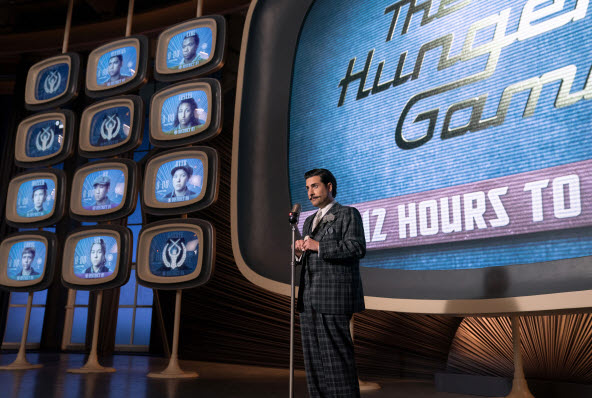
Compared to the Hunger Games trilogy, the movie deliberately looks more old-fashioned in many aspects for being set in several decades ago, so we do not get much fun and excitement as the tributes are simply sent into a big arena building. At least, director Francis Lawrence, who previously handled most of the Hunger Games trilogy, and his crew members have some fun with filling the screen with Orwellian mood and details, and it certainly helps that Blyth and his co-star have enough presence and talent to hold our attention during its first two parts. Rachel Zegler, who was quite good in Steven Spielberg’s 2021 remake of “West Side Story” (1961), shines whenever her character shows off her considerable musical talent along the story, and Blyth complements her well without overshadowing her at all.
However, just like many supporting figures in the Hunger Games trilogy, several supporting cast members of the movie often provide juicier moments to be savored. While Dinklage brings some bitter remorse to his rather thankless character, Jason Schwartzman, who gives another good supporting performance after steadily delighting us in “Spider-Man: Across the Spider-Verse” (2023), “Asteroid City” (2023), and “Quiz Lady” (2023) throughout this year, enjoys his every flamboyant minute in the film, and Viola Davis magnificently chews her several big moments for demonstrating that she can easily eat Tyler Perry’s Medea for breakfast within a minute. In case of newcomer Josh Andrés Rivera, he only functions as a few bright spots in the story, but you may be amused a bit if you remember him playing a small but crucial supporting character in that Spielberg version of “West Side Story”.
On the whole, “The Hunger Games: The Ballard of Songbird and Snakes” is not a total waste of time at all, but it sometimes feels like the rushed summarization of several TV drama episodes. Its final part is particularly lackluster compared to the first two parts as slouching toward its expected ending, and you may find yourself becoming less interested in whatever may come next. I think we already spent enough time in Panem even long before this movie came, and, folks, I am almost ready to move on.


 Seongyong's Private Place