

South Korean documentary film “Promise” is a seemingly simple but undeniably poignant personal diary from a filmmaker father and his sensitive 9-year-old boy still missing his departed mother a lot. While wisely avoiding any cheap sentimentalism via its calm and restrained attitude, the documentary gradually reveals their quiet sadness and longing along its narrative, and the result often shines with sublime poetic beauty to be appreciated.
Since he lost his wife a few years ago, director/writer Min Byeong-hoon, who has been known for several acclaimed works such as “Pruning the Grapevine” (2006) and “Touch” (2012), has taken care of his little son Si-woo alone in their little residence located in Jeju Island, and the early part of the documentary shows us his mundane daily life with his son. As his father’s camera steadily follows after him, Si-woo looks as spirited as any kid around his age can, and you may smile as watching him cheerfully walking along the road to his elementary school.
However, as reflected by the opening part of the documentary, both Min and his little son have been haunted by the memories of his departed wife since her death. Si-woo sometimes cannot help but miss his departed mother at night, and his father tries his best for consoling his son, with the camera calmly and respectfully observing them from the distance. Although Min also surely misses his departed wife a lot, he knows too well that he must be someone to lean on for his son, so he usually keeps his feelings to himself as much as possible.
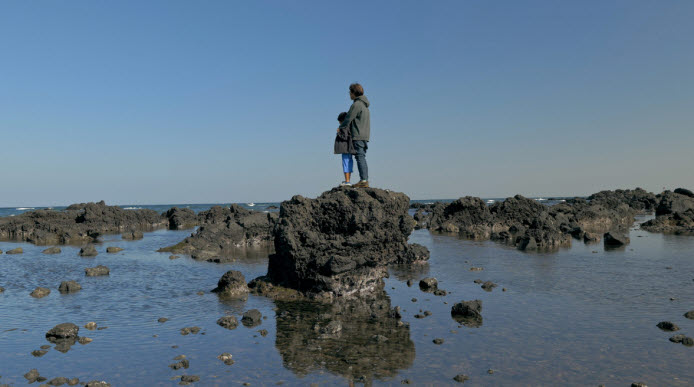
As the documentary often watches Min from the behind, we can only guess how much he has grieved. He sometimes works alone with his digital video camera in the middle of those wide landscapes of Jeju Island, and the somberly detached mood of these impressive shots convey to us a lot about whatever he has felt inside his grieving mind, even though neither he nor the documentary does not reveal much on the surface.
Meanwhile, Si-woo happened to write a little poem to express the longing for his departed mother, and that gives Min a little helpful idea for his son. As telling his son that his mother promised to meet her son in the heaven someday, Min suggests that Si-woo should write more poems as a sort of prayer to his mother and God, and Si-woo soon begins to write a number of poems one by one for expressing and processing more of his current feelings.
As Si-woo doles out one poem after another, we come to know and understand more of his emotional state – and how he gets more emotionally matured day by day. He is still sad whenever he thinks of his departed mother, but he also gets more accustomed to her absence, and he and his father become closer to each other as he gladly shares his poems with his father.
Min humbly allows his son’s poems to take the emotional center of the documentary, and many of these poems are accompanied with a number of stunning landscape shots to remember. Instead of merely functioning as visual backgrounds, these wonderful shots actually elevate Si-woo’s plain but sincere poems with more poignancy, and I particularly like one brief but impressive moment showing a vast field suddenly becoming quite snowy via a smooth transition of time.

Above all, we can also sense how Min and his son go through each own healing process via the passage of time. As they go through one season after another, their daily life becomes less melancholic, and there is a touchingly humorous moment from when they play a little card game together in one evening. When his birthday comes, we cannot help but notice that Si-woo looks more matured than before, and we all can agree that his departed mother would be proud of him if she were really watching from somewhere above our world.
Later in the documentary, Min takes his son to where his departed wife was buried. Their little but moving private moment is followed by a montage sequence mainly consisting of several different video clips played in backward, and this sequence beautifully summarizes Min and his son’s deep feelings toward his departed mother. Both Min and his son are well aware that they should move on no matter what, but they cannot help but miss their loved one nonetheless, and that is further emphasized by a certain little recorded moment from their past.
Overall, “Promise” is a solid personal piece of work which often shines with lots of thoughtful sensitivity, and many of its fabulous moments have grown up on me after I watched it in this afternoon. I must confess that my condition was not so good during the screening, but I did feel something special from the documentary despite that, and I guess I should revisit it sooner or later for more appreciation.
By the way, as shown from the documentary, Si-woo wrote more than 20 poems, and I came to learn later that Min actually published a collection of his son’s poems before the documentary was released in South Korean theaters a few days ago. To be frank with you, I am rather obtuse to poetry as an utterly straightforward guy who usually prefers prose more, but I guess I should check out that poem collection for feeling and understanding more of the emotional undercurrents of the documentary.


 Seongyong's Private Place