
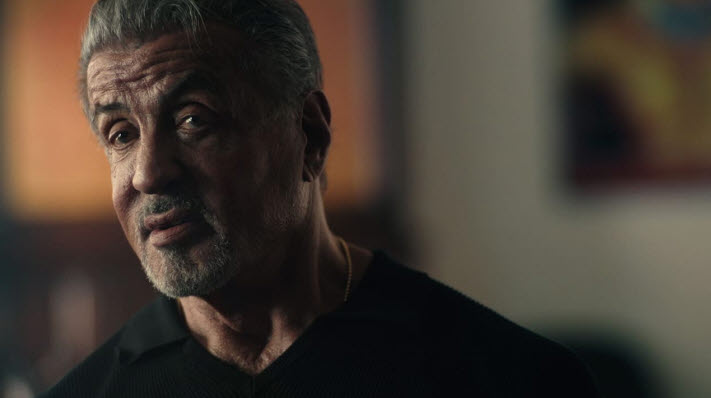
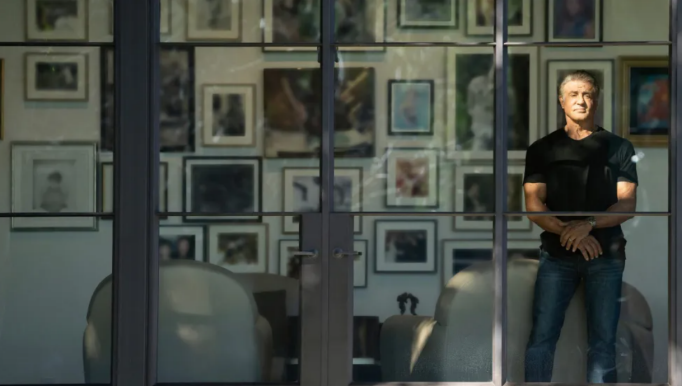
Netflix documentary film “Sly”, which is released on this Friday, sometimes shows a bunch of fancy stuffs inside Sylvester Stallone’s house, and that tells a lot about how it is about his life and career. While Stallone, who is often called “Sly”, is sincere and engaging as talking about many things in his life and career, the documentary merely follows his words without much of new insight or perspective, and we are only left with some admiration on how he has managed to endure during last several decades while always remembered for his two iconic movie characters.
Stallone’s life story is certainly remarkable to say the least. The early part of the documentary focuses on how much he struggled during his early years, and he tells us a bit about his unhappy childhood years under his deeply flawed parents. After several problematic years during his early adulthood period, he eventually got interested in acting thanks to an acting teacher, and he soon moved to New York City for building up his career, though, just like many other young performers coming to New York City, he had to go through a very difficult time which would test his will and resilience in one way or another.
Anyway, Stallone was hungry enough to play any role for supporting himself. While he was often discontent with being usually cast as a young thug as shown in Woody Allen’s “Bananas” (1971), he kept trying nonetheless as appearing here and there in a number of films (No, he does not mention anything about that certain softcore porn film made in 1970, which was incidentally his second feature film according to IMDB), and then there came a little breakthrough moment via Martin Davidson and Stephen Verona’s “The Lords of Flatbush” (1974). Again, he played a young hoodlum, but this movie made him more confident about his acting, and that prompted him to move to Hollywood for more opportunities to grabbed by him.
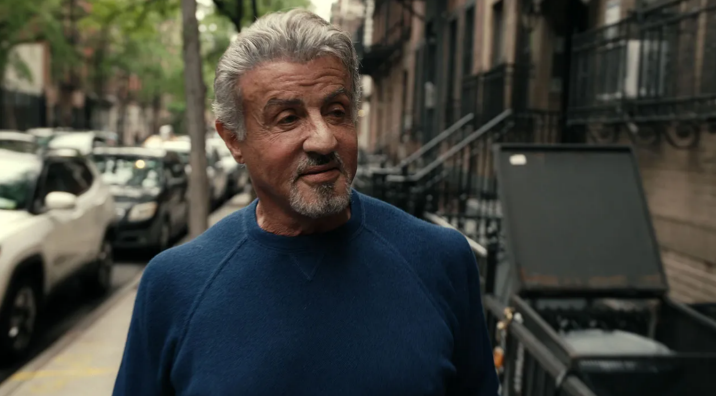
Of course, things did not go well for him in Hollywood at first as he could not get any good part to interest him, but he decided to write screenplays for himself, and that was how he came to write the screenplay for “Rocky” (1976). At first, his titular character was heavily influenced by those young hoodlum characters in Martin Scorsese’s “Mean Streets” (1973), but he gradually fleshed out his titular character here and there, and he was all the more determined to play this character of his once he completed the screenplay at last. As a matter of fact, he could get paid quite a lot for not playing his character, but he remained adamant to the end, and that was the first forward step to his eventual stardom.
When “Rocky” became one of the most successful films of 1976 while also garnering three Oscars including the one for Best Picture, Stallone’s status was virtually skyrocketed to the top, but then he came to face the pressure and expectation from his huge stardom. He had to prove himself that he was another exciting American actor after Robert De Niro and Al Pacino, but his subsequent films such as “F.I.S.T.” (1978) were not so successful, and that made him go for “Rocky II” (1979) and several following sequels during next 10 years.
Meanwhile, he also came to play another iconic movie character in “First Blood” (1982), which was also followed by several sequels just like “Rocky”. Thanks to “First Blood” and the two sequels during the 1980s, Stallone became a huge action movie star of that decade, and Arnold Schwarzenegger, who was his main competitor during that period, makes a few amusing comments on how Stallone often kept advancing ahead of him.
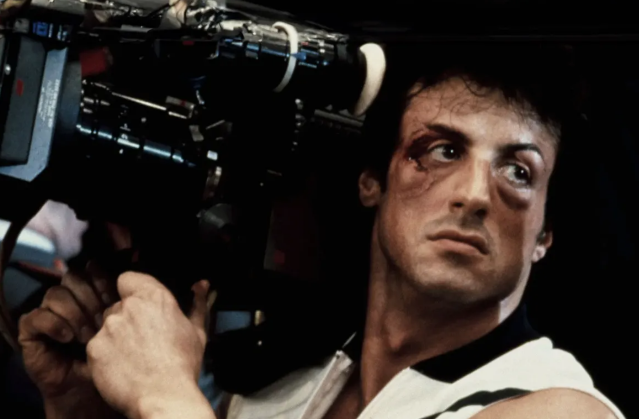
To my little disappointment, the documentary does not go that deep into some of Stallone’s worst films during the 1980-90s. While we only get a brief glimpse on some promotional stuffs associated with “Rhinestone” (1984) and “Cobra” (1986), Stallone only shows some regret on his few attempts on comedy including “Stop! Or My Mom Will Shoot” (1992). He agreed to appear in that disastrous flop just because Schwarzenegger pretended to be interested at that time, and Schwarzenegger surely got the last laugh for that.
In the end, Stallone returned to his usual territory as shown from “Cliffhanger” (1993) and “Daylight” (1996) while also trying to demonstrate more of his acting talent in James Mangold’s “Cop Land” (1997), but he found himself less popular than before as entering the 21st century. Nevertheless, he did not give up at all as making “Rocky Balboa” (2006) and “Rambo” (2008), and then he moved onto “The Expendables” (2010), which led to another hit series of his after Rocky and Rambo (He does not talk anything about how forgettable the series has become these days, by the way).
On the whole, “Sly”, directed by Tom Zimny, only shows and tells as much as we know about him, and I think it could delve deeper into Stallone’s life and career. For example, the documentary could show more about his troubled relationship with his father, which was resolved to some degree when his father was about to die. In addition, I wish he could talk a bit about playing Rocky again in Ryan Coogler’s “Creed” (2015) and the following 2018 sequel, which were surely another peak in his acting career (He even received an Oscar nomination for the former, as many of you remember). At least, Stallone can still hold our attention as before, and I think he will go on as usual while ready for whatever will come during the rest of his ongoing life and career.


 Seongyong's Private Place