
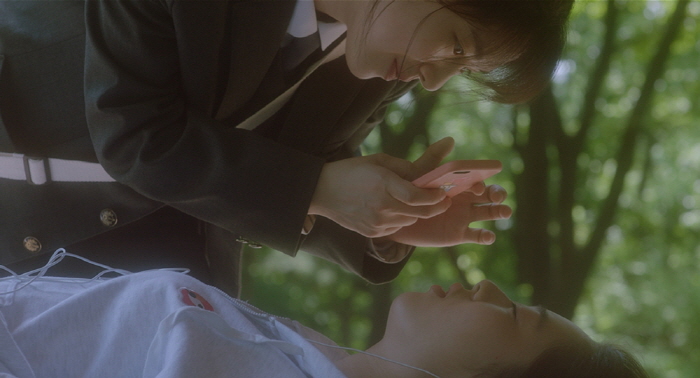
The emotional power of South Korean film “The Dream Songs” mainly depends on how much you know about a certain disastrous incident which shook the whole South Korean society on April 16th, 2014. I think the story itself will still come to you as a touchingly intimate coming-of-age tale even if you do not know that much, but, considering its understandable restraint on what it is really about, you should do some homework in advance for feeling and understanding more of how many South Korean audiences will respond to the movie.
The story mainly revolves around the relationship between two high school girls named Se-mi (Park Hye-soo) and Ha-eun (Kim Si-eun), and the movie opens with Se-mi waking up from a brief sleep she had in the middle of her another school day. While not exactly remembering the details of her dream, Se-mi cannot help but worry about Ha-eun as her best friend, and she decides to leave the school earlier for seeing Ha-eun, who happens to be staying at a local hospital for a minor physical injury of hers.
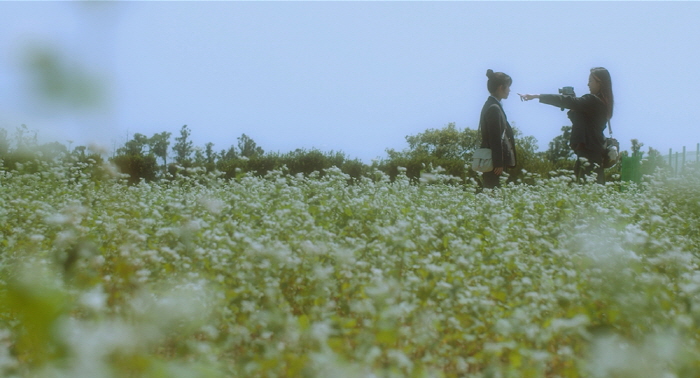
When Se-mi comes to see Ha-eun at the local hospital, Ha-eun is rather discontent for an understandable reason. Many of her schoolmates will have an excursion trip to Jeju Island on the very next day, but she cannot go due to not only her current physical injury but also not having enough money for the excursion trip. Nevertheless, Se-mi really wants Ha-eun to join her and others, so they decide to get the money via selling a used camcorder belonging to Ha-eun’s father.
As they try to sell this camcorder, the movie leisurely move along with them for a while, but we seldom get bored because the screenplay by director Cho Hyun-chul, who was mainly known for his acting career before making a feature film debut here, and his co-writer Jung Mi-young provides a series of authentic dialogues to be appreciated. As far as I can see, Se-mi and Ha-eun really talk like many ordinary South Korean high school girls in real life and, not so surprisingly, Cho actually observed a lot of how high school girls talk as working at a private academy for a while.

The mood between Se-mi and Ha-eun are casual and playful at first, but we gradually sense a certain degree of strain beneath their interactions. It becomes more apparent to us that Se-mi wants to be more than Ha-eun’s best friend, but she does not know how to reveal her growing romantic feelings to Ha-eun, and she only finds herself more agitated by whatever Ha-eun has not told her yet. It seems that Ha-eun has been involved with some older lad, and Se-mi cannot help but become more jealous when she notices a nickname written on one page of Ha-eun’s little notebook. Is it possible that this nickname is for someone with whom Ha-eun has been currently involved?
Things become a little more serious when Se-mi and Ha-eun eventually argue a lot with each other for rather petty matters, and then Ha-eun is gone missing for no apparent reason. Se-mi and several other friends of theirs subsequently search for any clue to Ha-eun’s whereabouts, and Se-mi becomes more suspicious when it looks like Ha-eun has been really hiding something from Se-mi.
The movie does not hurry itself as taking more time in character development, and we get to know and feel more of Se-mi’s romantic feelings toward Ha-eun along the story. At one point in the middle of the story, she lets out some of her personal feelings when she and two friends drop by a karaoke booth, and her deeply emotional singing is soon accompanied with a little poignant fantasy moment projected on the monitor of the karaoke machine.
In the meantime, Se-mi also comes to have some emotional maturation as coming to learn more about not only Ha-eun but also herself. As one of her friends sharply points out later in the film, she can be quite self-absorbed at times, and she belatedly come to realize that her friends including Ha-eun have each own issue to deal with just like her.

As depicting the story and characters as realistically as possible, the movie sometimes catches us off guard via the sudden insertions of unexpected story elements. There is a recurring image of a clock showing the same time, and then there is a seemingly coincidental subplot involved with a missing dog, which comes to resonate a lot with Ha-eun’s dead pet dog as well as a little parrot belonging to Se-mi.
Most of all, the movie never loses its focus on the relationship between Se-mi and Ha-eun, and the eventual climax of their drama is quite moving with lots of emotional intensity. Even at this narrative point, the movie wisely restrains itself despite shedding some tears as required, and I particularly appreciate how it deftly lays out a subtle mournful undertone in the background during one key scene between Se-mi and Ha-eun around the end of the story.
As the center of the story, Park Hye-soo and Kim Si-eun surely give two of the best South Korean movie performances of this year. Right from the beginning, they effortlessly click with each other as movingly illustrating their characters’ emotional bond, and I enjoy how their unadorned natural acting is flawlessly mixed along with several other female performers who play Se-mi and Ha-eun’s schoolmates in the film. Although he appears in only one scene, Park Jeong-min, who has steadily advanced since his breakout supporting turn in “Bleak Night” (2010), ably steals the scene as he recently did in “Dr. Cheon and Lost Talisman” (2023), and Park Won-sang briefly appears as Se-mi’s father.
In conclusion, “The Dream Songs” may feel a bit opaque to you if you are not very familiar with the main subject hidden under the surface, but it is still a very good adolescent drama to be admire for the sensitive and thoughtful handling of its story and characters. In short, this is one of the best South Korean films of this year, and I sincerely urge you to check it out when you get a chance to watch it.
Sidenote: If you are not familiar with that real-life incident, please check out this Oscar-nominated South Korean documentary.


 Seongyong's Private Place
Pingback: 10 movies of 2023 – and more: Part 3 | Seongyong's Private Place