

There was a time when Jean-Luc Godard films were pretty cool. He became one of the prominent members of the French New Wave during the 1960s thanks to his first two feature films “Breathless” and “Vivre sa vie” (1962), and he made a series of interesting films after these two immortal masterpieces during next 10 years, but then his subsequent works began to look quite opaque and pretentious in my inconsequential opinion. To be frank with you, many works of his later career years did not click me that well, and my growing disillusionment with him has grown more during last two decades after I was quite annoyed and frustrated with “In Praise of Love” (2001) and “Notre musique” (2004).
While he seemed to hit the bottom in case of “Film Socialisme” (2010), Godard was embraced by many reviewers and critics when he came back with “Goodbye to Language”, which won the Jury Prize along with Xavier Dolan’s “Mommy” (2014) when it was premiered at the 2014 Cannes Film Festival. It looked like he tried some interesting stuffs including 3D effects, but, alas, the movie itself is not different from many of his baffling previous works, and I remained distant and dissatisfied throughout its rather shorting running time (69 minutes) when I finally watched it today.
As many of you know, it is pretty futile to explain whatever Godard attempted here, because he constantly makes his audiences baffled and disoriented via many different bits of images and sounds. Many scenes shot by his co-editor Fabrice Argano are often accompanied with deliberate aural/visual manipulations, and that is the main reason why we become more distant to what seems to be the main narrative line of the film. While it sometimes focuses on a young woman and her romantic relationship with some guy, we never get to know them much because, as you already expected, their lines mostly consisting of Godard’s philosophical/political babblings which do not look like going anywhere in my trivial opinion. Oh, Godard surely has lots of various stuffs to say here and there throughout the film, but many of his statements do not mix well together much without any sense of coherence we can hold onto.
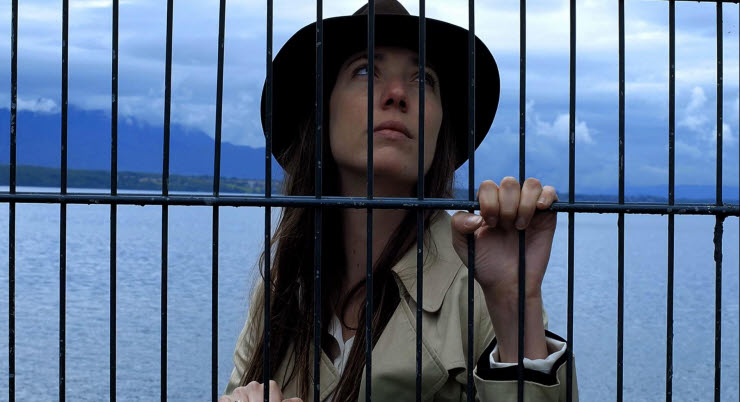
Probably that is probably how the world seemed to be more chaotic and incomprehensible to him during the last years of his life, which was incidentally ended when he died in last year. Yes, he surely looked like a cool filmmaker/intellectual during his prime period, but then he became far less cool than before, and his later films may be the artistic reflection of his cranky intellectual mind trying to make any sense of how the world was drifted away from his grasp day by day.
And that is probably why the recurring image of the movie is a big ship ready to depart and sail away to somewhere. The camera simply observes the ship from the distance, and we are again flabbergasted as wondering what exactly Godard intends here, but this recurring image of the film feels a bit more melancholic as I reflect more on what exactly I watched from the film. Did Godard come to feel that he finally had to get off from a ship called life?
In case of the 3D effects in the movie, as far as I could observe from the 2D version, they look less fancy after the end of another peak period of 3D effect in the history of cinema, but we can see that Godard has a little naughty fun with what he can do with 3D effect for realizing his artistic vision. The frequently superimposed intertitles of the film are surely intended for 3D, and there are a number of amusing visual moments which may look more interesting if you watch the 3D version.

I forgot to tell you that there is the other memorable thing in the film, and that is none other than Godard’s pet dog Roxy, which deservedly received the Prix Special Palm Dog Award at the Cannes Film Festival. As a matter of fact, my interest was more increased whenever the camera focused on Roxy, and now I wonder whether the movie was actually intended as a sincere love letter to this likable dog. While it still makes one hollow statement after another even during Roxy’s scenes, I sensed a bit of Godard’s affection toward his dog, and that made me less grouchy about the film for a while in fact.
On the whole, “Goodbye to Language” is not a totally boring experience, but it still feels like merely existing as a homework for many cinephiles out there. Yes, the movie has been analyzed and interpreted a lot since it came out, and I understand why it has excited and fascinated many of critics and reviewers during last several years, but I am still not so impressed while only coldly admiring how Godard tried to go his own way till his last film “The Image Book” (2018). Several years ago, I heard from a close friend of mind that the movie did not generate much excitement among the audiences when it happened to be shown at the beginning of the 2015 Ebertfest, and now I really want to tell them that they are not alone at all.
Anyway, “Goodbye to Language” is worthwhile to watch to some degree if you are a serious cinephile like me, and you may come to see more than I did. While he was one of the greatest filmmakers in the movie history, I bet that he will be remembered more for “Breathless” and his early films instead of those supposedly cerebral cinematic doodlings in his later years, and I am already considering revisiting these early films of his sooner or later.


 Seongyong's Private Place