

Hayao Miyazaki’s much-anticipated comeback animation film “The Boy and the Heron” feels more like an exercise than an entertainment. It is surely filled with lots of Miyazaki’s personal style and touches to admire, and there are certainly a number of powerful visual moments to linger on your mind. However, is it actually as awesome and glorious as we have wished since the announcement of his comeback? Folks, I must confess that my mind was not exactly enthralled during my viewing even while my eyes observed its visual beauty with lots of respect and admiration.
Like his previous animation film “The Wind Rises” (2013), which was incidentally supposed to be his final work at that time, “The Boy and the Heron” is connected with the World War II, and, in contrast to the rather mushy attitude of “The Wind Rises”, it really seems to try to face the reality of the wartime during the opening part. Not long after we are introduced to its young hero Mahito (voiced by Soma Santoki), the film strikes us hard with an air raid scene which may remind you of the similar scenes in Isao Takahata’s great animation film “Graves of the Fireflies” (1988), and we can really sense here how much Mahito is devastated as facing his mother’s unfortunate death.
One year later, Mahito and his father move to a rural area which is also his mother’s hometown. His father is going to manage an arms factory there, and he also recently married his dead wife’s sister Natsuko (voiced by Yoshino Kimura). Natsuko’s close physical resemblance to Mahito’s mother understandably makes Mahito rather uncomfortable right from when she greets Mahito and his father at a local train station, and Mahito is not so pleased to learn that Natsuko is soon going to give birth to another child of his father.
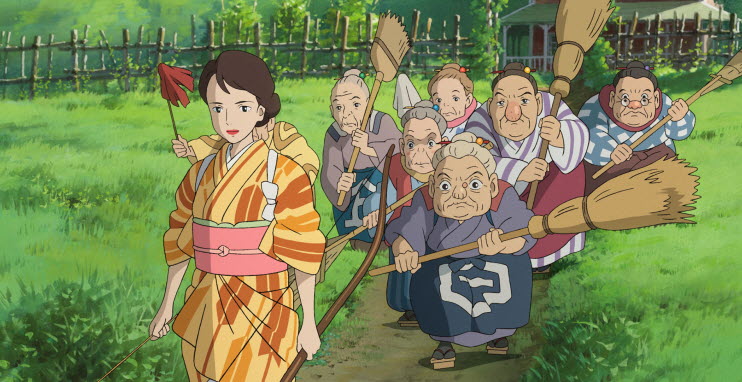
Anyway, Natsuko tries to do as much as she can as Mahito’s aunt/stepmother. She takes him to a big family manor mainly consisting of an older traditional house and a western house built right behind it, and Mahito gets a room in the latter which once belonged to his mother. In addition, the employees of the manor including seven old (and very wrinkled) maids of the manor, who are somehow reminiscent of those seven dwarfs in “Snow White and the Seven Dwarfs” (1937), are mostly welcoming to Mahito, and it looks like he will eventually get accustomed to this new environment of his.
However, Mahito is still haunted by the memories of his mother’s death, and then he begins to hear and see strange things around the manor. There is a mysterious abandoned spot involved with one prominent ancestor in the family, and the old maids are willing to tell Mahito more about how strange and weird this spot really is. In addition, there is also a big heron which can somehow speak to Mahito, and this heron often taunts him with the possibility of meeting his dead mother somewhere beyond the world.
When Natsuko is suddenly gone missing later, things get more interesting for us. Along with one of the old maids, who can be called “Grumpy” in my humble opinion, Mahito looks for Natsuko, and then they come upon that mysterious spot which turns out to be the portal toward a hidden fantasy world. Shortly after confronting that heron, Mahito and the old maid are suddenly sucked into this fantasy world, and then Mahito finds himself alone and lost without anyone to help him.
Fortunately, there soon comes a young feisty woman for his rescue, and Mahito gets to know this strange fantasy world a bit while getting some help from this young lady. At one point, you may wince a lot as watching them trying to gut a big grotesque fish they caught from the sea, and then you will be delighted as a bunch of small white globular entities floating one by one to the sky, which may remind you of that little enchanting moment of numerous tiny forest creatures in “Princess Mononoke” (1997).

Because of its leisurely narrative pacing and rather thin characterization, you may wish the film developed and pushed the story and characters more, but Miyazaki seems to be simply enjoying himself without much concern or pressure, and he demonstrates here that he has not lost any of his skill and talent yet. As before, I often marvel at all the painstaking details accompanying his distinctive cell animation style, and I was also quite tickled by his wry black humor associated with those big talking parrots appearing later in the story.
However, the film somehow did not click with me well in terms of story and characters. While Mahito merely functions as a blank canvass for more colorful figures in the story, many of the main characters in the story are no more than archetypes without much human personality or depth, and that is the main reason why its eventual climactic party is not as emotionally resonating as Miyazaki intends. In addition, the historical background of the story is regrettably pushed aside as Miyazaki focuses more on fantasy and other metaphysical stuffs in the story, and now I begin to wonder whether Miyazaki is an artist too mild and gentle to handle the grim reality of the World War II in contrast to Takahata, who did not pull any punch at all in “Grave of the Fireflies”.
To my little dissatisfaction, “The Boy and the Heron”, which is released as “How Do You Live?” in Japan and South Korea, is another minor footnote after “The Wind Rises”, but I still recommend it for the undeniable artistry in its top-notch visual qualities. As many of you know, Miyazaki is already working on his next project, and I sincerely hope that he will entertain me more in the next time.


 Seongyong's Private Place
Pingback: 10 movies of 2023 – and more: Part 2 | Seongyong's Private Place
Pingback: My Prediction on the 96th Academy Awards | Seongyong's Private Place