

Good human drama films can not only interest but also energize me sometimes, and Celine Song’s remarkable debut feature film “Past Lives” is one of such fantastic examples. When I watched it, I was not so sure about whether I could watch one more film due to some physical exhaustion at that time, but, what do you know, I soon found myself thoroughly captivated by its exquisite handling of story, mood, and characters, and I was quite touched as observing how effortlessly and powerfully it pulls out a sublime finale to remember in the end.
After the opening part which introduces its three main characters, the movie goes back to 24 years ago. Na Young (Seung Ah Moon) and Hae Sung (Seung Min Yim) were two elementary school kids living in Seoul, South Korea, and their first scene succinctly establishes how much they have been close to each other. Although they often fiercely compete with each other in school examinations, Hae Sung wants to be more than a classmate to Na Young, and it looks like the feelings are mutual between him and Na Young as they are returning together after another day at their school.
However, as subtly reflected by the last shot of this little sweet moment, they are soon going to be separated from each other. Na Young’s parents decides to immigrate to Canada probably for making a new start for them as well as their kids, and Na Young does not like this change much as her feelings toward Hae Sugn gradually grow. At least, her mother understands this well, so she lets her daughter spend some time with Hae Sung before eventually leaving South Korea with her family.
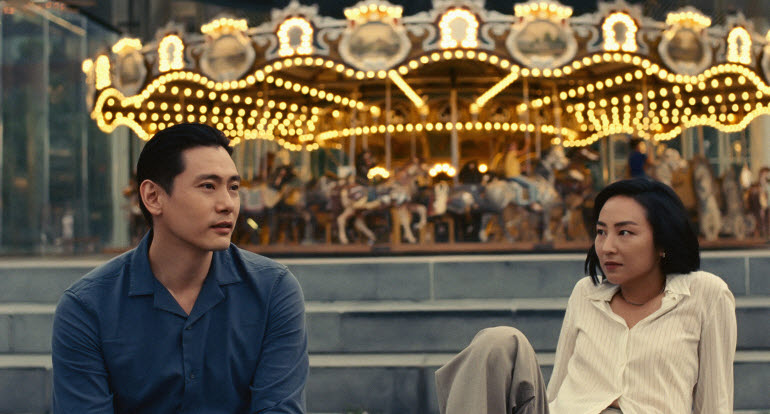
That seems to be the end of a little romance between Na Young and Hae Sung, but they have an accidental encounter between them 12 years later thanks to Facebook. Now Na Young becomes Nora (Greta Lee), and she has been aspiring to become a playwright in New York City. In case of Hae Sung, now played by Teo Yoo from this point, he has been studying at a college in Seoul for becoming an engineer someday, and he is certainly delighted when his online search for his old childhood sweetheart is unexpectedly succeeded.
For a while, Nora and Hae Sung frequently talk with each other via online communication services, but, not so surprisingly, their rekindled feelings are gradually burdened by the distance between them. While Nora is more occupied with her future playwriting career, Hae Sung also has to pay more attention to his study and future professional career, and there eventually comes a point where they agree to have some period of separation.
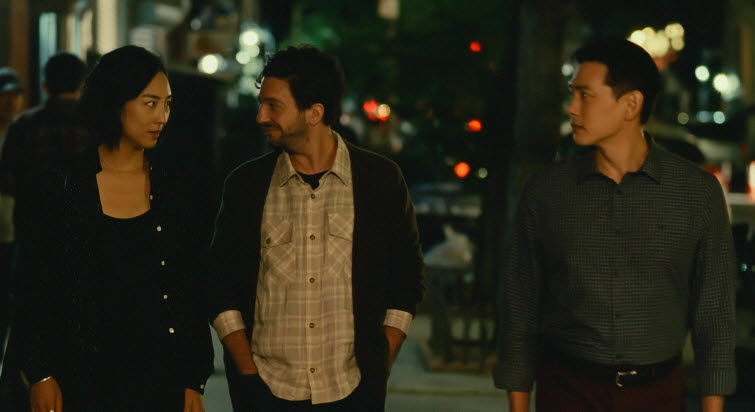
That seems to be the end of their second romance, but we see how much Nora and Hae Sung are connected with each other even 12 years later. Now Nora is happily married with a writer dude she met a rural retreat for writers, and it is clear that she and her husband have lots of genuine love and understanding between them, but she cannot help but excited when Hae Sung is going to come to New York City for meeting her again.
As Nora and Hae Sung meet and then speak with each other, Song’s screenplay makes a delicate balancing act between romance and nostalgia. Nora and Hae Sung become more aware of their old feelings as they enjoy more of each other’s company, but they also clearly recognize how things have changed between them during last 24 years. As Hae Sung phlegmatically points out later in the story, Nora is now quite different from a girl he used to know, though, as Nora points out in response, that girl remains as a shared memory between them.
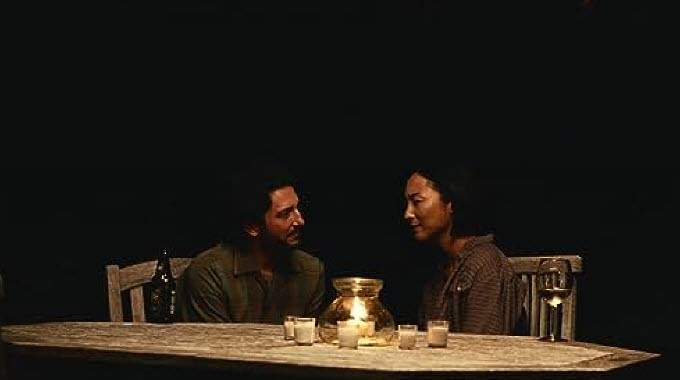
Nevertheless, they still feel attracted to each other as sensing more of their emotional connection, which may be associated with what Koreans often call “In-yun”. “In-yun” means a fateful connection in the past lives of two different people, and, as Nora casually explains to her soon-to-be husband at one point, it is just a common term often used by Korean guys trying to seduce girls, but she and Hae Sung cannot help but wonder about whether they are actually soulmates bound together via “In-yun” – and how things could have turned out differently if Nora and her family had not left South Korea.
Without making any attempt to push its two main characters into conventional romantic plot, the movie confidently saunters from one point to another along with them, and Song and her crew members including cinematographer Shabier Kirchner often tinge the screen with subdued but lasting visual beauty. I like how they vividly presents Seoul during the late 1990s with authentic mood and details to be noticed by South Korean audiences like me, and the result is good enough to be mistaken for being made by a South Korean filmmaker. In case of the New York City part of the film, it looks plain and unadorned on the surface, there are a number of wonderful poetic moments to be appreciated, and it surely demonstrates Song’s considerable filmmaking skill and talent.
Above all, Song’s two lead performers are absolutely terrific in their low-key natural performance. Greta Lee gracefully embodies her character’s complicated emotional journey without signifying too much on whatever is going behind her gentle appearance, and Teo Yoo, who recently made a brief appearance in Park Chan-wook’s “Decision to Leave” (2022), is believable as her equal match, though, as many of my South Korean acquaintances pointed out, Hae-sung is too good to be true at times considering thousands of deplorably misogynistic free-range male rudes out there in the South Korean society. As Nora’s decent husband, John Magaro dutifully hangs around the fringe of the story without drawing too much attention, and there is a brief but poignant moment when he silently conveys to us how his character is rather frustrated for a good reason even while sincerely respecting his wife’s longtime relationship with Hae Sung.
In conclusion, “Past Lives” is a superlative piece of work which turns out to be more emotionally complex behind its seemingly simple tale, and Song delivers a considerable breakthrough which may led to more good works to come from her during next several years. Folks, here is a truly exceptional human drama you should not miss at any chance, and it is certainly one of the best films of this year.


 Seongyong's Private Place
Pingback: 10 movies of 2023 – and more: Part 1 | Seongyong's Private Place
Pingback: My Prediction on the 96th Academy Awards | Seongyong's Private Place