

“Are You There God? It’s Me, Margaret.”, the adaptation of the iconic middle-grade novel of the same name by Judy Blume, has enough sincerity and sensitivity besides being a witty coming-of-age dramedy film to enjoy. While it may look relatively tame and modest compared to many of recent coming-of-age dramedy movies out there, the movie is still engaging for its deft and thoughtful handling of story and characters, and you may find yourself rooting more for its plucky young heroine more as she is more prepared to take her first step into adolescence around the end of the story.
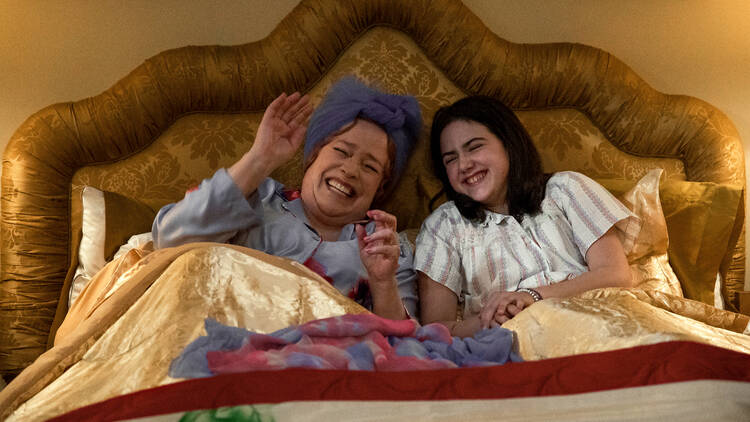
Mainly set in a suburban area of New Jersey during 1970, the movie tells the story of Margaret Simon (Abby Ryder Fortson), an 11-year-old girl who suddenly finds herself moving from New York City to New Jersey along with her parents Barbara (Rachel McAdams) and Herb (Benny Safdie) not long after coming back from a summer camp. Because she has been totally fine with living in New York City, Margaret is not so happy about this abrupt change, but she still can sometimes visit her jolly Jewish grandmother Sylvia (Kathy Bates, who has had no problem at all with becoming Shelley Winters of our time) in New York City at least.
Anyway, right from her first day in New Jersey, Margaret comes to befriend Nancy (Elle Graham), a popular neighborhood girl who is going to be in the same classroom in their local elementary school. Nancy gladly introduces Margaret to several members of her little circle, and the movie gives us a series of humorous moments as Margaret and her new friends talk about a number of stuffs including boys and the signs of adolescence to come. As talking more about menstruation and breast growth, they are all eager to experience these typical adolescent physical changes, and we surely get some good laugh when they innocently try something which somehow reminds me of Sharon Tate’s certain infamous moment in “Valley of the Dolls” (1967).

In the meantime, we get to know a bit about several other new classmates of Margaret. There is a rather unpopular chubby kid who often looks like a little underage version of my late mentor Roger Ebert, but he often seems to be oblivious to his current circumstance at least, while also being less miserable than a girl who has been ridiculed by others for growing up a bit faster than others. With her early signs of early adolescence, this girl surely stands out among others, and Nancy and her girls often make a fun of this girl behind back even though they cannot help but envy this girl’s faster physical maturation.
While she is trying to find out what she wants to do next for her own life, Margaret’s mother also sincerely pays attention to her daughter like any good mother would, and that leads to another funny moment in the film. So eager to wear a certain piece of female underwear, Margaret asks her mother to take her to a female underwear shop in the local shopping mall, but, alas, she only comes to learn more about why some women do not want to wear it at all, besides being reminded that her body has not grown much yet.
As empathically handling its young heroine’s bumpy emotional/physical journey toward adolescence with a wholesome sense of humor tinged with poignancy and honesty, the screenplay by director/writer Kelly Fremon Craig, who previously made “The Edge of Seventeen” (2016), also focuses on Margaret’s growing conflict on faith and religion. As reflected by the very title of the film, she often tells a lot to God as if God actually existed, but she is not so sure about her choice of religion as the child of an interfaith couple. While Margaret’s grandmother is willing to draw her more to Judaism, it does not seem to fit with her, and the same thing can be said about Christianity, which is mainly represented by the estranged parents of Margaret’s mother.

We naturally see a trouble right from when Barbara’s parents eventually come from Ohio and then meet not only Margaret but also Sylvia, but the movie is too smart to resort to any simple resolution for Margaret’s ongoing conflict on her choice of religion. Later in the story, she comes to have an unexpected moment of comfort at a certain religious place, but that does not make anything definite for her, and we come to see that she will make an active choice someday although nothing is certain for her yet.
I think the movie is a bit too loose in its episodic narrative structure, but it still holds our attention thanks to its solid storytelling and the good performances from its main cast members. While young actress Abby Ryder Fortson earnestly holds the center as required, Rachel McAdams, Kathy Bates, and Benny Safdie dutifully support her while having each own moment from time to time, and several young main cast members including Elle Graham and Isol Young are also effective in their respective supporting part.
In conclusion, “Are You There God? It’s Me, Margaret.” may not feel as fresh or groundbreaking as Blume’s middle grade novel was at the time of its first publication in 1970, but it is fairly recommendable to young female audiences around Margaret’s age and their parents. Incidentally, the movie happened to be released in US not long after documentary film “Judy Blume Forever”, and I am sure that the movie will make a nice double feature show along with that excellent documentary.


 Seongyong's Private Place
I thoroughly enjoyed reading your detailed and thoughtful review of “Are You There God? It’s Me, Margaret.” Your analysis delves deep into the nuances of the film, capturing its sincerity, humor, and the profound challenges faced by its young protagonist, Margaret Simon.
Your description of the film’s portrayal of Margaret’s coming-of-age journey, set against the backdrop of 1970s New Jersey, provides a vivid picture of the story’s emotional depth. I appreciate how you highlighted the film’s exploration of themes such as faith, religion, and the complexities of adolescence. Margaret’s struggle to find her identity amidst societal expectations and religious conflicts is a poignant reflection of the challenges many young individuals face.
Your keen observations on the performances of the cast members, especially Abby Ryder Fortson in the central role, Rachel McAdams, Kathy Bates, and Benny Safdie, add another layer of depth to your review. It’s evident that the actors’ portrayals contributed significantly to the film’s impact.
I agree with your assessment that while the film’s narrative structure might be a bit loose, its compelling storytelling and strong performances make it engaging for the audience. Your mention of the potential double feature with the documentary “Judy Blume Forever” is an excellent suggestion for viewers interested in exploring the life and works of this influential author.
Thank you for sharing your insightful review. Your passion for cinema and your ability to articulate your thoughts so eloquently truly enhance the reader’s experience. I look forward to reading more of your reviews in the future.
SC: I really appreicate your kind words, sir.
Pingback: 10 movies of 2023 – and more: Part 2 | Seongyong's Private Place