
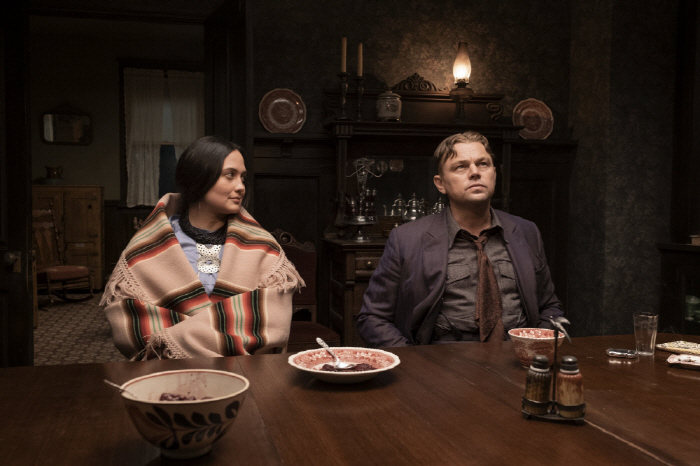
Martin Scorsese’s new film “Killers of the Flower Moon”, which was released in South Korean theaters on this Thursday, is a stunningly epic piece of work vividly looking into one massive injustice against a Native American tribe during the early 1920s. While often touching on the recurring personal themes of many of Scorsese films, the movie also firmly stays focused on the devastatingly tragic aspects of its real-life story, and the underlying pain and sadness of its ambitious tale will linger on your mind for a while after it is over.
The opening part of the movie succinctly establishes its historical background. In the late 19th century, a midwestern Native American tribe called Osage was forced to leave their territory and then settle in a barren region of Oklahoma by the US government, but this later turned out to be a blessing in disguise. Once oil was found there in the early 20th century, many of Osage members became quite wealthy, and their area naturally attracted lots of White people willing to profit from them by any means necessary.
Ernest Burkhart (Leonardo DiCaprio) was one of such people, and the movie steadily follows how he gets involved into an insidious conspiracy against the Osage tribe because of his uncle William King Hale (Robert De Niro), who is incidentally one of the most powerful and influential local figures in the area. While he is pretty close to many prominent figures in the Osage tribe, Hale is also connected with not only numerous local businessmen but also many rotten crooks to do any dirty work for him, and you will be more chilled and disgusted as the story gradually reveals how he pulls strings here and there for his own benefit behind his seemingly benevolent façade.

To Hale, Burkhart is someone who can be easily persuaded and manipulated under his influence, and Burkhart just goes along with that without much thinking. While Burkhart works as a taxi driver, Hale slyly suggests that Burkhart should get closer to a pretty young Osage woman named Mollie (Lily Gladstone), and Burkhart soon finds himself romantically involved with her not long after he actively tries to befriend her. They eventually get married after more courtship from Burkhart, and this seems to help and benefit Mollie and her wealthy family more as they become closer to Hale via her marital relationship with Burkhart.
However, we also see how things have been getting worse for Mollie and her family and tribe. Their people keep dying or getting killed under suspicious situations, but nothing much has been investigated yet, and Mollie becomes alarmed all the more than before as her close family members die one by one. She and many other members of her tribe surely try as much as possible for getting any help, but, of course, they only find themselves becoming more desperate and frustrated as facing the racism and prejudice against them in one way or another – until a bunch of federal agents from Bureau of Investigation (BOI), which was the precursor of FBI, finally come to the region later in the story.
As the screenplay by Scorsese and his co-writer Eric Ross, which is based on the nonfiction book of the same name by David Grann, patiently builds its narrative momentum with a lot of details and insights to muse on, the movie constantly engages us via its top-notch technical aspects. While the cinematography by Rodrigo Prieto, who previously worked in Scorsese’s several recent works including “The Irishman” (2019), often provides striking visual moments including the one reminiscent of the fire sequence in Terrence Malick’s “Days of Heaven” (1978), the production design by Jack Fisk and the costume design by Jacqueline West are superlative as the crucial parts of the authentic period atmosphere of the film, and the smooth and precise editing by Scorsese’s longtime collaborator Thelma Schoonmaker keeps things rolling along with late Robbie Robertson’s quietly throbbing score. Although its running time is more than 3 hours, the movie seldom lags as diligently advancing the story and characters, and its overall result surely shows Scorsese at the top of his craftmanship as usual.

It goes without saying that Burkhart’s growing sin and guilt in the story is certainly your average typical Scorsese element, but the movie takes a rather detached position to that while slowly focusing more on what Mollie and many other Osage members had to suffer and endure during that time. Thankfully free from any kind of cheap sentimentality, the movie remains calm and sobering till the epilogue part, which is unexpectedly witty at first but then ultimately shows more of where Scorsese’s heart lies.
The main cast members of the film are impressive to say the least. While Leonardo DiCaprio and Robert De Niro, who once appeared together in “This Boy’s Life” (1993) 30 years ago, are stellar as effortlessly embodying their characters’ toxic relationship, a bunch of various supporting performers including Jesse Plemons, John Lithgow, and Brendan Fraser have each own moment to shine, and Jason Isbell, who plays Mollie’s brother-in-law, is particularly good during his one brief key scene with DiCaprio. In case of Lily Gladstone, who was achingly unforgettable in Kelly Reichardt’s “Certain Women” (2016), this wonderful Native American actress’ unadorned but powerful performance becomes as the moral center of the story, and many other Native American cast members in the film are also solid in their respective supporting parts.
In conclusion, “Killers of the Flower Moon” is another fascinating masterwork from Scorsese, who has always kept advancing for more than 55 years since he made a feature film debut in “Who’s That Knocking at My Door?” (1967). While cinema may be really declining to its eventual demise, Scorsese, who is soon going to have his 81st birthday, is fortunately still around us to remind us of how artistically powerful cinema can be, and the sheer cinematic qualities of “Killers of the Flower Moon” certainly remind me again of why I still go to movie theaters. In short, this is one of the best films of this year, and I really think you should take a chance with it at any nearby movie theater around you.


 Seongyong's Private Place
Pingback: 10 movies of 2023 – and more: Part 1 | Seongyong's Private Place
Pingback: My Prediction on the 96th Academy Awards | Seongyong's Private Place