

“The Exorcist: Believer”, the latest installment of the series which started with William Friedkin’s “The Exorcist” (1973), did not scare or disturb me at all. While it surely tries to bring some freshness into its utterly familiar genre formula, the result is messy and mediocre to say the least, and it is not even as unintentionally hilarious as John Boorman’s “Exorcist II: The Heretic” (1977), which is incidentally still the bottom of the series.
This time, no less than two young girls are possessed, and we get to know a bit about one of these two young girls and her widow father during the first act of the film. Since he lost his wife who gave birth to their daughter shortly before her unfortunate death caused by a big earthquake in Haiti, Victor Fielding (Leslie Odom Jr.) has been quite protective of his adolescent daughter Angela (Lidya Jewett), but he has not talked that much about her mother, and that eventually leads Angela to a little attempt on the world of spirits. Without telling her father anything, she and her classmate Katherine (Olivia O’Neill) go into a local forest area for performing a small ritual for contacting with the spirit of Angela’s mother, and then they are gone missing for no apparent reason.
Naturally, their respective parents are quite concerned as fearing for the worst, and then the girls are eventually found a few days later. However, it does not take much time for not only Victor but also Katherine’s parents to realize that something is going very wrong with the girls. Both Angela and Katherine begin to show one disturbing behavior after another, and their parents are more unnerved as a number of other weird things happen around them.

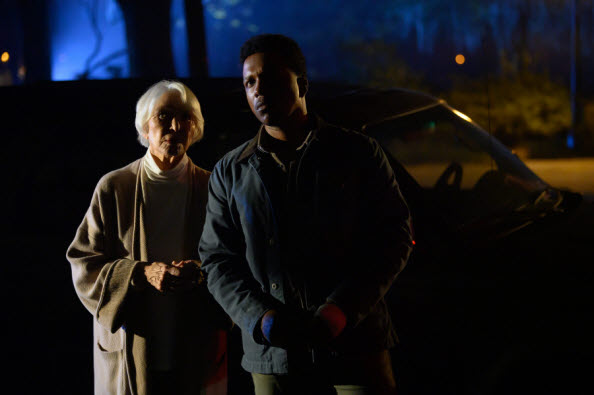
Of course, there eventually comes a point where the girls’ parents come to see that the girls are going through something much more disturbing than they thought at first, and that is where Victor’s neighbor Ann (Ann Dowd) gets herself more involved into this increasingly alarming circumstance. As a nurse who was also an ex-nun, she instantly sees that the girls are possessed by some powerful demon, and she later recommends to Victor that he should consult with someone who knows much about demons and exorcism rituals.
That figure in question is none other than Chris MacNeil (Ellen Burstyn), who was that tormented mother in “The Exorcist”. After going through what happened in the “The Exorcist”, MacNeil has devoted herself on studying many different rituals of exorcism besides the one practiced by the Catholic Church, and she surely has a lot to tell when Victor visits her residence later in the story. Although she merely functions as a link between the movie and “The Exorcist”, Burstyn, who is soon going to have the 91st birthday, acquits herself mostly well while playing her material as straight as possible, and I hope that we will continue to see her more during at least next several years.
Just like Burstyn, the screenplay by director David Gordon Green and his co-writer Peter Sattler, which is developed from the story by Green, Danny McBride, and Scott Teems, tries to be as serious as possible, but its rather overblown attempts often lead to hollow silliness. When the story eventually arrives at its expected climactic part, the movie applies no less than three different religions on this part, but they do not mesh well together instead of generating any kind of dramatic synergy, and their mushy result only makes me wonder whether there will be a rabbi or an imam or a Buddhist monk in the two planned sequels after the movie.
In case of the devil in the film, who is, not so surprisingly the same one who possessed that poor girl in “The Exorcist”, the movie surely throws lots of grotesque moments you can expect from a case of demonic possession, but none of them particularly sticks on my mind much as often resorting to lots of digital special effects. As a matter of fact, this reminds me again that the climactic part of “The Exorcist” may look a bit dated at times but still retains its utterly disturbing qualities even at present thanks to the deft utilization of practical effects.
In addition, the screenplay feels flat and quotidian in case of character development, and many of its notable main cast members are often wasted while struggling a lot with their cardboard roles. Leslie Odom Jr. who has been steadily moving onto TV and movie since his Tony-winning performance in Broadway musical “Hamilton”, is suitably earnest, and he and young performer Lidya Jewett are convincing in their several scenes early in the film, but then the movie simply push their characters into more misery and horror without any substantial narrative development. In case of Jennifer Nettles, Norbert Leo Butz, and Ann Dowd, they fill their superficial parts as much as possible, and young performer Olivia O’Neill surely looks as committed as Jewett during the climactic part.
Overall, “The Exorcist: Believer” is not as awful as I feared, but it is still a disappointing opener for whatever may come next, and I came to reflect more on the undeniable artistic achievement of “The Exorcist”, which I happened to revisit not long after hearing about Friedkin’s death a few months ago. That film still makes us believe in its intense depiction of demonic possession because we come to believe in its realistic story and characters first, but “The Exorcist: Believer” does not have anything to make us believe in its story and characters from the beginning, and I also must point out that there have already been many better horror films about demonic possession out there since “The Exorcist” came out. Seriously, I do not know whether there will actually be some improvement in the next film, but, so far, “The Exorcist: Believer” just depressed me instead terrifying me, and that is all, folks.


 Seongyong's Private Place