

Japanese animation film “Blue Giant” is simply riveting whenever it conveys to us that ecstatic quality of jazz music performance. Probably because of being singled-minded as its main characters’ artistic pursuit for sublime perfection, the movie often feels a bit too thin in terms of storytelling and characterization, but its every weak aspect is almost forgiven as it reaches for more musical intensity and excitement, and I found myself quite enthralled more than once even while recognizing its weak aspects from time to time.
At first, the film introduces us to a 18-year-old lad named Dai Miyamoto (voiced by Yûki Yamada), and it quickly establishes this lad’s considerable artistic passion and dedication as observing his lonely saxophone practice in the middle of one cold winter night. As he later reveals, he only started to play a saxophone just for a few years, but he is evidently quite confident as well as very talented, and we are not so surprised when he subsequently leaves his small hometown for going to Tokyo. Right from his first day in Tokyo, he starts to search for any suitable outdoor spot where he can practice alone, and he surely feels exalted when he finally finds the right spot for him.
Of course, Dai needs a place to stay while pursuing his big dream of becoming a great jazz musician, and it turns out that there is a hometown friend currently living in Tokyo. Although he does not welcome Dai much at first, Shunji Tamada (voiced by Amane Okayama) lets Dai into his small residence, and Dai shows some appreciation via paying some rent to Shunji once he begins to do a part-time work at a construction site.

Things seem to be going nowhere for Dai for a while, but there come a couple of fortunate encounters for him. As looking for any suitable jazz club, he happens to enter a little jazz bar owned by a nice middle-aged lady, who gladly allows him to practice there after sharing their common passion toward jazz between them. When he attended a small jazz concert during one evening, he happens to spot a young pianist named Yukinori Sawabe (voiced by Shôtarô Mamiya), and it does not take much time for them to befriend each other as they later talk a lot about their artistic passion with each other.
Both Dai and Yukinori soon come to feel that they really need a drummer to hold the ground for their respective performances, and, what do you know, Shunji suddenly finds himself trying on playing drum. Although he does not have any previous experience, Shunji comes to discover his own musical passion while supporting Dai and Yukinori as much as possible, and Dai gladly encourages his friend despite Yukinori’s skepticism. After all, their main goal is performing at a certain prestigious jazz club in the downtown area of Tokyo, and it goes without saying that Shunji can be a major handicap for them.
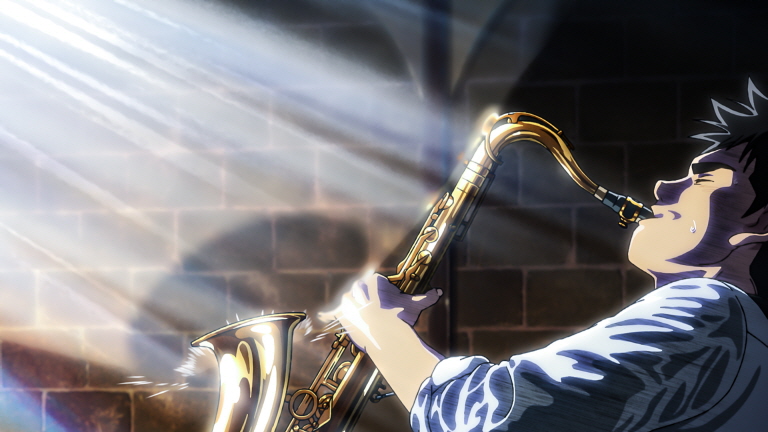
It is not much of a spoiler to tell you that Shunji actually improves his drumming skill more and more while constantly practicing as hard as, say, the hero of “Whiplash” (2014) – and that he and his two colleagues eventually give one hell of performance to surprise and impress a bunch of audiences. Director Yuzuru Tachikawa and his crew members have a field day as dynamically illustrating a number of performance scenes in the film, and their stylish result is lovely and exhilarating to say the least with the effective score provided by Hiromi Uehara.
However, what is supposed to be the center of the story feels bland and hollow in my inconsequential opinion. Besides his irrepressible artistic passion and dedication, we never get to know much about Dai except a few personal details, and the film comes to distance itself from him more as occasionally inserting the interview clips of several supporting characters reminiscing about him. They keep saying how awesome his talent is, and, to our disappointment, that is all they can tell us about him.

Instead, I come to care more about the other two characters surrounding him, who actually have more interesting narrative arc. Although he knows well that he may not be as good as his two colleagues, Shunji continues to push himself more and more, and his efforts eventually get some respect and admiration from audiences while also having a fulfilling artistic experience of his own. In case of Yukinori Sawabe, he seems to be almost flawless as Dai, but then he later gets a painfully honest criticism on why his performance still cannot reach to the level of sheer distinction just like Dai, and that certainly frustrates him a lot for some time until he comes to realize how to lose and open himself for more artistic expression.
During the last act, the story becomes melodramatic as taking a sudden left turn, but that does not dampen the mood at all as its main characters are still willing to go further for, yes, a performance to remember. The finale might have looked a bit too contrived and preposterous in live-action film, but it works better than expected in the context of animation film, and you will certainly root for them more than before while also being more exhilarated than before.
In conclusion, “Blue Giant” is another solid Japanese animation film of this year after “The First Slam Dunk” (2022) and “Suzume” (2022), and I enjoyed its good mood and style even though the story and characters sometimes feel plain and predictable compared to that. Yes, it sounds a little too familiar in terms of genre conventions, but it knows and plays its music well on the whole, and I certainly left the screening room with enough entertainment satisfaction.


 Seongyong's Private Place