
Willaim Friedkin’s last film “The Caine Mutiny Court-Martial”, which incidentally came out a few months after his death, is a modest but engaging legal drama to watch. While looking inherently theatrical at times, the movie is also compelling enough to hold our attention to the end, and it is certainly nice to see that Friedkin was still a good filmmaker even during the last chapter of his long and illustrious filmmaking career.
The movie is based on Herman Wouk’s 1953 play of the same name, which was adapted from his 1952 Pulitzer-winning novel “The Caine Mutiny”. Wouk’s novel was later adapted into Edward Dmytryk’s Oscar-nominated 1954 film starring Humphrey Bogart, and that was followed by several TV movie adaptations of Wouk’s play including the one made by Robert Altman in 1988. Besides moving its period background to the post-9/11 era, Friedkin’s adapted screenplay mostly sticks close to Wouk’s play, so, like Altman’s 1988 version, it simply focuses on what is going on during its titular court-martial till the eventual finale.
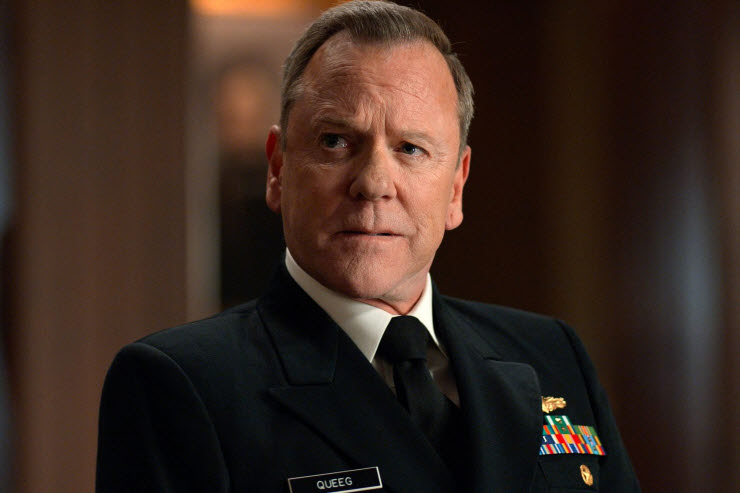
At first, the case of its titular court-martial looks pretty simple on the surface. A US Navy ship under the command of Lieutenant Commander Queeg (Kiefer Sutherland) happened to have an extreme case of emergency in the middle of the sea area between Iran and Saudi Arabia, and one of Queeg’s officers, Lieutenant Maryk (Jake Lacy), quickly decided to relieve Queeg of his post because he had believed that his commander was not mentally fit enough to command the ship. In the end, the ship and everyone inside it managed to avoid a possible disaster, but now Maryk is charged for mutiny, and he may end up being incarcerated for more than 10 years at least.
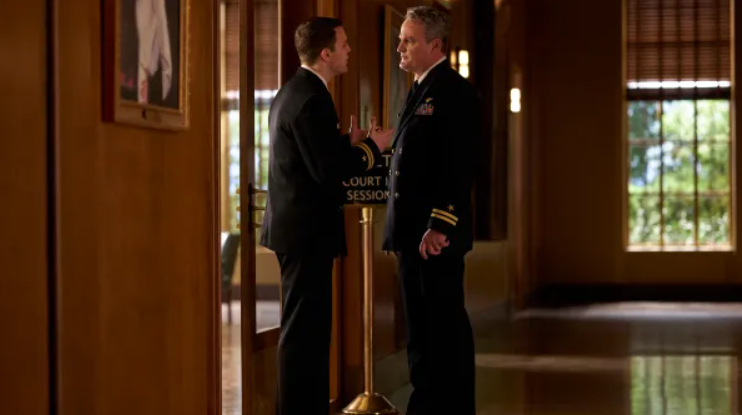
Maryk’s only chance for avoiding that dire consequence is his defending lawyer Lieutenant Greenwald (Jason Clarke), who comes to handle the case with understandable reluctance as nobody else is willing to defend Maryk. Unlike Maryk, Greenwald apparently has a clear understanding of not only how that incident happened on the ship but also what he should do as Maryk’s lawyer, and we gradually come to sense that he is not so eager to do his unenviable task despite his compassion on Maryk.
Friedkin’s dryly unobtrusive direction allows his main performers to shine in one way or another along the story. Cinematography Michael Grady’s camera usually observes the performers from steady positions, and I appreciate how subtly it focuses on them bit by bit as we listen to their words. As Maryk and several other crew members including Lieutenant Keefer (Lewis Pullman) and Lieutenant Kieth (Tom Riley) testify one by one, we get a fairly good idea on how things went wrong under Queeg’s command, and we come to wonder more about whether Queeg was really unfit for commanding the ship as believed by Maryk during that nearly catastrophic happening. While Jake Lacy is effective as a simple-minded dude who still does not have much understanding of his situation even around the end of the story, Lewis Pullman and Tom Riley are also solid as the two other officers on the shop, and Jay Duplass, Elizabeth Anweis, and Francois Battiste have each own small moment as several experts brought to the court-martial.
Queeg is surely a key witness at the court-martial, and, thanks to Greenwald’s wily strategy, the court-martial comes to focus more on Queeg’s questionable mental state instead of the confirmation on Maryk’s supposedly mutinous act. Keefer Sutherland, who can be quite intense as shown from TV drama series “24”, deftly dials up and down his character’s apparent neurotic side during his two substantial scenes, and he is quietly devastating when Queeg belatedly comes to realize how he gets himself exposed and embarrassed in front of the others at the court-martial.

As Greenwald and the lead prosecutor, who is played well by Monica Raymund, often clash against each other throughout the court-martial, the head judge, played by late Lance Reddick, intervenes between them with stern authority at times. Although his supporting role looks rather thankless, Reddick, who was an ever-reliable character actor as recently shown from “John Wick: Chapter 4” (2023), firmly holds the ground, and he is particularly good when his character makes a bit of admonition on Greenwald’s morally murky strategy later in the film.
Greenwald surely goes for the jugular at the court-martial as much as required, but there is some bitter undertone in Jason Clarke’s seemingly straightforward acting, and that is evident especially when his character makes the final statement in front of the judges presiding over the court-martial. Greenwald keeps his attitude straight and unflappable, but his feelings about the case are more palpable to us than before, and this later culminates to a scathing dramatic moment at the very end of the movie.
Overall, “The Caine Mutiny Court-Martial” may look like a mere footnote compared to many notable works of Friedkin such as “The French Connection” (1971) and “The Exorcist” (1973) but Friedkin did a competent job of bringing Wouk’s acclaimed play to the screen with enough skillful touches to be appreciated. Although his prime period unfortunately passed after “To Live and Die in L.A.” (1985), he kept working at least as making a few more good films such as “Bug” (2006) and “Killer Joe” (2011), and “The Caine Mutiny Court-Martial” surely deserves to be included in that bunch.


 Seongyong's Private Place
Pingback: 10 movies of 2023 – and more: Part 2 | Seongyong's Private Place