
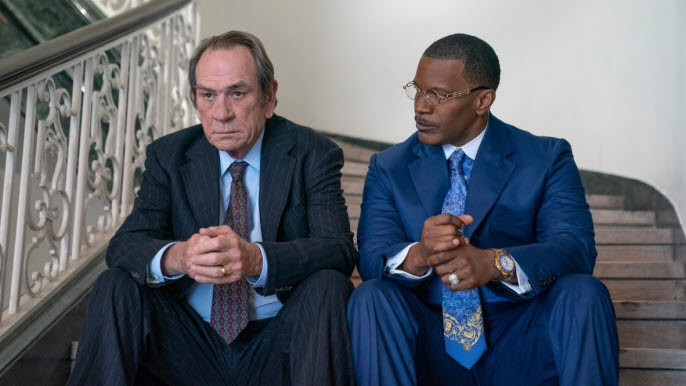
“The Burial”, which was released on Amazon Prime on last Friday, is a modest but engaging drama about the legal battle of two different men who came to stand against a big corporation. While it does not exceed our expectation that much, the movie does its job well at least as taking its time on story and character development, and it is also anchored by the compelling contrast between its two reliable lead performers.
Tommy Lee Jones, who has been one of the most dependable actors working in Hollywood during last several decades, plays Jeremiah O’Keefe, a funeral director living in Biloxi, Mississippi. Since he inherited the family company from his father not long after the World War II, O’Keefe has diligently run it in addition to becoming not only a proud father and husband but also a respectable member of his local community, but he comes to face a serious business problem which may be beyond his control in 1995. After consulting with his family lawyer Mike Allred (Alan Ruck), he eventually decides to sell some of his family business to a large funeral home company named the Loewen Group, so he and Allred comes to have a meeting with its CEO Raymond Loewen (Bill Camp) in Vancouver, Canada.
At first, everything seems to be going well for O’Keefe as the Loewen Group promises a deal supposedly benefiting both sides, but then O’Keefe soon senses something fishy about this deal as the Loewen Group keeps delaying signing the contract on their deal. Hal Dockins (Mamoudou Athie), a young African American lawyer who is incidentally a friend of one of O’Keefe’s children, tells O’Keefe that they should be more active about this ongoing problem because the Loewen Group was apparently not interested in signing the contract from the beginning for a good reason, and O’Keefe eventually agrees to take a legal action against the Loewen Group.

Because the following lawsuit will be handled at a local court whose area happens to have lots of African American people, Dockins suggests that O’Keefe should hire an African American lawyer instead of being just represented by Allred, who is incidentally a white American just like O’Keefe. There is a well-known African American lawyer in Florida who has been mainly known for personal injury cases, and Dockins is confident that this lawyer, Willie E. Gary (Jamie Foxx), is suitable for O’Keeffe’s legal battle against the Loewen Group, though O’Keeffe has some understandable reservation because, after all, Gary does not have much experience or knowledge on those contract laws.
Jamie Foxx, who has gradually been back in his element during several recent years, plays his showy character with pure gusto right from his first scene in the film. While he is surely your average ambulance chaser, Gary is also pretty good enough to convince the court and the jury members in one way or another, and O’Keefe is certainly impressed when he and Dockins come to watch Gary handling his latest case.
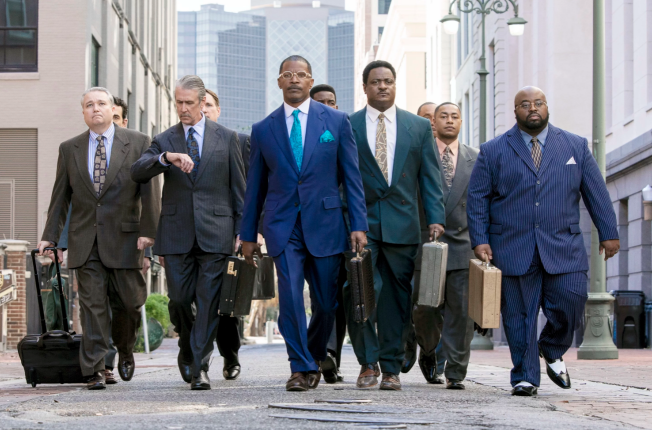
When he is later approached by O’Keefe and Dockins, Gary understandably does not show much interest at the beginning, but, after Dockins makes a good argument on how O’Keefe’s case can make Gary all the more famous than before, Gary agrees to represent O’Keefe. He promptly takes the lead position of O’Keeffe’s counsel team to Allred’s annoyance, and he is also ready to tackle against those several high-profile lawyers representing the Loewen Group, who are all African American as expected.
One of Gary’s opponents is a young female lawyer named Mame Downes (Jurnee Smollett), and one of the most entertaining moments in the film comes from when Gary and Downes has a little unofficial meeting before the first day of their trial. While their casual conversation is tinged with some playful respect, Downes tactfully warns that she will not be easy on Gary and O’Keefe at all as doing her job as usual, and Gary has no problem with that as her main opponent at the court.

What is unfolded at the court is quite conventional to say the least, but the screenplay by director Maggie Betts and her co-writer Doug Wright, which is based on the 1999 New Yorker article of the same name by Jonathan Harr, keeps us engaged as steadily paying more attention to character details. Yes, Gary and O’Keefe surely come to have some conflict between them during the trial, but they also come to respect and admire each other more as they continue to stand up against their opponent, and they become more determined as coming to learn more about how sneaky their opponent has been in its rather aggressive business expansion.
While Jones and Foxx ably complement each other along the story, several notable cast members including Alan Ruck, Bill Camp, Mamoudou Athie, and Jurnee Smollett, whom I still fondly remember for her powerful performance in Kasi Lemmons’ great film “Eve’s Bayou” (1997), have each own moment to shine. Smollett clicks so well with Foxx during several key scenes between them that I would not mind watching them playing against each other again someday (I can easily imagine them appearing together in the remake of Steve Soderbergh’s “Out of Sight” (1998), for example). In case of Camp, who has been one of the most interesting American character actors during last several years, he is particularly fun to watch when his despicable supporting character finally comes to the court later in the story.
Overall, “The Burial” mostly sticks to its genre conventions, but the result is still good enough for recommendation thanks to Betts’ competent direction and the commendable efforts from her main cast members. I was not surprised, but I was satisfied with its fairly solid storytelling and performance, so I will not grumble for now.


 Seongyong's Private Place