
It has been 20 years since I watched Federico Fellini’s “La Dolce Vita”, and I could not help but become a bit reflective about its timeless qualities when I revisited it at a local movie theater today. While it can be simply regarded as a time capsule containing a certain chic urban lifestyle in Rome during the early 1960s, it is also a supreme personal masterwork full of wit, charm, and style to be appreciated, and I was enthralled again by its sharp and humorous illustration of how its supposedly cool and dashing hero is hopelessly stuck in the ups and downs of his ultimately hollow social life and career.
Its hero is Marcello Rubini (Marcello Mastroianni), a slick gossip journalist constantly working through the glamorous days and nights in Rome. As the movie hops from one episodic moment to another along with him, we are dazzled at first by all those fun and excitements around him, but we come to sense more of the growing emptiness and anxiety inside him, and the main source of humor in the film comes from how usually he fails in his endless pursuit of pleasure and happiness. Every evening seems to dangle a new opportunity for pleasure or happiness in front of him, but he only ends up feeling unfulfilled or frustrated whenever another day begins – and then he finds himself reaching for more as usual.
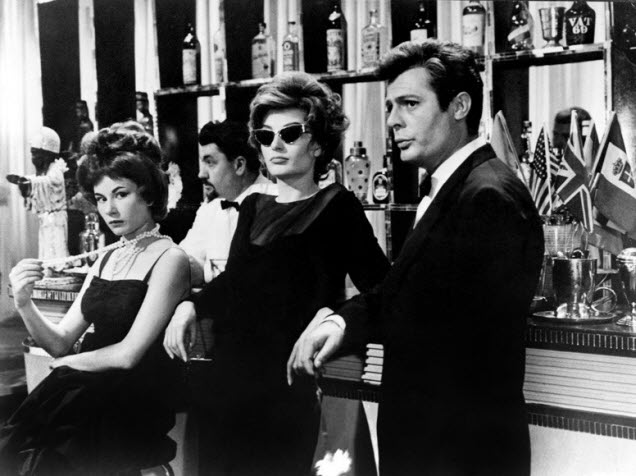
The first act of the film, which is preceded by the grandly amusing opening sequence a helicopter carrying a big statue of Jesus to Rome, sets this recurring narrative pattern as Marcello begins another fun evening in the downtown area of the city. He is looking for any juicy gossip material at a posh nightclub, and a photographer named Paparazzo (Walter Santesso), who is incidentally the origin of that well-known term for those trashy photographers, is eager to shoot anything interesting from many celebrities simply enjoying their little private time at the nightclub.
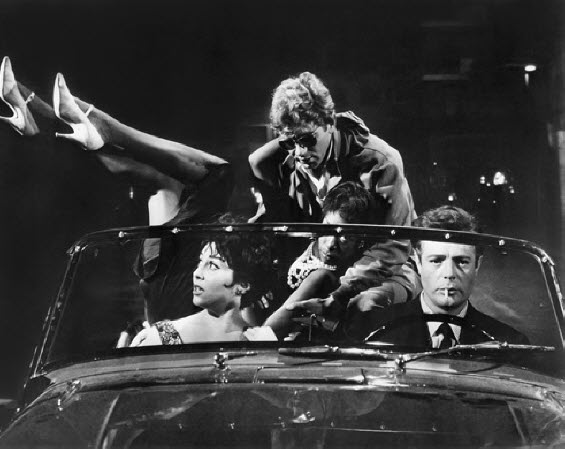
When Marcello comes across a rich socialite named Maddalena (Anouk Aimée), he does not hesitate to spend some nighttime with her, but the situation becomes rather absurd when they go outside for a car ride. Maddalena makes an impulsive decision of having a prostitute accompanying them, and they eventually go to that prostitute’s shabby residence. In a closed space, Marcello and Maddalena come to have a little fun time together, but their fun time is quickly over as the dawn eventually comes, and then Marcello has to take care of an emergency involved with his long-suffering girlfriend Emma (Yvonne Furneaux).
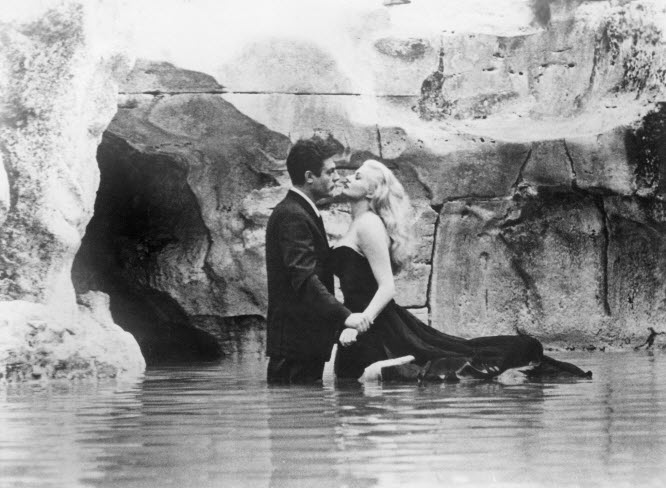
Although he may regret about not paying much attention to Emma, Marcello’s mind soon goes astray as he and many other journalists flock around a famous American star movie actress who has just arrived in Rome. Although the movie may be the only valuable spot in her whole movie acting career, Anita Ekberg has a lot of fun with playing with her own public image, and Fellini immortalizes her undeniable beauty on the screen via a series of unforgettable moments including that iconic scene involved with the Trevi Fountain. Everything surely feels almost perfect to Marcello during that wonderful scene, but then, of course, there comes the next day along with the sobering disappointment for him to our little amusement.
Marcello’s desperate pursuit of happiness is reflected further by the episode where, along with Emma and Paparazzo, he goes to a rural village for reporting on two little children who have attracted lots of attention as claiming to have seen a holy spirit. As these two children say that they see the holy spirit here and there, the big crowd surrounding them are thrown into a sort of mass madness while reaching for any kind of miracle to behold, and that is not so far from how much Marcello tries to reach for something seemingly beyond his reach.
Besides his increasingly strained relationship with Emma, the movie also focuses on Marcello’s personal interactions via two different figures. When his father visits Rome, Marcello is glad to have some good time with his father, and his father appreciates Marcello’s generosity at first, but then there comes a point where he bitterly admits that he is not young anymore while Marcello is reminded more of how he may end up being utterly lonely and dissatisfied just like his father. In case of his best friend Steiner (Alain Cuny), this confidently sophisticated man seems to have everything for which Marcello has yearned so much, but then he later turns out to have his own problems behind his back.
All these and other things in the film are presented with a lot of style and humor under Fellini’s dexterous direction, and the movie remains fresh as ever while dynamically swinging back and forth between alluring beauty and daunting ugliness. With the constant presence of Nino Rota’s unforgettable score on the soundtrack, it steadily serves numerous awesome moments shining with artistic imagination, and I particularly like a solo musical performance scene involved with lots of balloons. I am sure that Fellini and his crew members used some practical effect for this scene, but it still feels funny and magical while being a quintessential case of being, yes, Felliniesque.
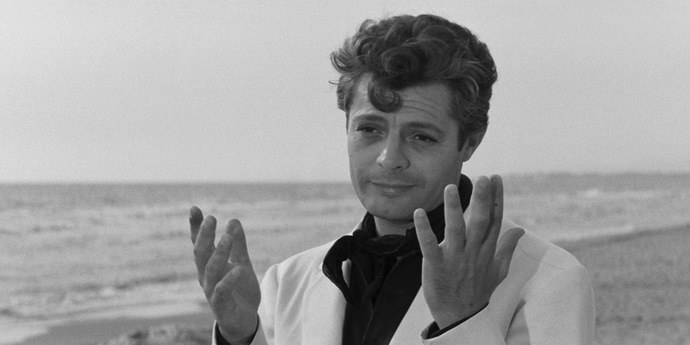
And the achingly human qualities of Marcello Mastroianni’s performance hold everything together in the film. During my recent viewing, I observed more of what a cad Marcello really is, and I felt more disgust on how he often mistreats his poor girlfriend, but Mastroianni, who is still one of the coolest actors in the movie history, held my attention as usual while gradually conveying to me Marcello’s anxious melancholy behind his frequently detached appearance. You may not like Marcello that much even at the end of the story, but you may pity him a lot while also feeling some empathy on his desperation and frustration. After all, we all have a fair share of disappointment and discontent as reaching for happiness and pleasure just like him, don’t we?
Fellini also surrounds a bunch of variously colorful performers around Mastroianni. Just like Ekberg, Anouk Aimée and Yvonne Furneaux are impressive in each own way as two contrasting female figures in Marcello’s life, and Walter Santesso and Lex Barker, who plays the stern boyfriend of Ekberg’s character, are also engaging in their respective crucial supporting roles. In case of Alain Cuny, he flawlessly embodies his character’s calmly assuring attitude, and that is why it is devastating to see what his character comes to commit before the final act of the film begins.
Overall, “La Dolce Vita” is indeed one of Fellini’s best works, and I admire how it has grown on me during last 20 years. In 2003, the movie just felt to me like a homework to do, but I came to appreciate it more as observing how it has influenced many subsequent films including Paolo Sorrentino’s Oscar-winning film “The Great Beauty” (2013), which can be labeled as the successor to “La Dolce Vita” for a number of reasons including its aging gossip journalist hero who can be regarded as Marcello’s older version.
By the way, the final scene of the film, which makes a striking contrast with the opening scene for an apparent reason, initially seems rather pessimistic with another failure to connect for Marcello, but, as I reflect more on this scene, the very last shot of the film somehow feels hopeful even while leaving an ambiguous impression on the whole. Perhaps, he will come to realize what is really important to him as remembering that lasting moment again someday, and then, who knows, he may simply be happy to stroll around here and there in Rome just like the hero of “The Great Beauty”.


 Seongyong's Private Place