
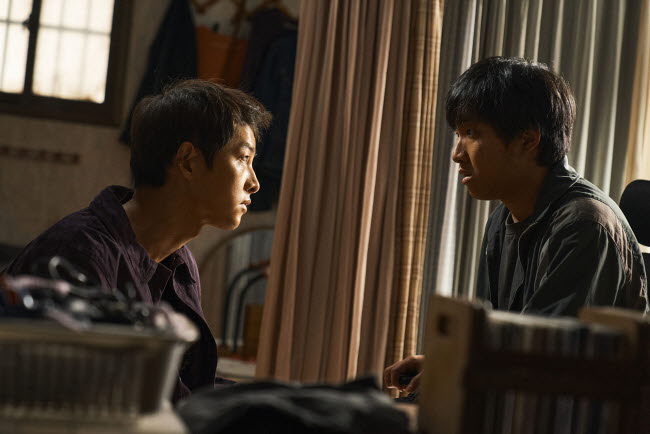
South Korean film “Hopeless” is a grim crime noir drama which tediously pushes the story and characters into more violence and misery without much substance or interest. Besides being unlikable or pathetic, most of the main characters in the film are not particularly interesting or engaging enough to hold our interest, and the rather murky aspects of its plot only make us more distant to their increasingly despairing circumstance.
The movie opens with a striking act of violence committed by a high school student named Yeon-gyu (Hong Xa-bin), and the movie subsequently depicts his utterly, yes, hopeless status. He has to pay around 3 million won to the family of the student injured by him for their settlement, but his family is too poor to pay the settlement money, and neither of his parents is particularly willing to step forward to help him. While his mother has almost given him up, his abusive alcoholic stepfather is only ready to beat him more, and his stepsister, who is incidentally the main reason behind that violent incident, is the only one who can stand between him and their father.
Yeon-gyu tries to handle the situation as much as he can, but things only get worse and worse for him. He gets beaten by a bunch of adolescent thugs associated with that student beaten by him, and then he gets seriously injured on his face when his stepfather tries to beat him again while being quite drunk as usual. Due to his resulting facial scar, he comes to lose his part-time job, and that surely makes him all the more desperate than before.
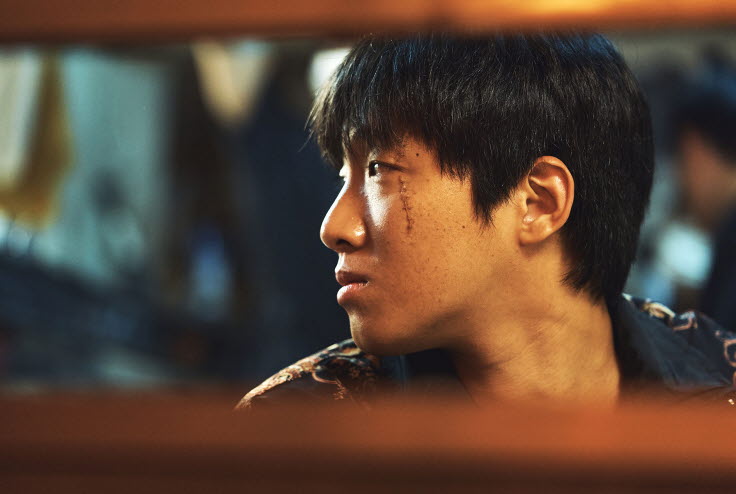
And then there comes an unexpected help. Yeon-gyu’s desperate circumstance happened to be noticed by a local middle-level loan shark named Chi-geon (Song Joong-ki), and, for some personal reason, he takes little pity on Yeon-gyu. He gives Yeon-gyu the money for the settlement, and Yeon-gyu subsequently comes to work under Chi-geon because he is willing to not only pay Chi-geon back but also earn enough money to take him away from his miserable daily life to somewhere outside the country.
What follows next is how Yeon-gyu quickly becomes Chi-geon’s protégé. Besides his small-time loan-sharking business, Chi-geon also runs a chop shop for stolen motorcycles, and Yeon-gyu learns a bit about how to steal a motorcycle within a short time. Although he probably knows well that he is stealing from poor people not so different from him, he focuses on earning more money and more recognition from his mentor/boss, and Chi-geon appreciates his earnest efforts in response.
However, Yeon-gyu remains pathetic and miserable at his home. Whenever his stepfather appears to be quite drunk, he cannot help but become scared and cornered, and his stepsister usually stands against their father as before. When it later turns out that she has her own problem to deal with, Yeon-gyu takes care of her problem via Chi-geon’s thugs, but his stepsister is not so pleased about that even though there has been a certain feeling between her and Yeon-gyu.
Meanwhile, the movie also pays some attention to what is going on in Chi-geon’s crime organization. Chi-geon’s boss has been supporting a certain local politician for his financial gain, but this local politician turns out to be not so trustworthy. Naturally, Chi-geon and his gangs must do something drastic for handling this problematic situation, and, not so surprisingly, Yeon-gyu finds himself getting involved with the circumstance much more than expected.
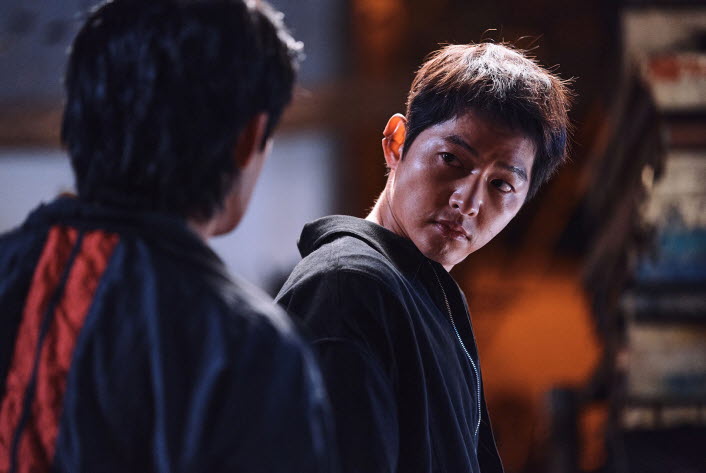
Of course, Yeon-gyu becomes more conflicted about what he is demanded to do by Chi-geon, but the screenplay by director/writer Kim Chang-hoon does not put much effort on bringing enough detail and substance to its hopelessly monotonous hero. Hong Xa-bin does try a lot throughout the film, but he is unfortunately limited by his superficial one-note role, and his resulting performance in the movie frequently feels ponderously wooden without generating anything compelling enough to engage us.
On the opposite, Song Joong-ki has a bit more to play in comparison, but the movie also fails to develop his character into someone really interesting to observe, and Song’s hunky image sometimes feels awkward in the seedy background of the film. Although there is a private conversation scene where Chi-geon shows a little more of himself to Yeon-gyu in the middle of the story, we never get any sense of relationship development between these two main characters, and that is why Chi-geon’s choice during the final act feels quite contrived instead of organically developed from the narrative.
Furthermore, the movie often baffles us as being adamantly vague about what is going on in Chi-geon’s crime organization, and it also does not handle well its several substantial supporting characters, who are more or less than plot tools for more misery and violence along the story. As the sole main female character in the story besides Yeon-gyu’s mother, Kim Hyung-seo, who is also known as a popular local singer Bibi, brings some pluck to her role, but she does not have much to do from the beginning, and that reminds me again of how female characters are frequently wasted in many of recent South Korean crime drama noir films.
Although it is not lousy in terms of technical aspects, “Hopeless” does not bring anything particularly new to its genre territory while merely depressing us with lots of misery and violence. No, I do not mind at all watching lots of misery and violence on the screen – as long as they work well as a part of story and character to observe with interest and, perhaps, empathy. However, “Hopeless” is not such a case like that, and it only left me with dirty and unpleasant impressions to be erased as soon as possible.



 Seongyong's Private Place