

Federico Fellini’s “8 1/2” is your average navel-gazing piece of work, but it is surely one of the best ones of its kind in addition to being the groundbreaking one. While having been emulated so much by numerous subsequent films ranging from Bob Fosse’s “All That Jazz” (1979) to Charlie Kaufman’s “Synecdoche, New York” (2008), this supreme masterpiece remains on the top of the bunch as their bold and pioneering senior even at present, and it is also quite funny, charming, and touching at times once you go along with Fellini’s undeniably big artistic ego and ambition behind the screen.
It is well-known that Fellini actually had no clear idea about how to make his movie even right before beginning its production. After making a big impression on audiences and critics with his previous film “La Dolce Vita” (1960), he surely felt lots of pressure on what to do next, and “8 1/2” is essentially a cinematic reflection of his immense artistic frustration and desperation during that time, but, boy, everything in the movie somehow feels so effortlessly lightweight with lots of stylish freedom and imagination – even while its filmmaker hero, Guido Anselmi (Marcello Mastroianni), reaches to the dead end of his artistic struggle again and again.
The surreal opening scene of the movie humorously exemplifies what has been eating at Guido’s mind. As literally reflected by one impressive shot in the middle of this scene, he wants to fly higher with more artistic freedom, but, to his despair and frustration, he always finds himself facing the chaotic crisis of his life and career. While he is supposed to get some rest at a big spa for whatever he will do next, the production of his next film is already set in motion, and everyone ranging from his producer to his mistress keeps asking him to make up his mind on one matter after another.
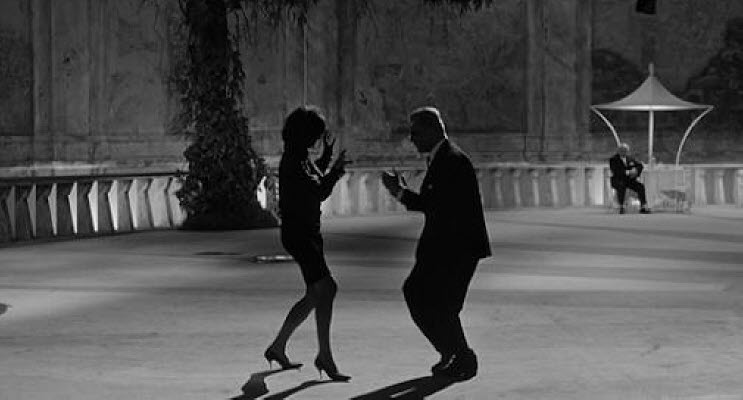
As Guido’s chaotic circumstance gets more complicated along the story, the movie certainly feels messy and confusing without any clear direction to lead us, but Fellini and his crew members including cinematographer Gianni Di Venanzo and composer Nino Rota busily keep things rolling around Guido even though he remains rather passive without making any choice at all in contrast. Besides his original score, Rota freely utilizes several recognizable pieces of classic music such as Richard Wagner’s “Ride of the Valkyries” on the soundtrack, and the result is often quite amusing as cheerfully accompanying numerous memorable moments in the film. At one point, the camera simply but drolly follows the lines of various people waiting to get a cup of mineral water one by one, and this silly moment feels all the more absurd as these people often look like doing a sort of musical choreography across the screen (As many of you know, Fellini often played music on the set for getting his performers and extras into the specific mood he wanted).
More pressured and frustrated than ever, Guido frequently finds his mind going astray into the fleeting moments of personal memory and artistic imagination, and that is where Fellini goes further with more personal artistic touches to be savored. In case of one particular flashback moment from Guido’s childhood years, his certain sexual taste, which is represented by one earthy woman with big breasts, is cheerfully juxtaposed with his Catholic repression represented by his mother and several stern priests, and it is interesting to observe how this juxtaposition is connected with his ongoing personal conflict between his long-suffering wife and his current mistress. He later makes an unwise choice of having both of these two women come to the spa, and his wife is silently enraged not just because of another infidelity of his but also because of his apparently lousy choice of mistress.
Guido’s messy and complex situation with these and many other women in the film is vividly developed into an outrageous fantasy sequence where he dominates over them in his own little harem. At first, everything seems to be going well for everyone including him, but there soon comes a trouble in his paradise, and that is when this sequence becomes much more hilarious than before. Frankly projecting his desire and need onto his hero, Fellini willingly makes a fun of his constantly confused fascination with many women in his actual life including his actress wife Giulietta Masina, and you may admire how unhesitating he is in almost showing himself warts and all even while proudly wielding his artistic ego across the screen.
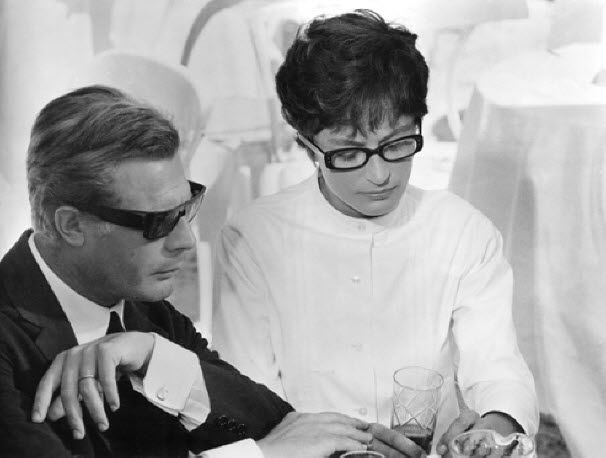
This apparently egoistical aspect of the film is sometimes difficult to process, but that is mostly compensated by not only Fellini’s seemingly endless stream of style and imagination but also the buoyantly debonair presence of Marcello Mastroianni, who holds everything together in the movie just like he did in “La Dolce Vita”. Deftly balancing his character between absurd comedy and intense drama, Mastroianni elegantly glides along with the movie, and we come to care more about Guido’s artistic struggle while also clearly recognizing many human flaws of his.
Around Mastroianni, a number of actresses come and go as having each own moment to shine, and that surely shows how Fellini was often good at drawing memorable performances from his actresses. While Anouk Aimée and Sandra Milo make an amusing contrast as Guido’s wife and mistress, Claudia Cardinale is simply sublime as an ethereal star actress idolized by Guido, and several actresses including Rossella Falk, Barbara Steele, Madeleine Lebeau, and Eddra Gale are also solid in their respective supporting parts.
Although it will require some patience from you for understandable reasons, “8 1/2” is worthwhile to watch for its inarguable greatness, and I came to love it more as coming back to it from time to time. When I revisited it at a local movie theater during this evening, I found its bittersweet finale more poignant than ever, and then I came to reflect more on how I failed and then restarted more than once throughout my life. Yes, I have had a fair share of frustration and desperation, but, like Guido, I also found that nothing is really over as long as I can keep going along with many others in my inconsequential life. Sure, as sadly reflected by the very last shot of the film, the show will be eventually over for me in one way or another, but I can put aside that matter for now at least, can’t I?


 Seongyong's Private Place
I really liked this analysis on 8 1/2 and Fellini 🙂
SC: Thanks for posting it.