

Chilean documentary film “The Eternal Memory”, which won the Grand Jury Prize when it was premiered at the World Cinema Dramatic Competition of Sundance Film Festival early in this year, simply observes the small and big struggles of an Alzheimer’s disease patient and a woman who has loved him for more than 20 years. This is surely a strong emotional stuff, but I wonder whether it would be more powerful if it let us get to know more about who they are.
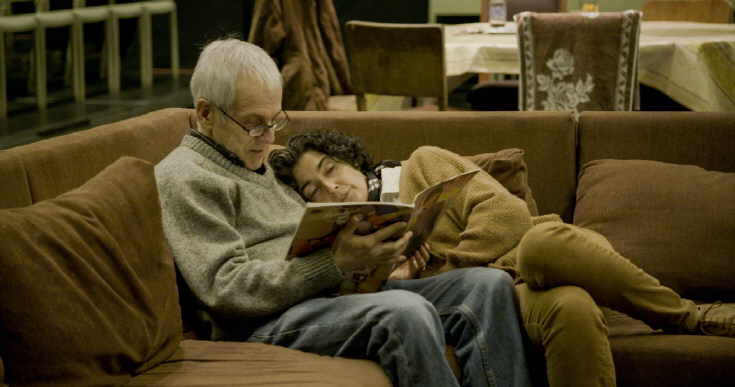
The main subject of the documentary is the daily life of Augusto Góngora and Paulina Urrutia, who married several years ago but actually lived together as a couple for more than two decades. When Góngora turned out to be suffering Alzheimer’s disease, Urruitia stood by him as his devoted spouse, and the documentary chronicles several years of their struggle before his eventual death early in this year.
At first, Góngora looks pretty well on the surface. He is well aware of how his mind is being faded day by day, so he and Urrutia often focuses on remembering one thing after another in their shared past, which is reflected a bit via occasional archival footage clips. While she was a prominent actress during that time, he was a progressive journalist who was passionate about chronicling all those bloody injustices committed under that dark period of dictatorship in Chile during the 1970-80s, and the illness during his later years is sort of ironic considering how much he tried for preventing the public from forgetting that dark and violent time in the past.

No matter how much he tries, Góngora slowly succumbs to his illness bit by bit despite his spouse’s sincere efforts. At one point, we observe how much Urrutia tries to get her husband involved in her latest theater project, but he still looks like a child who does not understand much what is going on around him. He surely appreciates his wife’s efforts, but he cannot help but feel lost at times, and, to the frustration of both him and his wife, his mental condition only gets deteriorated more and more as time goes by.
In the end, there comes a point where we wonder whether Urrutia really should take her husband to any suitable facility. In addition to more erratic behaviors, Góngora becomes more dependent on his wife, and the situation becomes all the worse as not only Chille but also the whole global world is shaken by the COVID-19 pandemic during the beginning of this decade. As more isolated than before, Góngora comes to show more anxiety and confusion, and Urrutia only can provide him comfort and assurance as much as possible while standing by him as usual.
What follows next in the documentary is often pretty painful to watch to say the least, and you may have some doubt on the warts-and-all approach of the documentary to Góngora and Urrutia’s increasingly challenging daily life. In case of one certain big moment, the camera closely observes another confusing incident of Góngora without any intervention, and we are only relieved as watching him subsequently handled by his wife.

In my humble opinion, this and several certain moments in the documentary could be more harrowing or poignant if we get to know more about the life and career of Góngora and Urrutia, but director/writer/co-producer Maite Alberdi, who was previously Oscar-nominated for “The Mole Agent” (2020), adamantly sticks to her dryly detached storytelling approach while occasionally becoming a bit sentimental. Although the documentary shows us some highlights in the life and career of Góngora and Urrutia, we never get the full picture of their respective contributions to the Chilean society, and we also do not learn that much about Góngora’s two kids from his previous relationship. There is a bittersweet moment between Góngora and one of his two kids, but it did not linger much on my mind because I did not get to know that much about his two kids.
Nevertheless, the documentary still engages us via a number of raw emotional moments generated between Góngora and Urrutia. Even when he could not recognize her at all, she continued to try as much as she could for the man she had dearly loved, and she did stand by her man to the end. She was indeed a remarkable woman, and it is a shame that the documentary does not delve much into her life or personality. I understand that the documentary tries to be restrained as much as possible for avoiding any possibility of sentimentality or exploitation, but I still want to know more about not only Góngora but also Urrutia, who must have had her own interesting life during that gloomy period of dictatorship in Chile during the 1970-80s.
On the whole, “The Eternal Memory” is less amusing compared to “The Mole Agent”, but Alberdi and her crew members handled their main subject with enough sensitivity and respect at least, and the result is another notable documentary of this year. Yes, it could be a bit less detached while showing more about its two engaging human figures, but it still left enough impression on me at least, so I recommend you despite some reservation. After all, there are not many things as devastating as helplessly watching a loved one losing mind day by day, and the documentary did a commendable job of conveying that painful truth to us without any pretension.


 Seongyong's Private Place
Pingback: My Prediction on the 96th Academy Awards | Seongyong's Private Place