
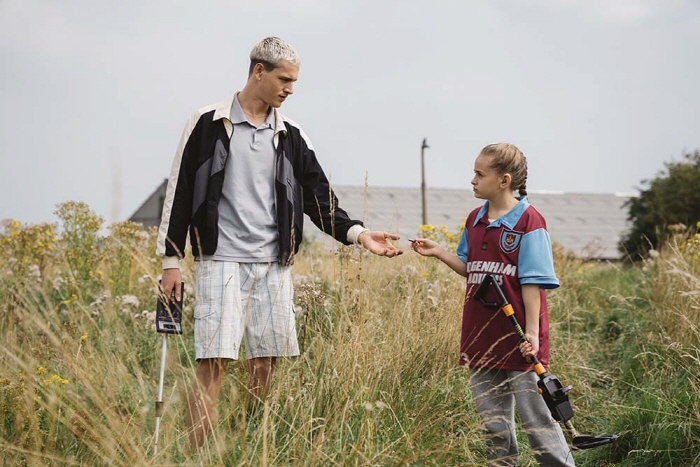
“Scrapper” is a modest but endearing character drama film revolving around the strained human relationship between two very different characters. Right from when they meet each other for the first time, you will know where the story is heading, but you will gladly go along with that as amused and then touched by how their relationship is developed along the story.
At the beginning, the movie quickly establishes the daily life of a 12-year-old girl named Georgie (Lola Campbell). Because her single mother recently died due to some terminal illness, Georgie has lived alone in their little residence for a while, but, as reflected by her plucky response to a certain familiar saying appearing right before the opening scene, she has been pretty all right with living all by herself, and we get some amusement as how she does that. Besides routinely checking on her current stage of grief, she always cleans her residence everyday, and she also often earns a bit from stealing bicycles outside while often absent in her elementary school. In case of those social workers assigned to her, she lied to them that she has living with an uncle (His name is one of many little funny things in the film, by the way), and she certainly makes sure that this deception of hers works.
The only person who knows what Georgie has been doing is Ali (Alin Uzun), one of the neighborhood boys who has been Georgie’s best friend. He does not even tell anything to his single mother mainly because Georgie’s residence can be a little private place where he and Georgie can freely spend time together. He simply lies to her mother that he and Georgie will be fine with her uncle, and his mother becomes more interested in meeting her uncle someday.

On one day, there comes an unexpected change into Georgie’s daily life. A lad suddenly comes into the backyard of her residence, and, what do you know, this lad turns out to be her father who left her and her mother several years ago. Because she does not remember her father a lot, Georgie does not trust or like Jason (Harris Dickinson) much from the beginning, but he is determined to stay in her residence as long as he wants, and Georgie has no choice because he may expose her ongoing lie to those social workers.
What follows next is how Georgie and Jason gradually accept each other more than before. Although he looks more like a big brother instead of a good father, Jason tries his best for taking care of Georgie, though that is the last thing she wants from him now. He willingly presents himself as someone to take care of her instead of her uncle, and he also gives a bit of advice to her when she happens to clash with Ali at one point.
Meanwhile, the movie comes to pay more attention to the emotional status of Georgie, who is not as fine as she looks on the surface just like many other people struggling with personal grief. There is a room where she can be totally alone, and what is inside that room reflects more about how much she has struggled with her immense loss caused by her mother’s death.
Despite the remaining gap between him and Georgie, Jason tries his best for making things better for her, and we get a series of sweet moments as they tentatively approach closer to each other. Besides teaching her a little on how to steal a bicycle more efficiently, he tells a bit about his past with her mother, and there is a humorous scene where he and Georgie try a little conversation play at a local train station.

Without resorting to any cheap sentimentality, the screenplay by director/writer Charlotte Regan, who made a feature film debut here after making several short films, sticks to its low-key tone while occasionally throwing some offbeat touches to enjoy. The situation surrounding its main characters is sometimes explained by a number of minor supporting characters looking and talking directly into the camera, and I also like a couple of nice humorous moments involved with those little spiders in Georgie’s residence, though they will surely make a friend of mine wince a lot due to his arachnophobia.
Above all, the movie is held together well by its two lead performers. Young newcomer Lola Campbell is superb in her unadorned natural acting balanced well between innocence and shrewdness, and Regan also did a fabulous job of drawing solid supporting performances from a group of other young performers including Alin Uzun. On the opposite, Harris Dickinson, who has been a new talented actor to watch since I came across his breakout performance in Eliza Hittman’s “Beach Rats” (2017), ably supports his young co-star without never overshadowing her at all, and he is also quite convincing as his character comes to show more care and affection along the story. Although he is absent in a certain key scene around the end of the story, we can feel his character’s sincerity as we observe Georgie’s response to a certain stuff left by his character, and that is the main reason why the ending is so poignant to say the least.
In conclusion, “Scrapper”, which won the Grand Jury Prize for the World Cinema Dramatic Competition when it was shown at the Sundance Film Festival early in this year, is a small but precious gem to cherish thanks to Regan’s skillful handling of story and characters as well as the excellent works by Campbell and Dickinson. It is exactly what you can expect from the story premise, but it handles the story and characters much better than you may think, and I assure you that you will find it quite touching in the end.



 Seongyong's Private Place
Pingback: 10 movies of 2023 – and more: Part 2 | Seongyong's Private Place