

South Korean film “Road to Boston” is so shamelessly corny and old-fashioned that I cringed a lot more than once while watching it yesterday. Here is a dramatic real-life story which is surely worthwhile to tell for good reasons, but the movie unfortunately soaks this interesting story in heavy-handed melodrama coupled with blatant nationalism, and it actually feels pretty boring and tedious despite being less than 2 hours.
At first, the movie shows us the historical injustice involved with a Korean marathoner named Sohn Kee-chung (Ha Jung-woo), who has been regarded as one of the legendary Korean athletes in the 20th century since he won the marathon race at the 1936 Berlin Summer Olympics. As many of you know, Korea was occupied by Japan at that time, so Sohn had to wear the Japanese flag on his uniform all the time as officially being a Japanese runner, and a little gesture of defiance at the time of his monumental glory could almost finish his athletic career later.
After 11 years later, Korea and its people are now free, and Sohn has been openly respected as a national hero in Seoul, but he feels rather bitter and sour while being retired for a while. Right after Japan left Korea after the end of the World War II in 1945, Korea was divided in half by US and the Soviet Union, and Sohn still cannot bring his family from the north side as this division becomes more solidified day by day.

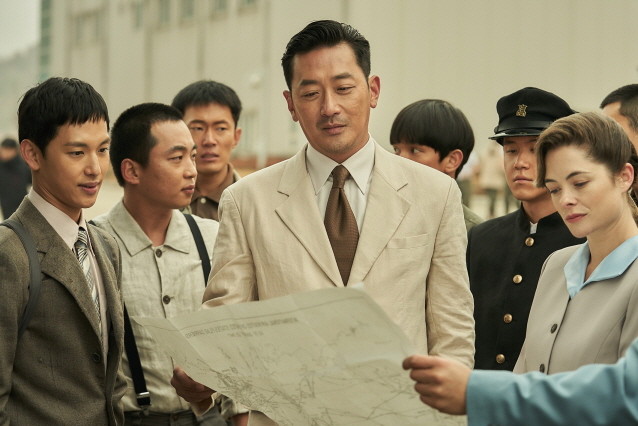
On one day, Sohn is approached by Nam Sung-yong (Bae Seong-woo), a friend/colleague of his who incidentally finished third at the 1936 Berlin Summer Olympics marathon race. Nam has been training a bunch of lads who may become as good as him and Sohn someday, and Nam suggests that Sohn should coach these lads for the upcoming Boston International Marathon, which is incidentally the first international marathon race to be held after the World War II. Sohn is not so eager to accept this proposal of his colleague, but, of course, he eventually agrees to be back in action because somebody must succeed his invaluable legacy.
One of these lads under Sohn’s coaching is Suh Yun-bok (Im Si-wan). As shown from his first scene in the film, he has already shown his considerable potential as a long-distance runner, but Sohn does not like Suh that much just because he thinks Suh is too cocky and willful. In case of Suh, he surely wants to be a marathoner as good as Sohn, but he must do a number of menial jobs first for taking care of his sick mother, so Nam has to provide a bit of unofficial help for persuading Suh to join the team.
What follows next will not surprise you much if you are a seasoned moviegoer like me. Yes, Sohn surely gives Suh and others hell for reminding them that they really should train themselves hard for representing their country. Yes, Suh and Sohn certainly come to conflict a lot with each other, but then they come to recognize and respect each other. Yes, the movie definitely overuses its loud and sentimental score whenever Sohn galvanizes Suh and other trainees including Nam, who volunteers to run again even though he is a bit too old considering his current age.
We might not mind these and many other clichéd stuffs at all if director/writer Kang Je-gyu, who has been known for his two successful films “Shiri” (1999) and “Taegukgi” (2004), paid more attention to storytelling and characterization. His screenplay is frequently riddled with bad dialogues and clumsily nationalistic speeches, and the movie also often hurries itself too much without any engaging character development. While its three main characters feel rather flat and quotidian, many of supporting characters around them are more or less than broad caricatures, and this glaring flaw is particularly evident from several perfunctory female roles in the film.

During its last act involved with the Boston International Marathon, the movie underwhelms us more with its mediocre presentation of what is supposed to be a dramatic race to excite and touch us. It merely hops from one point to another without any real sense of narrative momentum, and we are only distracted more due to its many crummy aspects including the overbearing score which constantly forces more sentimentality and nationalism upon us. Furthermore, it is quite evident that Kang and his crew members did not shoot this part in Boston (They did it at several locations in Australia instead, by the way), and I cannot possibly give any good excuse if the movie is roasted by the members of the Boston Society of Film Critics for the sheer lack of authentic mood and details.
The main cast members of the film diligently try, but they are ultimately limited or wasted by their superficial roles. While Ha Jung-woo is merely required to raise his voice from time to time, Im Si-wan does not leave much impression despite his committed efforts, and Bae Seong-woo and Kim Sang-ho manage to acquit themselves fairly well despite mostly being demanded to function as the comic relief element of the story.
In conclusion, “Road to Boston” is another disappointing mainstream South Korean film of this year. When the movie was over, I was already ready to run to some other South Korean released on the same day, and that surely says a lot about its utterly exasperating failure. In my humble opinion, these three real-life figures are indeed remarkable athletes to remember, but, folks, they deserve much better than this crappy flop.


 Seongyong's Private Place
I saw the film today, just in time before its cinema run ends. Kang Je-gyu’s earlier film My Way got me interested in the history of Korean marathon running. That film included scenes of the marathon of the 1948 Olympic Games, and having been taken to see King George VI on his way to opening them (as shown in The King’s Speech) and attending elementary school in the early 1950s across the road from the stadium where they were held, I found the race scenes in that film (shot in Riga) even more incongruous than the scenes in this one (though the vintage Citroen van might have been better used in a Jacques Tati or Rene Clair film). Korean athletes’ later participation in the Boston Marathon makes an interesting story.
SC: I did not like “My Way” (2011) either.