
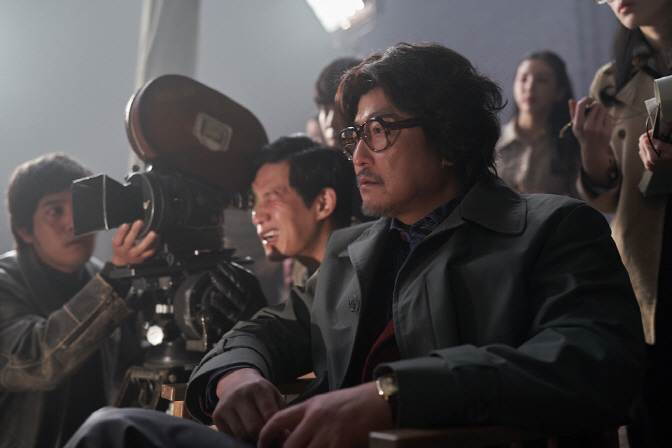
South Korean film “Cobweb”, which finally arrived in South Korean movie theaters yesterday after being shown at the Cannes Film Festival early in this year, is about one crazy filmmaking day to watch. Although it stumbles from time to time besides being a bit too long, the movie delivers a fair share of entertainment on the whole, and you may appreciate it more if you are familiar with the South Korean films during the 1960-70s.
Set in South Korea in the early 1970s, the movie opens with the artistic dream of a prominent filmmaker named Kim Yeol (Song Kang-ho). Kim has been making his latest work, and he and his cast and crew members are almost at the end of their shooting period, but Kim comes upon a seemingly brilliant idea about his new film, which is incidentally titled, yes, “Cobweb”. Inspired by that dream of his, he decides to change the finale a bit, and it looks like all he and his cast and crew members will have to do is working for two more days before the following post-production process.
However, not so surprisingly, things do not go that well for our filmmaker hero right from the start. His production team members manage to have all the cast members come to the big studio building of their production company, and his technical crew members quickly prepare for this sudden shooting, but the president of the production company, who is incidentally the wife of a famous director who was Kim’s mentor before his untimely death, is not so willing to allow that for understandable reasons. Kim’s revised screenplay must be checked by those government censorship officials first, but Kim is already determined to ignore this routine procedure while being so occupied with his artistic vision, and he naturally comes to clash a lot with the president before the president eventually leaves for Japan.
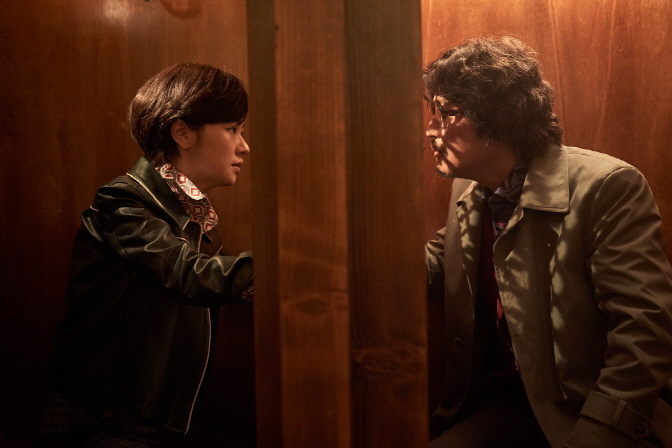
In contrast, the president’s niece, Mi-do (Jeon Yeo-been), is willing to help and support Kim as much as possible as a fervent admirer of Kim’s movies. Once her aunt is gone, she actively pushes the cast and crew members into the shooting as Kim wants, and everything seems to be going fairly well for everyone including Kim as the camera begins to roll on the set.
Of course, the situation gradually becomes messy and chaotic in one way or another. For instance, Kim’s lead actor seems to be very close to one of the actresses of the movie, and that becomes more evident to everyone else around them, no matter how much they try to hide that from others. They and the other cast members often express their confusion and frustration with Kim’s revised finale, but Kim simply pushes them forward after belatedly coming to realize that he must finish the shooting before the end of the day. In addition, there also comes a grouchy censorship official later, and we get an absurd moment from Mi-do’s hasty attempt to hold this official at one spot while Kim and his crew and cast members are hastily working in the other spots inside the studio.
The main pleasure of the movie comes from how Kim’s artistic vision randomly bounces along the story. At first, he thought that he and his crew members will just need to shoot a few big scenes, but they come to shoot much more than he originally planned, and this certainly frustrates not only his crew members but also the cast members of the film. At one point in the middle of the story, he has no choice but to play a certain minor supporting character for himself, and what follows next is a hilarious moment of narcissistic acting to amuse you.
After the chaotic spirit of its first half, the screenplay by Shin Yeon-shick, who also directed a fair share of films including “The Fair Love” (2010) and “The Russian Novel” (2013), comes to lose some of its comic momentum during the second half as the situation becomes more serious and daunting for Kim and others around him. While he is still determined to make a masterpiece to remember, he is still blocked here and there as before, and he also comes to face the fact that he should make a bit of compromise for protecting his artistic vision.
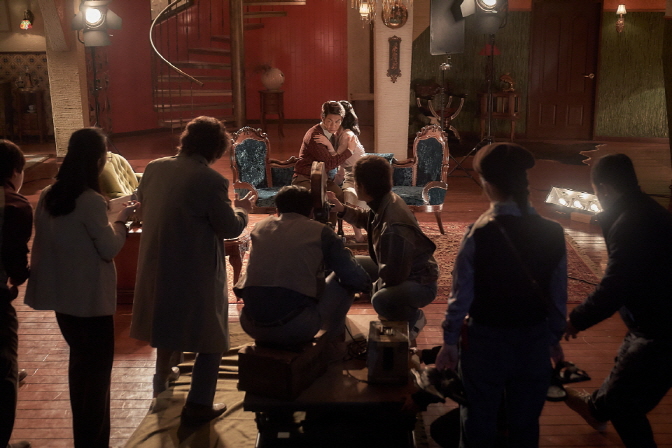
Kim’s movie in the story occasionally functions a pastiche of the South Korean filmmaking during the 1960-70s as demanded, and director Kim Jee-won and his crew members including Oscar-nominated editor Yang Jin-mo and cinematographer Kim Ji-young surely have a field day as recreating the recognizable qualities of those old South Korean film of the 1960-70s. I am sure that this aspect of the film will be appreciated more by the audiences of older generations including my parents, and I really want to know how my parents will respond to a number of key filmmaking moments in the film.
While Song Kang-ho, who has been the ever-dependable stalwart of South Korean Cinema during last three decades, diligently holds the center with another fine performance of his, several other performers in the film leave some impression even though many of supporting characters in the story remain on the level of broad caricatures. While Jeon Yeo-been steals the show with her character’s irrepressible enthusiasm, Im Soo-jung, Oh Jung-se, and Krystal Jung have each own moment to shine, and I also enjoyed the brief cameo appearance by Jung Woo-sung, who previously worked with Song in Kim’s previous film “The Good, the Bad, and the Weird” (2008).
On the whole, “Cobweb” is not entirely without flaws, and I still wonder whether it can be improved more via cutting around 20 minutes, but it is at least more entertaining compared to the glaring failure of Kim’s recent film “Illang: The Wolf Brigade” (2018). It certainly does not reach to the greatness of Federico Fellini’s “8 1/2” (1963) or François Truffaut’s “Day for Night” (1973), but it has some goodies to be savored including Song’s entertaining acting, and I will not deny that I chuckled more than once at last night.


 Seongyong's Private Place