

“Cassandro”, which was released on Amazon Prime in last week, is less flamboyant while also being more earnest than expected. Based on the real-life story of a gay American-born Mexican luchador (professional wrestler), the movie sensitively focuses on its characters as paying some attention to those wrestling matches at times, and I enjoyed its down-to-earth qualities enough to overlook its rather glaring weak aspects.
Set in the early 1980s, the movie tells the tale of Saúl Armendáriz (Gael García Bernal), a young Mexican American gay man who works as a mechanic in El Paso, Texas while occasionally crossing the Mexico-US border to participate in lucha libre wrestling matches held in Ciudad Juárez, Mexico. During the opening sequence, we see how he prepares himself as “El Topo” before entering the ring, and we also get to know about a bit about how a wrestling match is set and then played before its audiences.
Because he has been rather bored and tired with being “defeated” by those more famous wrestlers, Saúl is willing to hone his skill and style more, and that is how he begins his modest training under a female trainer named Sabrina (Roberta Colindrez). As he becomes more confident day by day, he considers playing an exótico, an unmasked wrestler in drag, but he has a different idea about how to play his role. Usually, exóticos are expected to lose on the ring for making their opponents look better, but Saúl wants to win in his matches, and Sabrina is willing to help him as much as she can.
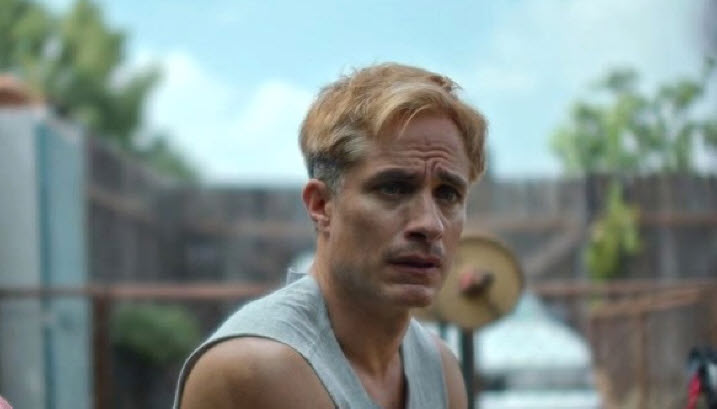
However, we do not get your average training montage sequence because, well, as many of you know, the outcomes of those wrestling matches are always determined from the very beginning. When Sabrina tries to persuade a promoter to end the match with Saúl as the winner, the promoter is not particularly interested at first, but then he changes his mind later as watching how much the audience gradually become enthusiastic about Saúl, who incidentally presents himself as “Cassandro”. As observing how Saúl wins his audiences’ enthusiasm along the match, I came to have more understanding of how some of those popular WWE wrestlers could transfer their success in the ring to the screen. After all, besides all those wrestling skills to wield, they have styles and personalities to draw and engage audiences as entertainers, and I guess that is the key to the success of Dwayne Johnson or David Bautista in Hollywood.
Once he finds his own professional ground, Saúl soon finds himself becoming pretty popular in Mexico, and his mother Yocasta (Perla De La Rosa), who has always supported him a lot even after he came out of his closet when he was 15, is certainly excited about that. Although she was initially not so eager to watch her son’s matches because of her understandable concern, she eventually becomes one of his No.1 audiences just like Sabrina, and there is a little poignant moment when she firmly defends his son to one of those homophobic audiences around the ring.
While surely feeling hurt a lot by all those homophobic insults hurled at him during his matches, Saúl does not mind this much mainly because he has been focusing on how to get the recognition of his absent father. Although he left his son and Yocasta shortly after learning that his son is gay, Saúl still often reminisces about those happy childhood times when he and his father spent time together while watching the wrestling matches on TV, and he sincerely hopes that his father will watch him on TV at least.
Meanwhile, the movie also focuses a bit on Saúl’s romantic relationship with one of his fellow wrestlers, which is unfortunately the weakest part of the story. Right from when their eyes meet early in the film, they click with each other while not showing anything to others around them, and Saúl and Gerardo (Raúl Castillo) eventually begin a little affair of theirs although Gerardo is a married guy with several children. However, when Saúl later comes to learn that Gerardo will never leave his family at any chance, their romance ultimately fizzles without much fuzz, and Saúl’s attention is soon diverted to a young hunky drug dealer named Felipe (Benito Antonio Martínez Ocasio)

Despite this weak subplot, the movie continues to hold our attention via its unadorned realistic approach to the story and characters under the good direction of director/co-writer Roger Ross Williams, who won an Oscar for his short documentary film “Music by Prudence” (2010). Several wrestling matches in the film feel rather plain on the surface, but they are depicted with enough spirit and cheer in addition to functioning as a crucial part of the story.
Above all, Gael García Bernal, who has always been interesting to watch more than 20 years since Alejandro González Iñárritu’s “Amores perros” (2000) and Alfonso Cuarón’s “Y tu mamá también” (2001), diligently carries the film with his another good performance, and he is supported well by several fine supporting performers around him. While Roberta Colindrez and Perla De La Rosa are solid in their respective parts, Raúl Castillo brings some charm to his rather thankless role, and that makes a big contrast to the rather colorless acting of Benito Antonio Martínez Ocasio, a musician who is also known as “Bad Bunny”.
In conclusion, “Cassandro” could be improved more here and there in my inconsequential opinion, but it is still worthwhile to watch mainly due to Bernal’s commendable efforts on the screen. The movie is much milder than I imagined, but this little queer drama film engaged enough on the whole, so I will not be grouchy about its weak points for now.


 Seongyong's Private Place