
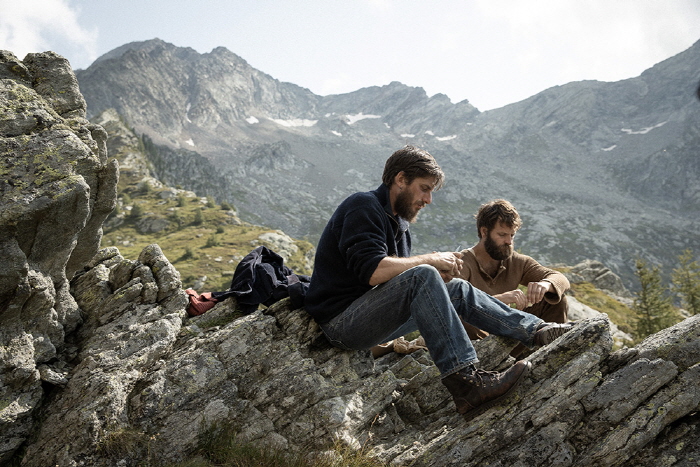
The best thing of “The Eight Mountains” is the cinematography by Ruben Impens, who gives some of the most stunning landscape shots I have ever seen during this year. Although I was a bit tired due to watching and then reviewing two films in row before watching the movie, my rather sleepy eyes were constantly fixated on what is so vividly and crisply captured by Impens’ camera from the beginning to the end, and that was a bit more than enough for compensating for the slow and elusive narrative flow of the film, which baffled and frustrated me from time to time.
Based on the Italian novel of the same name by Paolo Cognetti, the movie mainly revolves around a longtime friendship between its two different characters: Pietro (Luca Marinelli) and Bruno (Alessandro Borghi). In 1984, young Pietro’s parents happened to rent a little cottage in one small rural village in the middle of the Italian Alps area for spending some summertime away from a city where they and their son lived, and that was how young Pietro, played by Lupo Barbiero, befriended young Bruno, played by Lupo Barbiero. Mainly because Bruno was the only boy around Pietro’s age in the village, Pietro was encouraged to hang around with Bruno, and they quickly became each other’s best friend during their first summer.
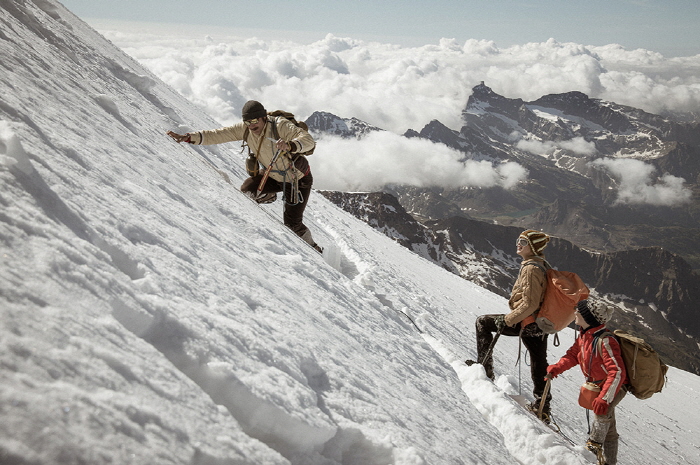
Since that, Pietro and his parents continue to spend every summer in Bruno’s village, and he certainly often looks forward to that, and so does his father. He sometimes takes Pietro to those high mountains around the village, and Bruno also comes to join them later. At one point, they all climb up to one big and snowy mountain, and that is where Pietro unfortunately comes to have his first experience of mountain sickness.

Probably because he is their son’s best friend, Bruno’s parents come to care a lot about Bruno’s welfare and education, so they persuade Bruno’s uncle and aunt, who have incidentally taken care of Bruno due to his parents’ respective absence, to let Bruno live with them and their son. However, Pietro does not like this decision much because he thinks Bruno is happy enough in his village, and Bruno is not particularly enthusiastic about this change either.
Anyway, the situation is abruptly changed later because Bruno’s mostly absent father takes away Bruno from the village instead. Several years later, Pietro, who now becomes a teenager played by Andrea Palma, accidentally comes across Bruno, who also grows up a lot as being played by Francesco Palombelli. However, they simply and silently recognize each other from the distance, and that has been all for them during the next 15 years.
In the meantime, the movie also focuses on Pietro’s rebellious conflict with his father. He wants to be a writer, but his father does not approve much of that, and that eventually leads to several years of estrangement before his father’s untimely death. Quite saddened and devastated, Pietro returns to the village for getting to know his diseased father more, and Bruno gladly welcomes him while ready to show a little isolated place bought by Pietro’s father some years ago. He wants to build a cabin there as Pietro’s father always wanted, and Pietro willingly agrees to help his friend’s little personal project as much as possible.

It seems that there is indeed a strong bond between Bruno and Pietro, but the screenplay by Felix van Groeningen, a Belgian filmmaker who has mainly been known for his Oscar-nominated film “The Broken Circle Breakdown” (2012), and his co-director/co-writer/wife Charlotte Vandermeersch frequently regards Bruno and Pietro’s relationship from the distance without clarifying or illustrating their friendship that much on the whole. No, there is not any homosexual undertone around their private moments, and I appreciate that the movie simply wants to depict a plain male friendship with considerable sincerity and honesty, but the depiction of their relationship development in the film is often a little too dry and opaque for me. In fact, it is rather difficult for me to understand why Bruno is so special to Pietro, and the movie is all the more elusive about how Bruno exactly feels about his friendship with Pietro, because the story is mainly presented via Pietro’s viewpoint.
In the end, what ultimately remains on my mind is all those breathtaking landscape shots in the film, which is a very good reason for watching the movie in a big screening room. While being shot in the screen ratio of 1.33:1, the landscape shots in the film are often astounding to say the least, and I frequently found myself wondering more about how they actually shot these haunting visual moments. As a matter of fact, some of these moments look quite risky for the crew members as well as the performers, who surely took some safety measures during the shooting.
In conclusion, “The Eight Mountains”, which won the Jury Prize along with Jerzy Skolimowski’s “EO” (2022) when it was shown at the Cannes Film Festival early in last year, seems more interested in capturing the natural beauty of its main background than delving into its two main characters’ longtime relationship, and that made me constantly feel distant to the overall result even though I patiently follow the story and characters to the end. Mainly thanks to its top-notch visual quality, it was a mostly rewarding journey on the whole at least, but I think you should be aware of what it is about as well as how it is about in advance, so I recommend it with some reservation.


 Seongyong's Private Place
Pingback: 10 movies of 2023 – and more: Part 2 | Seongyong's Private Place