

“The Blue Caftan”, which was selected as the Moroccan submission to Best International Film Oscar in last year, is about three good people who happen to find themselves facing their matters of heart in one way or another in their little world of tradition and craftmanship. Just like they carefully handle those lovely clothes in the film, the movie subtly and sensitively handles their hidden emotions below the surface, and it is often poignant to see how they try their best to deal with their tricky personal circumstance.
Saleh Bakri, a Palestinian actor who was one of the supporting characters in “The Band’s Visit” (2007), plays Halim, a middle-aged guy who has run a caftan store along with his wife Mina (Lubna Azabal, who was unforgettable in Oscar-nominated film “Incendies” (2010)) in Salé, Morocco. Although things have been not so good for their business as handmade caftans become less popular, Halim and Mina keep going nonetheless, and we come to see more of how much he has depended on his wife while he mostly focuses on making those beautiful caftans in his workplace behind the counter.
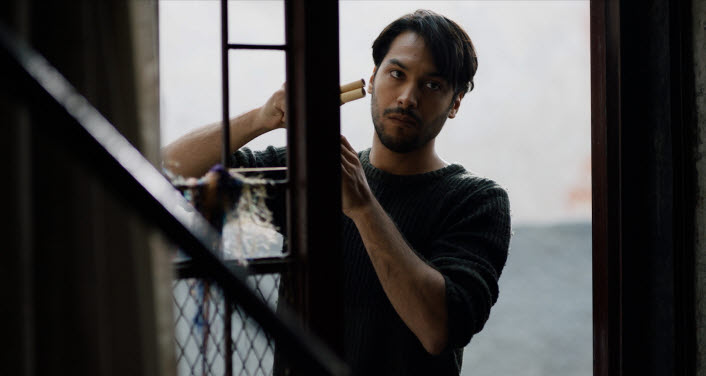
And then there comes a little change via a handsome young man named Youssef (Ayoub Missioui), who happens to be hired as a new apprentice of the shop. Although both Halim and Mina do not much expect much from him because they have seen so many other lads merely come and then go, Youssef somehow feels different to Halim, and Halim cannot help but become more conscious of Youssef as mentoring him day by day.

Not so surprisingly, it is gradually revealed that Halim is a gay man who has been hiding his sexuality for many years behind his stoic and reserved appearance. The movie often shows him visiting a local bathhouse where he can have a quick hookup in a private place, and we also see how Mina has accepted her husband’s closeted status just because she really loves him despite their incompatibility. Although they have been more like business partners/roommates instead of real spouses, Halim appreciates Mina’s affection and devotion nonetheless, and that is the main reason why Mina has been content with her rather barren married life.
As a woman who has known and understood her husband well, Mina soon comes to sense what has been going on between her husband and Youssef. At one point, she has been rather hostile to Youssef due to a little matter involved with a supposedly missing roll of fabric, and that certainly adds more tension among her and the two men in the store.
However, as already shown to us earlier in the film, Mina has been quite ill, and there eventually comes a point where she must stay at her home as her illness gets worsen hopelessly. After being told that there is nothing he can do for her except standing by her to the approaching end, Halim does not hesitate to stop working for a while, even though he has been working on a certain expensive caftan for some snotty customer.
The mood surely becomes a little more melodramatic, but the screenplay by director Maryam Touzani, who previously made a feature film debut with “Adam” (2019), and her producer/co-writer Nabil Ayouch takes its time as usual while never losing its human dimensions. Throughout the film, we often observe more details on Halim’s craftmanship, and the movie is constantly filled with melancholic qualities as he is frequently reminded of how his old traditional craft has been overlooked and forgotten bit by bit. There are not many craftsmen like him out there, and there is a little bittersweet moment when he examines a very old caftan which still looks gorgeous but will probably be never made again.
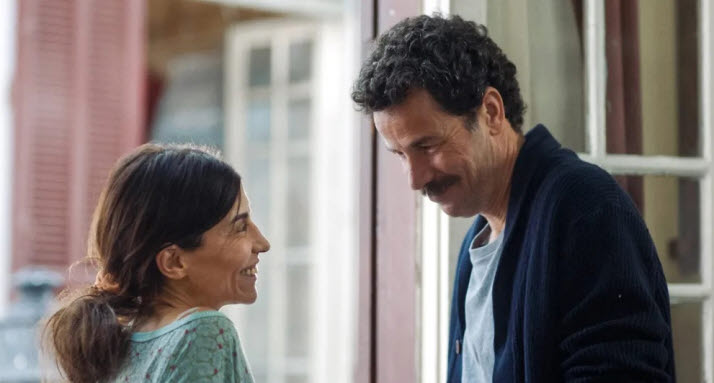
Touzani also did a commendable job of immersing us into Halim and Mina’s little isolated world. Cinematographer Virgine Surdej’s camera usually sticks around the main characters and their respective viewpoints, and their surrounding environment is seldom opened up until the very last shot of the film, while we occasionally hear the sound of the nearby beach from the distance. As a result, we are reminded more that Halim and Mina have had only each other despite the emotional distance between them, and that is why it is so moving to see what Mina does for Halim later in the story.
The movie depends a lot on its three main cast members, who are all convincing in their respective roles. Quietly holding the center as required, Bakri slowly lets us to sense his character’s growing emotional conflict along the story, and he is especially terrific when Halim is barely holding his feelings when he could respond more to Youssef. On the opposite, Azabal is equally powerful as vividly illustrating Mina’s complex emotion, and she and Bakri effortlessly embody a long history between their characters. While Youssef is relatively less developed in comparison, Ayoub Missioui holds his own place well between Bakri and Azabal, and he is effective when his character come to show more care and sincerity than expected.
On the whole, “The Blue Caftan” is a slow and restrained drama of repressed feelings and thoughts, so it takes some time for you to get accustomed to its rather dry storytelling and leisurely narrative pacing. Nonetheless, this is still an engaging human story filled with not only empathy and compassion but also specific mood and details to be appreciated, and it will come to you as another interesting window to others different from you.


 Seongyong's Private Place
Pingback: 10 movies of 2023 – and more: Part 2 | Seongyong's Private Place