

Pablo Larraín’s new film “El Conde”, which was released on Netflix in last week not long after it was shown at the Venice International Film Festival, is a horror black comedy which depicts a notorious real-life Chilean dictator as a 250-year-old vampire. This sounds like a mere one-joke premise on the surface, but the movie is willing to go for more gore and grotesqueness for its dark laugh and ridicule, and you will be often amused by how it makes acerbic points on evil and fascism under its austerely deadpan storytelling approach.
Mainly set in an unspecific remote and isolated rural area, the movie initially establishes how things have been depressing for Augusto Pinochet (Jaime Vadell) since he faked his death several years ago. There was a time when he has been quite thirsty for not only blood but also many different revolutions ranging from the French one in the late 18th century to the Russian one in early the 20th century, but, after becoming a powerful dictator in Chile, 1973, he found himself losing the will to live and suck blood more. As a matter of fact, the main reason of faking his death is that he simply wants to die quietly without having to answer for many of those crimes committed under his dictatorship.
As he has stopped ingesting human blood, Pinochet has become much more aged and fragile, but it seems that there is still a desire for blood and life somewhere inside him. At one point early in the film, a figure in full military attire surreptitiously flies to Santiago at one night, and we surely get a series of gruesome moments including the one showing a human heart vigorously ground in a blender (According to the English narrator of the movie, this particular human organ is a delicacy for vampires).

Naturally, the world outside Pinochet’s residence is shaken by this bloody killing, and that prompts his several human children to visit their vampire father, but, not so surprisingly, their father’s welfare is the last thing to concern them. Unabashedly greedy and opportunistic, they all want him to reveal any information involved with the family’s secret fortune gathered during their dictatorship era, but this turns out to be rather difficult due to Pinochet’s equally depraved wife and his longtime right-hand guy, who has incidentally served him for decades since the Russian revolution and surely enjoyed every brutal and sadistic moment of his during Pinochet’s dictatorship period.
Pinochet’s children try a little scheme to persuade their father, and that is why a young nun comes to Pinochet’s residence as a confidential accountant to sort out all those hidden assets of his. Although she is not a certified public accountant, this young nun turns out to be pretty good at what she is supposed to do on the surface, and Larraín and his co-writer Guillermo Calderón, who won the Screenplay award together at the Venice International Film Festival, have a lot of naughty fun as the young nun later corners Pinochet’s children in one way or another during her separate interviews with them.
Willingly quite oblivious to all those evil deeds committed under their father’s dictatorship, these dirty rotten people impertinently justify their ownership of those hidden assets, and so does Pinochet. Probably because of his unspeakable nature, he does not have much problem with being accused of lots of other crimes including torture and murder, but, ironically, he does not want at all to remembered as a scumbag who stole lots of assets from the country.

Meanwhile, the situation surrounding Pinochet becomes more absurd – especially when he somehow regains the lust for life and blood as being seduced by that young nun. Even though she does not hide much what she was ordered by her church from the very beginning, he cannot help but attracted more to her, and his wife, who has remained as a human as he has insisted for many years, is not so amused at all when it looks like her husband is eager to give the young nun the eternity of which she has been denied.
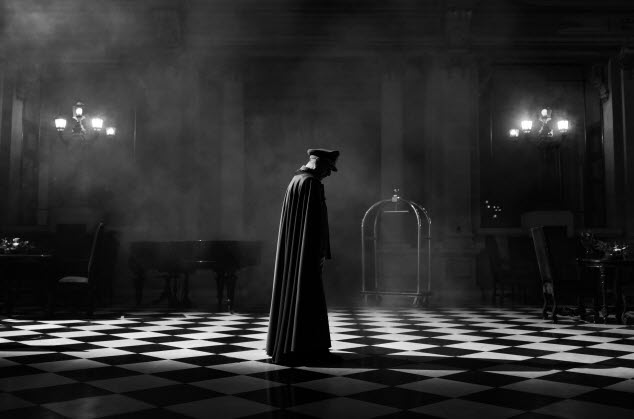
Around that narrative point, the movie springs up more darkness coupled with eerie surrealism, and the following scenes shine with a lot of twisted humor. Cinematographer Edward Lachman, who has been known for his frequent collaborations with Todd Haynes, provides a series of wonderful visual moments full of stark black-and-white beauty, and I particularly enjoyed when the young nun comes to experience a sort of liberating unholiness at one point later in the story. By the way, if you think the mostly offscreen narrator of the movie sounds rather familiar, you will not be surprised much when this figure in question finally makes an appearance in the last act, and this figure surely adds extra black humor to what has been so humorously built up along the story.
Although he drew my attention a lot with his compelling Oscar-nominated film “No” (2012), I found many of Larraín’s following works rather cold and distant despite also being compelling enough for recommendation in each own way. “El Conde”, which incidentally means “The Count” in Spanish, is no exception with its dryly cerebral handling of mood, story, and character, but it ultimately works well a sharply droll mix of horror and black comedy on the whole, and I found myself amused more than expected when I watched it at last night. In my humble opinion, this is one of Larraín’s more interesting works, and I wholeheartedly recommend you to give it a chance someday.


 Seongyong's Private Place
Pingback: 10 movies of 2023 – and more: Part 2 | Seongyong's Private Place
Pingback: My Prediction on the 96th Academy Awards | Seongyong's Private Place