
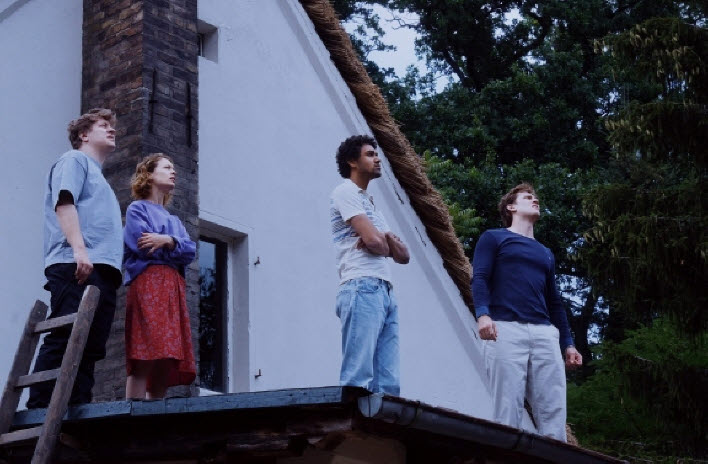
Christian Petzold’s new film “Afire” surprises me for being more humorous and playful compared to some of his more serious films such as “Phoenix” (2014) or “Undine” (2020). Mainly revolving around four different young people who happen to get involved with each other in one way or another during hot summer days, the movie subtly but palpably illustrates the complex emotional undercurrents among them, and then it becomes more poignant than expected after it literally sets the finale on fire.
The movie opens with the arrival of two lads who come to a rural seaside area for spending several summer days at a holiday home in the middle of the local forest. Leon (Thomas Schubert), who is a young promising writer, simply wants to have a quiet time for working more on his second book before his publisher comes, but his friend Felix (Langston Uibel), who is an art school student currently preparing an important photography portfolio of his, is ready to have some fun while also searching for any suitable theme for his portfolio, and this difference between them is more evident when they come across a little unexpected problem shortly their arrival in the holiday house. Somebody is already occupying the holiday house due to a little mistake of Felix’s mother, and Leon is quite annoyed as he and Felix have no choice but to be stuck with this stranger there during next several days.
This stranger in question is a young woman named Nadja (Paula Beer). At first, she is just a distant stranger occupying the room right next to the one occupied by Leon and Felix, but it does not take much time for Leon to become curious about this young lady – especially as he seems to be going nowhere in improving the draft of the second book. He keeps saying he has to work, but he only finds himself procrastinating in one way or another, and there is even an amusing moment which may take you back to a certain similar scene in Stanley Kubrick’s “The Shining” (1980).

In contrast, Felix actually becomes more inspired and productive as enjoying the summer days as much as possible unlike Leon. At one point, he happens to notice a young lifeguard on the nearby beach, and this leads him to a wonderful artistic idea for his portfolio. Incidentally, this lifeguard, Devid (Enno Trebs), has occasionally visited the holiday house for having sex with Nadja, so Najda willingly invites him to a dinner later, and then we observe how sexually fluid this handsome dude is. After holding everyone else’s attention with his little amusing fictional tale, he makes a little surprise move, and Najda is not bothered by that at all because, well, she and Devid’s relationship has been pretty casual with no string attached from the beginning.
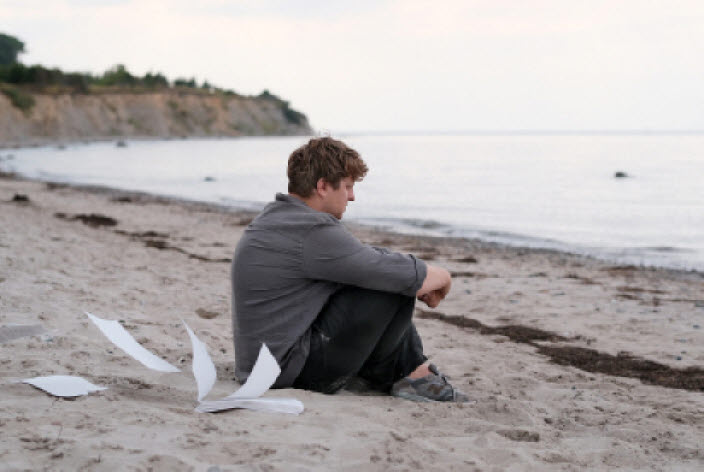
Even though the others around him are simply enjoying themselves, Leon still cannot help but become sullen and petty due to his accumulating artistic frustration, and he remains quite self-absorbed even as the surrounding area is being threatened by a forest fire started from a nearby region. Although it looks like they and others in the area will be safe, the forest fire gradually becomes an ominous fact hovering over them – especially when they watch the forest fire approaching from the distance during one evening.
Once everything in the story is set for the next act, Petzold’s screenplay goes for the jugular. While getting to know more about Nadja, Leon finds himself more attracted to her, and he even lets her read what he has been trying to improve, but, of course, her following response is not exactly what he hopes for. As a matter of fact, she turns out to be much more sophisticated than he thought at first, and there is even a sublime moment when she recites a work of one famous German poet in front of others including Leon’s publisher, who, to more of Leon’s frustration, seems to be more impressed by her than Leon’s second book.

Around that narrative point, you may have some good idea on the eventual arrival point of Leon’s pathetic artistic struggle, but then the movie springs up more honesty and sincerity as abruptly taking an unexpected plot turn later in the story. I will not go into details on that here, but I can tell you instead that what follows next almost perfectly fits with what has been gradually developed along the plot, and the movie eventually comes to us as a humorous but thoughtful exploration on life and writing.
Petzold also draws stellar performances from his several main cast members. As providing some gravitas to his writer character’s inner conflict and frustration, Thomas Schubert ably handles a number of humorous scenes driven by Leon’s silly pettiness, and he and Paul Beer, who previously collaborated with Petzold in “Undine”, have a tentative chemistry between them during their several key scenes in the film. While Langston Uibel and Enno Trebs have each own moments to shine as the two other substantial characters in the story, Matthias Brandt steals the show as Leon’s no-nonsense publisher, and he is simply terrific when his character dryly but emphatically peruses Leon’s latest creation around the end of the story.
Overall, “Afire”, which won the Silver Bear Grand Jury Prize when it was shown at the Berlin International Film Festival early in this year (It was also recently selected as Germany’s submission to Best International Film Oscar, by the way), is alternatively funny and touching in its dexterous mix of comedy and drama, and Petzold surely has a breezy fun to share with us. In short, this is one of the more enjoyable arthouse films of this year, and you should check it out as soon as possible especially if you have admired many of Petzold’s works like I have.


 Seongyong's Private Place
Pingback: 10 movies of 2023 – and more: Part 2 | Seongyong's Private Place