
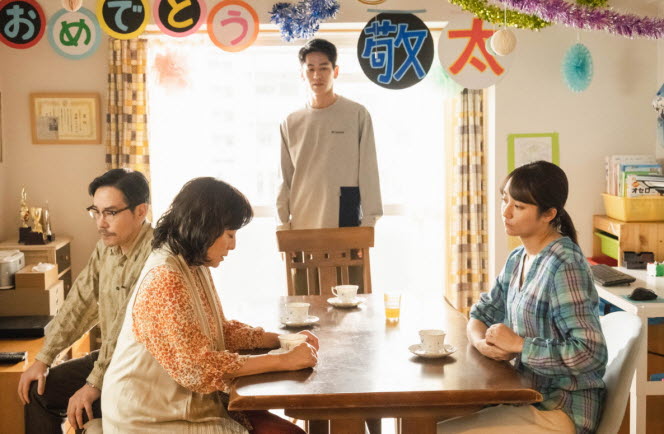
Koji Fukuda’s new film “Love Life” calmly follows the emotional struggles of its two main characters who come to reflect a lot on love and life after one shattering incident. This is surely a familiar melodramatic setting, but the movie thoughtfully handles its story and characters with enough sensitivity and sincerity, and we come to care more about their complicated matters of love and life along the story.
At first, the movie seems to be about a little family conflict. As Taeko (Fumino Kimura) and her second husband Jiro (Kento Nagayama) are preparing for a little private party for not only a little recent achievement of Taeko’s young son but also the 65th birthday of Jiro’s father, everything seems to be going well on the surface, but then we come to learn that Jiro’s father does not approve much of his son’s recent marriage just because Taeko was an divorcée with the son from the previous marriage when Jiro married her several years ago. While he has been like a real dad for Taeko’s son, Jiro still wants his father to show some recognition on his current married life at least, and this conflict between them causes a very awkward moment among them and others at one point, though it is quickly resolved mainly thanks to Jiro’s no-nonsense mother.
When the party is eventually started as more people come later for congratulating Jiro’s father and Taeko’s son, the mood becomes lightened up more than before, but that is when something really bad happens to everyone’s shock. The camera only observes the following aftermath of this devastating incident from the distance, but the resulting grief and anger are quite palpable under the calm surface to say the least, and this situation subsequently reaches to a sort of breaking point when Taeko’s ex-husband comes later after belatedly learning about what happened.

With this unexpected appearance of her ex-husband, Taeko and Jiro’s situation becomes more complicated than before. Her ex-husband, who is incidentally a Korean Japanese guy with hearing disability, has often been homeless since he left Taeko and their little son for some reason at that time, and Takeo, who has worked in a local charity organization for homeless people, is willing to help him a bit even though she still does not like him much. She initially thinks that is all she can do for him, but, what do you know, she finds herself helping him much more than expected when her husband subsequently happens to be absent for a while. When Jiro’s parents move out to somewhere, she lets her ex-husband stay in a nearby apartment of Jiro’s parents, and she also helps him get employed at a local junk shop.
What does she exactly want from him? Wisely not spelling out the answer to us, the movie lets us gather Taeko’s desperate reach toward any kind of consolation or resolution. As she comes to spend more time with her ex-husband, she feels a bit better than before, and he is certainly willing to help her when she needs to do something for resolving her remaining grief and trauma.
Meanwhile, the movie also shows what is going on in case of Jiro, who turns out to spend some time with a certain woman in his past. As talking with each other, Jiro and that woman remember more of how much they were close to each other time in the past, and Jiro cannot help but wonder what his life would have been if he had not cheated on her because of Taeko at that time. As they meet again later, she turns out to have something regretful to reveal to Jiro, and all Jiro can do for her is consoling her a bit, though he and she also see that there is still some feeling left between them.

Steadily maintaining its low-key mood as usual, the movie eventually arrives at its last act where a few unexpected things happen to Jiro and Taeko. While it does not take much time for Jiro to see what has been going on during his absence, the situation becomes rather humorous instead of being melodramatic – even when Taeko’s ex-husband happens to need to go back to his hometown in South Korea for a certain family matter of his. I will not go into details on what follows next, but I can tell you that the movie gives us one powerful moment of complex emotions as Taeko lets herself left alone under the rainy sky.
The main cast members of the film are all solid in their nuanced natural acting. Fumino Kimura is often poignant as her character tentatively struggles with grief and anger along the story, and she is particularly wonderful when Taeko comes to find some peace and quiet inside a certain space she has never wanted to enter since that incident. On the opposite, Kento Nagayama dutifully complements his co-star during their several key scenes, and Atom Sunada is also effective as Taeko’s ex-husband, who is mostly nice but not exactly someone she can rely on.
On the whole, “Love Life”, which is inspired by a song of the same name by musician Akiko Yano, is basically another gentle Japanese human drama of healing process, but it is a fairly engaging one coupled with good mood, storytelling, and performance at least. Although I have never seen Fukada’s several previous works including “Harmonium” (2016), the movie shows that he is an interesting filmmaker to watch, and I guess I should check out some of his previous works while waiting for whatever will come next from him.


 Seongyong's Private Place