
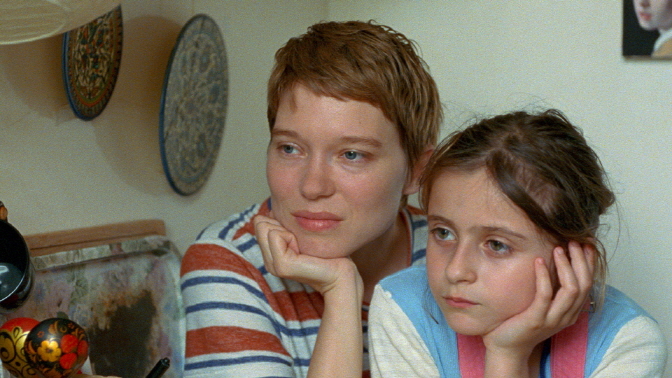
Mia Hansen-Løve’s new film “One Fine Morning” is another nice slice of life you can expect from her. Although it may not be one of her better works, there are a number of good things including that plain but palpable realism observed from many of Hansen-Løve’s works, and it is also anchored well by another stellar performance from its talented lead actress.
Léa Seydoux, a charismatic French actress who has been more prominent as appearing in a number of acclaimed films ranging from “Mission: Impossible – Ghost Protocol” (2011) to “Crimes of the Future” (2022), plays Sandra Kienzler, a young single mother who has worked as a translator/interpreter. During the early part of the film, we observe how busily Sandra goes back and forth between her work and her several family matters including her young daughter and her ailing father, and we gradually gather how much she has been accustomed to this constantly busy status of hers.
However, Sandra cannot help but feel frustrated as her father’s medical condition becomes worse day by day as expected. Due to a neurodegenerative disease called Benson’s syndrome (This does exist, by the way), her father’s cognitive and sight abilities have been seriously deteriorated, and this is quite devastating to him because he was a respected philosophy teacher before being confined to his little apartment due to his illness. As a daughter influenced a lot by her father’s intelligence and sophistication, Sandra is also saddened a lot by her father’s ongoing medical deterioration, but there is really nothing she can do about that, and there eventually comes a point where she really should consider sending him to any suitable facility for old people out there.

At least, her mother, who incidentally divorced her husband a long time ago but still cares about the man she once loved, is willing to help Sandra finding a nice facility to take care of her father, but, alas, it turns out that they do not have many options right now. There are some recommendable ones, but they will have to wait for a while, and her father’s medical condition keeps getting worse as before. In the end, Sandra and her mother decide to send him to a hospital instead, but he cannot stay there that long, and this certainly causes another headache for Sandra and her mother.
Meanwhile, life goes on as usual for Sandra, and there comes a little unexpected change on one day. She happens to encounter an old male friend of her, and, as they come to interact more with each other, they come to sense something mutual developing between them. When he later shows Sandra where he works, she seems simply fascinated with his interesting academic research (He is a cosmochemist, by the way), but then, what do you know, she and he soon come to recognize their mutual feelings to each other, though he has been married for some time.
When they consequently come to face and handle the consequence of their romantic passion, he turns out to be rather indecisive about whether he really should leave his wife and their little kid, and Sandra is not so sure about their relationship either. Maybe she should end their relationship once for all, but she and he keep finding themselves drawn to each other, and she does not know what to do about that.
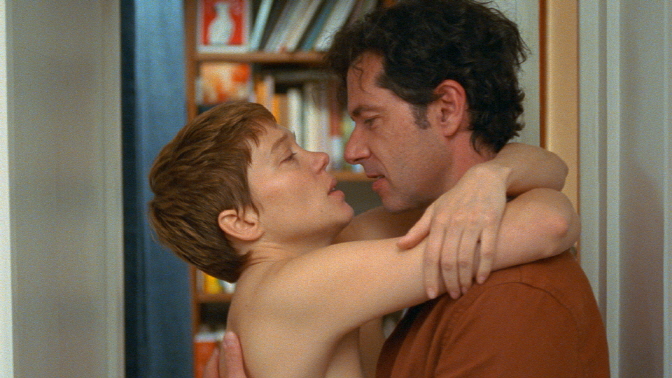
To our little surprise, Hansen-Løve’s screenplay leisurely rolls its heroine’s personal matters along the story without much resolution, but it is often engaging to observe small but precious human moments from that. While mostly sticking to Sandra’s viewpoint, the movie shows some attention to several substantial supporting characters, and I was particularly amused by a couple of humorous scenes involved with Sandra’s mother, an irrepressibly vivacious woman who seems to have had her own interesting life just like her ex-husband. In case of Sandra’s father, it is surely heartbreaking to see him fading bit by bit due to his illness, and there is a bittersweet moment mainly driven by a little piece of his writing later in the story.
The movie lags a bit at times in its slow narrative pacing, but Seydoux’s solid performance carries it to the end, and she is simply fabulous here as subtly illustrating her character’s gradual development along the story. Although many matters remain unresolved for her even at the end of the story, Sandra comes to learn a bit about how to deal and live with these matters, and Seydoux’s expressive face is crucial in conveying that to us in the final scene of the film.
Around Seydoux, several good supporting performers come and go as occasionally having each own moment to shine. While Nicole Garcia often steals the show as Sandra’s mother, Pascal Greggory brings enough pathos to his seemingly thankless role, and Melvil Poupaud clicks with Seydoux well enough to make us understand why their respective characters cannot easily quit each other.
Overall, “One Fine Morning” does not engage or touch me as much as Hansen-Løve’s two previous films “Father of My Children” (2009) or “Things to Come” (2016), which was incidentally included in my inconsequential list of 10 best films of 2016. Nevertheless, it is still a fairly admirable character drama to be appreciated for its strong aspects including Seydoux’s nuanced acting and Hansen-Løve’s sensitive handling of story and characters, and I recommend you to give it a chance someday.


 Seongyong's Private Place