
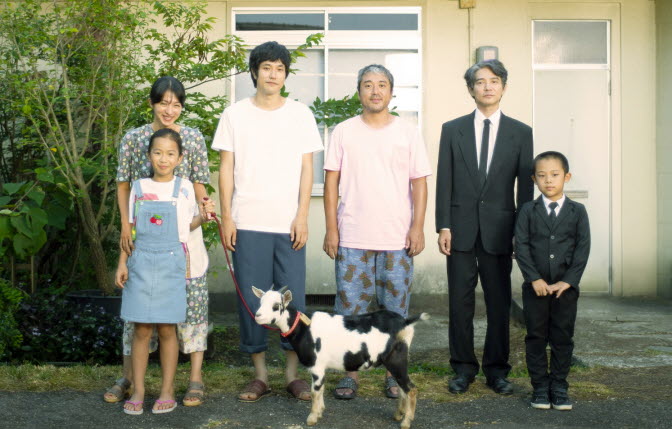
Japanese film “Riverside Mukolitta” is a little whimsical human drama about life and death. Although it does take some time for us to get accustomed to the rather artificial aspect of the story and characters, the movie gradually immerses us into the laid-back summer background inhabited by the main characters, and it earns some genuine poignancy in the end.
The movie begins with the arrival of a seemingly plain young man named Takeshi (Kenichi Matsuyama) at a small seaside village in the Hokuriku region. Shortly after his arrival, Takeshi gets hired as a small local factory manufacturing salty fermented squid, and then, thanks to the generous owner of the factory, he comes to reside in at a shabby one-story apartment building owned by a young widow named Shiori (Hikari Mitsushima). Although he does not particularly like this place or his new job, it seems that there is no alternative for him, and he simply goes through one day after another alone without much enthusiasm as summer leisurely continues as before.
However, there come two little changes in Takeshi’s solitary daily life. When Kozo (Tsuyoshi Muro), a jolly guy living right next to Takeshi’s apartment, drops by Takeshi’s apartment for a little favor, Takeshi does not pay much attention to him, but, what do you know, Kozo subsequently comes into Takeshi’s domestic environment much more than expected. At first, it is simply taking a bath in the bathroom of Takeshi’s apartment, but then, what do you know, Takeshi eventually finds himself sharing a meal with Kozo, and Kozo also has Takeshi help a bit on his little garden full of several different vegetables.

In the meantime, Takeshi receives an unexpected news involved with his father, who left him and his mother a long time ago. His father was recently found dead in his little apartment where he had lived alone, and, as the only surviving family member of his father, Takeshi is expected to take his father’s ashes and some other personal stuffs after the cremation. However, Takeshi is not so willing to do this because he has been cut off from his father for many years since his father left, and it is only after Kozo’s hearty persuasion that he eventually goes to collect his father’s remains.
Once his father’s remains, now contained in a China jar, is put in a corner of the living room of his apartment, Takeshi thinks that is all he can do for now, but, not so surprisingly, he cannot help but feel conflicted about what to do with his father’s remains next. Maybe he can just throw them away, but he does not feel that comfortable with that solution, so the jar containing his father’s remains simply stays there as before.
Fortunately, one of Takeshi’s neighbors turns out to be associated with funeral business, and there is a running gag involved with how this neighbor and his little son try to sell their products from one house to another in the village. Naturally, nobody is particularly willing to prepare for their death in the future right now, and we get some small laugh when this salesman neighbor finally finds a customer willing to pay a lot for what he is going to provide.
As watching this comic subplot, I could not help but think of Yōjirō Takita’s Oscar-winning film “Departures” (2008), which revolves around a guy who accidentally gets himself into a little funeral service business he comes to respect and appreciate a lot more than expected. Like that moving film, “Riverside Mukolitta”, whose title is explained a bit at the beginning of the film, has a lot to talk about life and death, and their common area is evident when Takeshi and his several neighbors enjoy some freshly cooked meat together thanks to the latest sales success of the aforementioned neighbor.

However, while I had no problem with embracing the humanity of the main characters of “Departures”, I must confess that it was a bit difficult for me to regard the main characters of “Riverside Mukolitta” as human figures instead of broad caricature. Sure, there are a number of small good moments which bring some depth and personality to some of its main characters, but director/writer Naoko Ogigami’s screenplay also often goes for more whimsical touches. As the movie frequently shows a local junkyard which looks as cute and ordered as Wes Anderson films in its stable and precise scene composition, we become more aware of its artificial aspects, and we also feel rather distant to its main characters including Takeshi, who mostly functions as a passive blank canvass for more colorful figures revolving around him.
Anyway, Ogigami, who previously directed “Close-Knit” (2017) and recently made “Hamon” (2023), draws engaging performances from her small cast members. While Kenichi Matsuyama humbly occupies the center, several other cast members including Tsuyoshi Muro, Hikari Mitsushima, and Hidetaka Yoshioka have each own little moment to savor, and Muro’s natural vivacity ably complements Matsuyama’s low-key appearance.
In conclusion, “Riverside Mukolitta” is mildly amusing rather than truly touching my heart like “Departures”, but it does everything you can expect from your average intimate Japanese character drama. I have not watched “Close-Knit” or “Hamon” yet, but Ogigami shows here that she is another interesting Japanese filmmaker to watch, and maybe I should check out her other works someday.


 Seongyong's Private Place