

South Korean film “Greenhouse” is mainly about one deeply troubled woman’s misery and despair – and how she comes to resort to some serious criminal measures because of that. While it is rather typical in terms of story and character, the movie is alternatively harrowing and disturbing as patiently building up its main character and the tension around her, and it is also anchored well by one of the most notable South Korean movie performances of this year.
At first, the movie dryly establishes how things have often been desperate and frustrating for Moon-jeong (Kim Seo-hyung), a middle-aged woman who has earned her meager living as a part-time caregiver. Due to some financial problem, she has been living alone in an abandoned greenhouse, and she can only hope that things will get a bitter in the end, once her adolescent son is released from a youth detention center and then she gets enough money for a small but fairly good apartment for them.
However, there are several matters Moon-jeong has to deal with in one way or another. While her son is not so particularly willing to live with her, she also has to pay some attention to her mother-in-law, who has been in a facility for old people due to her ongoing dementia. In addition, it turns out that Moon-jeong has a serious mental problem, and she sometime cannot help but slap or hit herself for no apparent reason.
Because she cannot afford to go to any good psychiatrist, Moon-jeong chooses to go to a support group where she can let out her feelings and thoughts a bit in front of others who are not so different from her as coping with each own mental issue. After listening to a young mentally troubled woman named Soon-nam (Ahn So-yo), Moon-jeong comes to befriend Soon-nam, but their counselor later warns to her about how unstable Soon-name can be at times.

Meanwhile, we get to know about Moon-jeong’s current main source of income. She has been hired to take care of an old blind man named Tae-kang (Yang Jae-sung) and his increasingly senile wife, and Tae-kang is actually willing to help Moon-jeong buy that apartment because he sincerely appreciates her patience and understanding in taking care of his wife. His wife is often quite hostile to Moon-jeong, but, probably because she had a fair share of difficulties as taking care of her mother-in-law, Moon-jeong keeps working without any complaint while becoming more like a family member in Tae-kang’s house day by day.
And then two very serious things occur. Tae-kang comes to learn on one day that he is actually going through the early onset of dementia, and, as a husband who still cares about her wife, he feels quite conflicted about what to do next. It goes without saying that both he and his wife will eventually be sent to a facility for old people someday, and that is the last thing he wants for both of them.
In the meantime, Moon-jeong inadvertently gets herself into a big trouble involved with Tae-kang’s wife. She naturally considers calling the police at first, but then she instantly changes her mind when her son calls her to tell her that he changes his mind and is willing to live with her now, and what follows next is a little act of deception for maintaining the status quo in her daily life as well as Tae-kang’s house.
Around that narrative point, the movie accordingly shifts onto thriller mode, and director/writer Lee Sol-hui, who won three minor awards when the movie was shown at the Busan International Film Festival in last year, provides a series of small suspenseful moments. While Tae-kang remains quite oblivious to her situation, Moon-jeong goes further with more lies and deception, and we come to wonder more what may eventually happen, even though we often observe her wrong choices and actions from the distance.
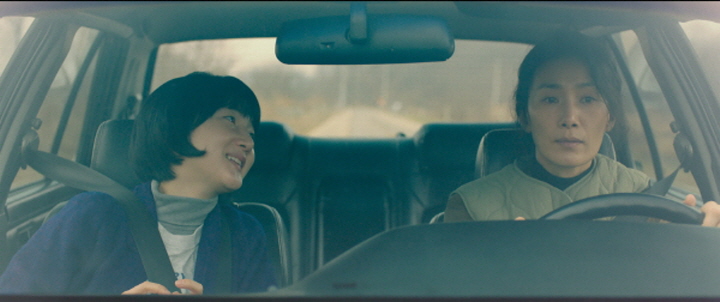
Lee’s screenplay does not give much detail on its heroine’s past, but it lets us understand her accumulating despair and frustration more, and Kim Seo-hyung is simply terrific in her nuanced performance. As steadily maintaining her detached façade without any excuse or compromise, Kim deftly embodies her character’s gradual implosion along the story, and that is the main reason why the inevitable finale works with utterly devastating dramatic effects.
Around Kim, Lee assembles several good performers to notice. As the most decent character in the story, Yang Jae-sung has a number of good scenes including the crucial one later in the film where his character comes to question what is really going on around him, and Shin Yun-sook is equally effective as Tae-kang’s senile wife. In case of Ahn So-yo, she is tasked with a rather tricky supporting role, but she did a commendable job of bringing some spirit and vulnerability to her part, and her character eventually comes to us another very desperate character in the movie.
Like many of recent South Korean independent drama films, “Greenhouse” is quite moody and despairing in its austere depiction of harsh reality, but it is still worthwhile to watch for its competent direction and good performances at least. This is certainly not something you can casually watch on Sunday afternoon, but you will not forget it that easily, and I also sincerely hope that the movie will be a major breakthrough point for the respective careers of its director and lead performer.


 Seongyong's Private Place