

My mind instantly went back to several different space drama films as watching South Korean film “The Moon”, which is incidentally not a remake of Duncan Jones’ acclaimed 2009 SF drama film of the same name. While its first act reminds me a lot of Alfonso Cuarón’s “Gravity” (2013), its middle act sometimes feels like the lunar version of Ridley Scott’s “The Martian” (2015) peppered with bits of Ron Howard’s “Apollo 13” (1995), and its last act attempts to squeeze tears much more than Christopher Nolan’s “Interstellar” (2014). However, there is nothing in the film which surpasses or reaches to the considerable achievement levels of all these wonderful movies mentioned above, and this sheer mediocrity is unfortunately exacerbated more by its awful screenplay and middling performances.
At the beginning, the movie, which is probably set in the late 21st century, quickly summarizes how the South Korean government has tried to advance its little but ambitious space program. Although the first manned mission to the moon was quite disastrously devastating to say the least, those folks at the South Korean space center try again 5 years later, and things seem to be going pretty well during the first several days after the successful rocket launch.
However, due to an unexpected big solar flare, the spaceship comes to have a serious mechanical problem, and that leads to another big problem which consequently kills two astronauts of this mission. To make matters worse, the only surviving astronaut, Hwang Sun-woo (Doh Kyung-soo), does not know much about how to control the spaceship, and that makes those folks at the space center all the more nervous. At least, the spaceship is on the autopilot mode, but there can be any unexpected problem during the rest of the mission period, and everyone begins to fear for the worst.
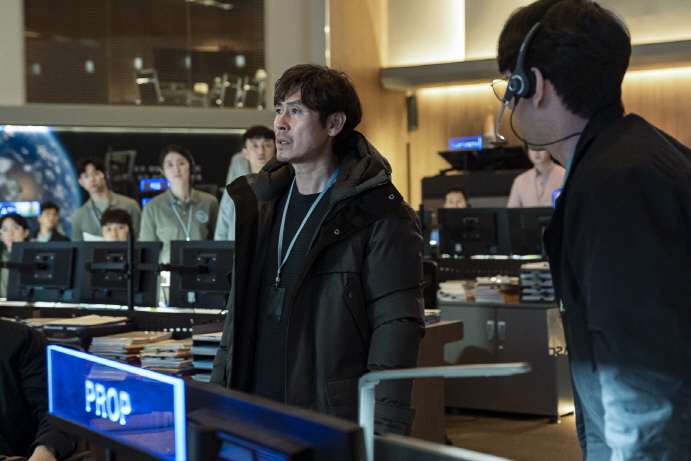
In the end, the head of the South Korean space center hurriedly seeks for help from Kim Jae-guk, who was incidentally his predecessor before that disastrous incident. As one of the chief engineers behind the development of the spaceship, Jae-guk surely knows a lot about how the spaceship is operated, and he reluctantly agrees to provide some help and advice even though he is still haunted by what happened five years ago.
And it soon turns out that there is some past between Jae-guk and Sun-woo, who is revealed to be the son of one of Jae-guk’s close colleagues. Because of their personal connection, Jae-guk becomes more determined to find any possible way to guarantee Sun-woo’s safety and eventual return to the Earth, and Sun-woo is surely ready to go for any chance for survival.
However, there subsequently come small and big troubles along Sun-woo’s increasingly perilous course around the Moon. At one point, he decides to go down to the Moon as scheduled before, but, of course, the situation becomes much more dangerous than expected, and we accordingly get a big action sequence as he desperately tries to survive at least for now.
Meanwhile, Jae-guk often finds his attempts blocked in one way or another. There is an incompetent science and technology minister who seems to have nothing to do except shouting or behaving like a jerk, and there is also some bureaucratic blocking by NASA. Although Jae-guk’s ex-wife Moon-yong (Kim Hee-ae), who is currently the general director of the NASA space station, tries to help him as much as she can despite their estranged relationship, but then she is also blocked by a couple of unsympathetic NASA bureaucrats (The movie will certainly not be welcomed that much by NASA just like Peter Hyams’ “Capricorn One” (1978)).
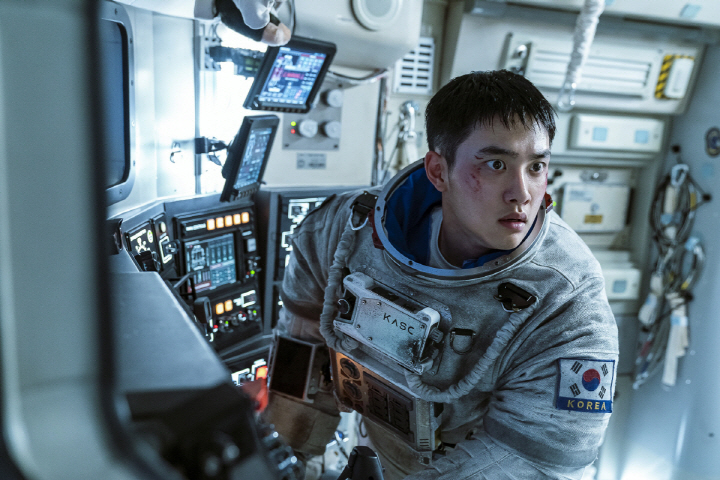
Around that point, we are supposed to care more about its several main character’s tenacious efforts along the story, but the movie frequently falters as resorting to lots of plot contrivance and heavy-handed melodrama. While none of its main characters are particularly developed well, most of dialogues in the film are not so good even at my rather low standard, and, above all, its many shameless attempts to squeeze tears from us are often on the verge of parody instead of ringing true to us.
It is apparent that the main cast members of the film struggle a lot with their deficient dialogues, and the movie will surely not be the best moment in their respective acting careers. Sol Kyung-gu broods, shouts, and cries a lot over many key scenes in the film, but the result remains monotonous to our boredom, and the same thing can be said about Doh Kyung-soo, who reminds me again that he always needs some strong direction for giving an engaging performance to watch. Besides merely looking convincing amid lots of CGIs on the screen, he is rather stiff or bland even during those blatant tear-jerking moments in the film, and he eventually get wasted just like Sol and several other main cast members including Kim Hee-ae, Park Byung-eun, and Hong Seung-hee.
Overall, “The Moon” underwhelms me for many bad reasons, and I can only appreciate the considerable technical efforts from its director/writer/co-producer Kim Yong-hwa, who previously directed “Along with the Gods: The Two Worlds” (2017) and “Along with the Gods: The Last 49 Days” (2018), and his crew members. Sure, the movie shows that they can make a technically competent space drama flick, but, alas, Kim overlooks what really matters most in those films mentioned at the beginning of this review, and I am already having an urge to revisit any of them.


 Seongyong's Private Place