

Florian Zeller’s second film “The Son” is disappointing for seeming to have all the right elements to give us a fairly good family drama on the surface. Again, Zeller adapted one of his acclaimed plays along with Christopher Hampton, but the overall result is curiously dull and lackluster compared to the powerful human moments of their previous Oscar-winning film “The Father” (2020), and we only come to observe its cast members struggling a lot with thin narrative and superficial characterization.
At the beginning, the movie depicts how the daily life of Peter Miller (Hugh Jackman), an affluent New York City lawyer currently living with his second wife, is unexpectedly disrupted when his ex-wife Kate (Laura Dern) comes to tell him about their son Nicholas (Zen McGrath). According to Kate, Nicholas has been quite problematic for rather unspecific reasons, and now he wants to live with his father instead of his mother. Although he is not eager to live with his son mainly because his second wife Beth (Vanessa Kirby) is raising her baby son at present, Nicholas eventually agrees to let Nicholas stay in his residence, and Nichoals seems to be grateful for that.
However, of course, the situation gradually becomes awkward between Peter and his son. While he seems to get a bit better than before after moving to a new school, Nicholas does not talk much about whatever he has been struggling with, and that certainly frustrates Peter a lot. As a father, Peter certainly tries his best to connect with his son, but Nicholas seems to be more withdrawn instead of answering to any serious question from his father, and things only get worse as he shows more erratic behaviors.

Because she usually stays in their residence along with her baby son, Beth often shows her understandable concern to Peter, and Peter feels more conflicted about what to do with his son. In addition, he happens to get a big opportunity which may boost his professional career a lot, and he wonders whether he should give up that chance for paying more attention to his son.
However, no matter how much Peter tries, Nicholas only becomes more distant to him with a number of clear signs of mental deterioration. He turns out to have a certain disturbing habit shown from many mentally unstable people, and he often says about how much he has been tired of everything in his life. He sometimes looks brightened up a bit as shown from an impromptu dance scene between him and his father, but he soon goes back to his usual moody mode, and that disturbs both Nicholas and Beth more.
However, the adapted screenplay by Zeller and Hampton unfortunately fails to convey us whatever Nicholas is struggling in his deeply troubled mind. Despite Zen McGrath’s earnest efforts, Nicholas is mostly defined by his frequent mood swings and inexplicable behavioral patterns instead of coming to us as a real human character, and Zeller and Hampton’s adapted screenplay gets worse as struggling to provide some explanation via a number of contrived dialogues scenes which belong more to stage than screen. Now I am reminded of late critic Pauline Kael once said; “Explaining madness is the most limiting and generally least convincing thing a movie can do.”
As a matter of fact, many of relatively better moments in the film are not directly involved with Nicholas. The private conversation scenes between Peter and his ex-wife are believable as we can sense their past from some underlying bitterness beneath the surface. Even though the movie does not show a lot about what is going on between Peter and his current wife, we can clearly observe some emotional wound when he apologizes to her for whatever happened between them when he was quite drunk at the previous night.
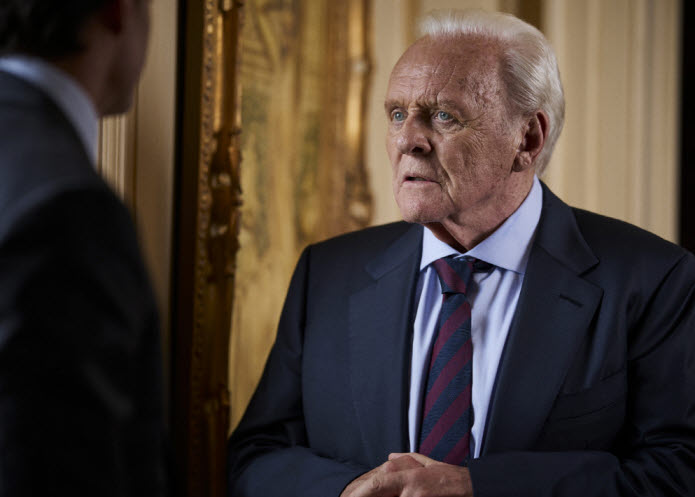
The best scene of the movie comes from a brief but crucial scene between Peter and his aging father Anthony (Anthony Hopkins). Peter still remembers how much he and his mother were mistreated by his father in the past, but Anthony does not show any regret or remorse at all, and it becomes quite apparent to us that their toxic father and son relationship is influencing Peter’s efforts for Nicholas in one way or another.
It is not much of a spoiler to tell you that Peter belatedly comes to realize what a crummy father he has been to Nicholas just like his father was to him, but the movie continues to disappoint us more as throwing more plot contrivance into the story. As a result, what is supposed to feel devastating do not strike us much, and the following epilogue scene do not ring true to us at all.
Anyway, the main cast members of the film try as much as they can do with their underwritten roles. While Hugh Jackman shows that he can be much more serious than he was in “The Greatest Showman” (2017), he is not demanded to do much except looking glum and conflicted, and Laura Dern and Vanessa Kirby are mostly limited by their thankless supporting parts. In case of Anthony Hopkins, who was absolutely magnificent in his Oscar-winning performance in “The Father”, he somehow leaves a lasting impression despite his short appearance, and that says a lot about his immense talent and presence.
In conclusion, “The Son” is a major letdown compared to the considerable achievement level of “The Father”, and it only makes me curious about watching its stage version someday. On sidenote, Zeller also wrote “The Mother” besides “The Son” and “The Father”, and I can only wish that he will have more luck when he is going to adapt “The Mother” later.


 Seongyong's Private Place