
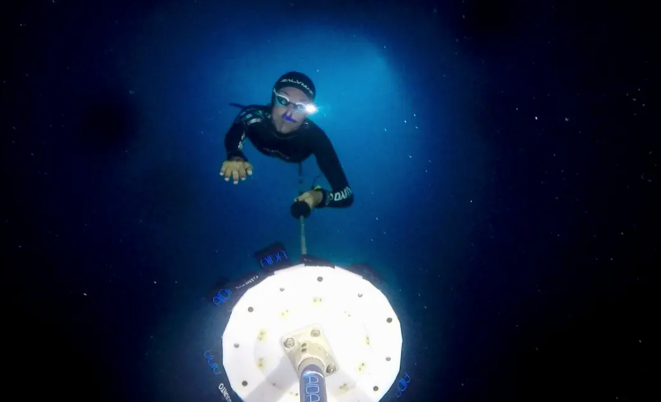
Netflix documentary film “The Deepest Breath”, which was released yesterday, amazed me, chilled me, and touched me more than once. There are a number of incredible moments showing professional freedivers challenging themselves to the end of their physical limits in the depths of the ocean. There are some gut-wrenching moments showing how risky and dangerous every attempt of theirs really is. And there is also a poignant love story between two different people at the pinnacle of their extremely demanding profession.
At the beginning, the documentary looks into the life and career a well-known Italian female freediver named Alessia Zecchini, which is presented mainly via the interviews of several people associated with her including her father. Even when she was very young, Zecchini became determined to become a professional diver once she found her passion toward the ocean and diving, and she impressed even seasoned professional divers a lot with her considerable potential when she was only 17. Although she was subsequently not allowed to participate in national diving competitions later due to her rather young age, she did not give up at all as preparing herself more and more, and she eventually distinguished herself as a rising star diver a lot several years later.
Once it seemed that she accomplished as much as she could inside pools, Zecchini’s interest quickly moved onto freediving, which was much more challenging to her to say the least for many good reasons. First, one should be able to hold his/her breath long enough for diving down toward a certain point deep into the sea, and that is relatively easier compared to big risks and challenges following that. When one later has to swim up to above the water, one has to consider everything including the remaining amount of the oxygen in his/her lungs, and, as explained to us in the documentary, there may be hell to pay if any of these factors happens to go wrong at any point.

Nevertheless, many professional freedivers have kept diving as long as they are allowed by their physical condition because of being drawn to not only the challenges upon them but also the wonder and beauty of the ocean, and Zecchini was no exception as she began to test herself at the following freediving competitions. She had already quite determined to break the world record held by a very famous female freediver to whom she looked up for years, and, probably except herself, it looked like there was nothing to stop her from reaching for that seemingly impossible goal.
When Zecchini later participated in the renowned annual freediving competition held in the Bahamas, she came across a well-known Irish safety driver named Stephan Keenan, and the documentary parallels his life story with Zecchni’s during its first hour. Just like Zecchini, Keenan always went for new challenges and adventures as leaving his home country and then going to here and there in Africa, and that was how he eventually found his lifelong profession later. During his accidental stay at a certain seaside town in Egypt which has a challenging place spot for any ambitious freediver, he became quite interested in freediving, and then he began to work as a safety diver for freedivers because that is also pretty challenging in its own way. Just like freedivers, those safety divers also usually have to depend on the limited amount of oxygen in their lungs, and that means they constantly have to pay attention to not only freedivers’ safety but also their own safety.
And the documentary shows and tells more about the sheer risk and danger of freediving. A number of archival footage clips show some disturbing moments of life and death which really happened in the middle of the competitions, and you will get chilled more as hearing about how human brain can be instantly shut down under the extreme conditions of freediving. Unless those safety divers swiftly work on this alarming emergency, called “blackout”, within one or two minutes, there will be considerable irreversible damage on brain, and this can actually lead to death in the worst cases.

Zecchini and Keenan surely witnessed and experienced numerous incidents of blackout, but that still did not deter either of them at all. Zecchini later agreed to train more under Keenan’s guidance in that seaside town of Egypt, and Keenan was willing to help and train her as much as possible. As they spent more time together, they became closer to each other, and it seemed that they finally found a lifelong soulmate from each other while sharing more passion and dedication toward freediving.
Because the documentary already set a subtle mournful undertone right from the beginning, you will have a pretty idea about what would happen to Zecchini and Keenan on one day of 2017, even though you do not know anything about them like I did before watching the documentary. All I can tell you for now is that director/writer Laura McGann deftly presents what happened at that time via the vivid and palpable mix of interviews, archival footage clips, and some reenactment shots, and the overall result is quite powerful as coupled with the undeniable human poignancy observed from the last interviewer of the documentary.
In conclusion, “The Deepest Breath” is compelling and informative for its close look into freediving and the two interesting human figures at the center of its narrative. As a frequently neurotic guy with considerable aversion to any kind of risk and danger, I initially observed their passion and dedication from the distance, but then I came to admire them a lot more than expected, and that says much about the emotional power of this remarkable documentary.


 Seongyong's Private Place
Pingback: 10 movies of 2023 – and more: Part 2 | Seongyong's Private Place