

“My Sailor, My Love” tries two different things together, but the resulting mix is often clunky and unconvincing. On one hand, we have a supposedly intimate romance drama between two aging people, and the movie did a fairly good job of decorating it with enough mood and sensitivity, but we still do not get to know that much about either of them. On the other hand, we also have a gloomy personal drama focusing on a toxic family relationship, and we are naturally served with painful and harrowing emotional moments, but these intense moments frequently feel jarring in the resulting mix.
Set in some rural Irish beach town, the film initially shows us how things have been not that good in a house belonging to Howard (James Cosmo), an old, retired captain who has lived alone since his wife died and then his children left for each own life. When his daughter Grace (Catherine Walker) comes first for his upcoming birthday party, she immediately notices how messy the house is, but Howard is not concerned much about that, and that eventually prompts Grace to look for a housekeeper to look after his house.
Fortunately, her public notice is soon answered by Annie (Brid Brennan), an aging local widow who has simply looked for some other job besides cleaning a bar belonging to one of her children. Although Grace warns to her in advance that her presence will not be welcomed by Howard, Annie soon finds herself quite disregarded and insulted by Howard right from her first day in his house. She does try, but Howard remains very callous to her without showing any appreciation to her cleaning work on the house at all.
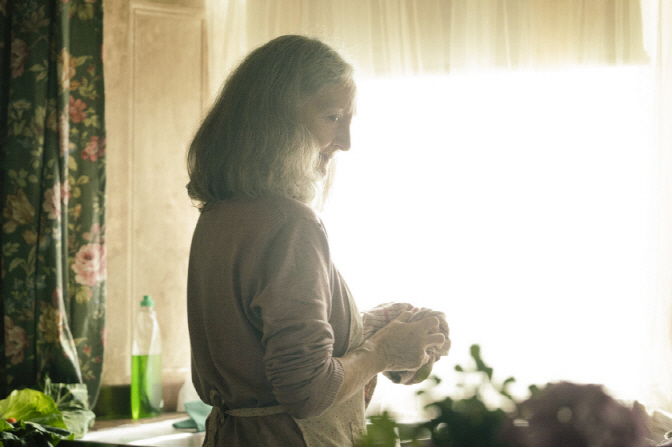
Of course, there eventually comes a point where Annie becomes really exasperated and then Howard belatedly comes to appreciate her domestic service more. He subsequently visits her for apologizing for his rudeness, and she eventually agrees to work again in his house. The mood becomes much milder than before as they get more accustomed to each other during next several days, and, what do you know, they eventually find themselves quite attracted to each other.
To my little distraction, the movie does not give much detail on Annie and Howard’s mutual attraction, except that they are your average two lonely old people. Howard later suggests to Annie that she should live with him, and, despite some initial hesitation, Annie accepts his suggestion just because she has been happy with this unexpected new possibility of romance for her.
While Annie’s kids fully support her decision to move into Howard’s house, Grace is not so pleased at all when she belatedly comes to learn of what is going on between her father and Annie. Although she does not like her father much for understandable reasons, she still finds herself bound to the duty of taking care of her father unlike several siblings of hers, and we also come to gather that this has caused lots of strains on not only her mind but also her relationship with her husband. Her husband tries his best for avoiding more estrangement between him and his wife, but, to his growing frustration, Grace only becomes more occupied with other things including her issues with her father.
Meanwhile, Howard turns out to have a serious health problem, and this leads to more conflict between Annie and Grace. Grace is ready to send her father to a facility for old people as soon as possible, but Annie is willing to stand by Howard just because she loves him, and this only exacerbates Grace’ old anger and resentment toward her father. Although Howard already admitted to Annie that he was not a good father or husband at all as spending most of his life on the sea, Annie comes to see more of what a lousy and horrible father he has been to Grace, and Grace bitterly confirms that to Annie later in the story.

Unfortunately, the screenplay by Jimmy Karlsson and Kirsi Vikman resorts to superficial sentimentality instead of fully delving into the emotionally complex situation among its three main characters, and its two different story elements end up merely clashing with each other without any dramatic effect on us. In my humble opinion, the movie is a bit too easy on Howard despite how much he has emotionally damaged his daughter for years, and his private scene with Annie around the end of the story feels is quite contrived to say the least. In case of Grace’s psychological problems with her father, the movie just scratches the surface while only dangling her in constant neurosis, and that is why the last scene of the movie is not particularly convincing.
At least, the three main cast members acquit themselves well. While James Cosmo and Brid Brennan have some little tender scenes together along the story, Catherine Walker manages to bring some life and personality to her frequently neurotic character, and I wonder whether the movie could be better if it focused more on her character’s emotional struggles.
“My Salior, My Love”, which is simply released as “My Dear Love” in South Korean theaters in this week, is directed by Klaus Härö, a Finnish filmmaker who previously directed “The Fencer” (2015). He and his crew members including cinematographer Robert Nordström did a competent job of establishing enough local atmosphere on the screen, but the movie is rather deficient in terms of story and character, and I only came to observe it from the distance without much emotional involvement. That is usually a problem in case of any kind of character drama, you know.


 Seongyong's Private Place