

“Guy Ritchie’s The Covenant” is something I have expected to come sooner or later after the fall of Kabul in Afghanistan in 2021, though I did not expect it to come from its director. While he deserves to be recognized for doing something different than his usual works, the movie itself merely does what exactly it is expected to do without showing anything particularly new or insightful at all, and that is a shame considering the committee efforts from its two charismatic lead performers.
The first act of the film gradually establishes the professional relationship between its US Army soldier hero and his new local translator around the end of the War in Afghanistan. After the previous local translator got killed due to an unfortunate incident, Master Sergeant John Kinley (Jake Gyllenhaal) and several soldiers under his command get an Afghan guy named Ahmed (Dar Salim) as their new local translator. Although he is not exactly a friendly guy, it does not take much time for Ahmed to get the trust and respect of Kinley and other soldiers as he comes to help them in one way or another, and Kinley also get to know a bit about a certain personal fact of Ahmed, which is the main reason why he came to work for the US Army despite considerable risks from that.
Anyway, thanks to the resourcefulness of both Kinley and Ahmed, Kinley and his soldiers eventually come to locate where those Taliban soldiers are making bombs, but, not so surprisingly, the situation turns out to be much more perilous than they thought at first. Once they are attacked by a bunch of incoming Taliban soldiers, everyone except Kinley and Ahmed are killed, and Kinley and Ahmed must depend on each other as they try to evade those Taliban soldiers during the highly risky journey to their military base.
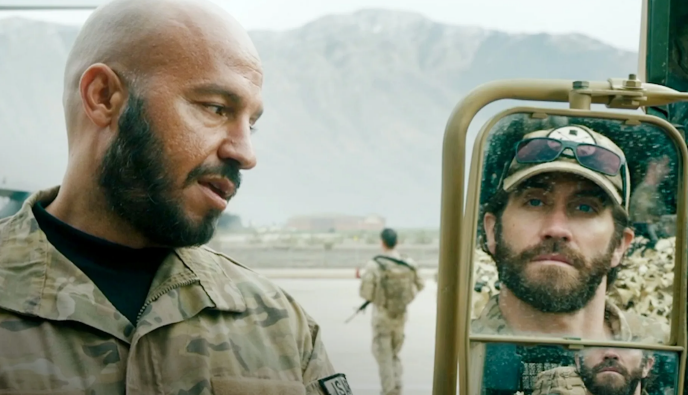
If you have seen several other similar films associated with the War in Afghanistan such as “Lone Survivor” (2013), you will probably not be that impressed by what follows next during the middle act of the film. Yes, there are a series of small and big suspenseful moments as our two main characters desperately struggle for their survival, and things become more serious later when Kinley comes to depend totally on Ahmed, who turns out to be as tough and strong-willed as Kinley. Yes, his main motive for saving and then taking Kinley to their military base is getting the US visa promised to him and his family as soon as possible, but he tries to do his best nonetheless in front of many different dangers in front of them, and the movie works best as focusing on how he cope with those big dangers one by one as he and Kinley get closer and closer to their destination.
I wonder whether the movie could be better if it simply stayed focused on its two main characters’ grueling journey across Afghanistan instead of moving onto the third act, which often feels like something between “The Killing Fields” (1984) and “Uncommon Valor” (1983). After he and Ahmed are eventually rescued (Is this a spoiler?), Kinley is sent back to US, but, as he recovers day by day, he cannot help but concerned more about Ahmed. As a matter of fact, Ahmed becomes one of the most wanted men in Afghanistan due to what he bravely did for Kinley, and that makes Kinley feel more guilty than before.
Kinley subsequently tries to do anything for helping Ahmed get the US visa for him and his family, but, of course, he only gets frustrated more and more due to lots of bureaucratic incompetence, so he decides to handle the matter for himself in the end. He hires a bunch of military contractors, and he also prepares to go back to Afghanistan for locating Ahmed, who has been hiding along with his family somewhere in Afghanistan.

What follows next is pretty predictable and quite contradictory to say the least. Yes, Kinley eventually succeeds in locating Ahmed and his family. Yes, the movie soon moves onto a big action sequence where our two main characters shoot a lot of Taliban soldiers before an expected dramatic moment of reversal. Yes, the movie later recognizes how much the US government and military let down thousands of local translators and their families during the complete evacuation from Afghanistan in 2021, but, in my humble opinion, that bitter fact inevitably clashes with its supposedly cathartic ending. Yes, they say that he who saves one life saves the world entire, but that is not enough in this case.
What ultimately remains in my mind is the commendable performance from Jake Gyllenhaal and Dar Salim. While Gyllenhaal reminds us again that he is one of the most dedicated actors working in Hollywood at present, Dar Salim, an Iraqi Danish actor I came to notice after watching two acclaimed Danish films “A Hijacking” (2012) and “A War” (2015), ably carries the middle act of the film as Gyllenhaal steps back for his co-star, and they are often engaging to watch as their characters come to show more respect and responsibility to each other along the story without any cheap sentimentality.
In conclusion, “Guy Ritchie’s The Covenant” is a fairly competent war drama movie, and director/co-writer/co-producer Guy Ritchie demonstrates again that he can be quite serious as he did in his previous film “Wrath of Man” (2021), but the overall result does not surpass its genre conventions and clichés that much. By the way, there is a little but undeniably harrowing documentary film called “Retrograde” (2022), and, if you want to observe and know more about the War in Afghanistan and those numerous Afghan people associated with the US Army during that messy period, I sincerely recommend you to check out that solid documentary first instead of watching this very conventional product.


 Seongyong's Private Place