
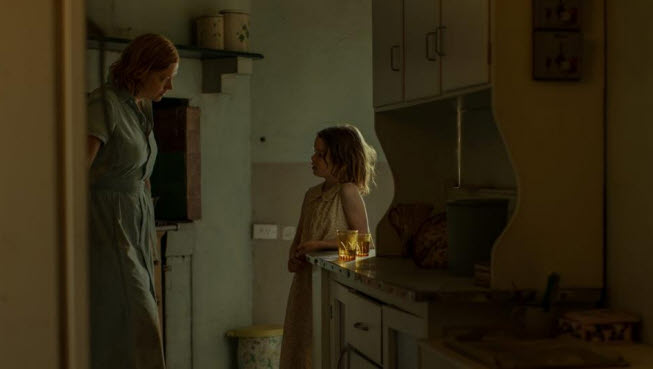
Netflix horror film “Run Rabbit Run”, which was released in last week, is palpably atmospheric but ultimately middling. While it is mainly driven by lots of mood and some emotional intensity from its solid lead performance, the movie is rather superficial in terms of story and characters, and that is the main reason why it fails to distinguish itself among similar genre works ranging from “The Babadook” (2014) to “The Hold in the Ground” (2019).
The movie mainly revolves around the increasingly deeply troubled relationship between a single mother and her little daughter. As her daughter’s birthday party is coming, Sarah (Sarah Snook) is willing to do her best for making her daughter Mia (Lily LaTorre) happy, and she even lets Mia keep a stray rabbit found in front of their house, but we cannot help but sense some distance between Sarah and her daughter – especially when they are joined by her ex-husband and his new family during her daughter’s birthday party.
And we come to gather about Sarah’s recent personal loss. Some time ago, her father died, and there are lots of family stuffs inside the garage of her house, but Sarah is not particularly eager to be reminded of her family past. While she clearly loved her father, she does not answer to frequent phone calls from a facility where her senile mother has been kept during last several years, and she does not want to talk about this matter with anyone, let alone her daughter.

However, to Sarah’s annoyance, Mia suddenly begins to show some interest in her mother’s past for some unspecified reason, while also starting to show a number of strange behaviors as if she were possessed by something. At first, she simply seems to be obsessed with an old family photograph of Sarah, but then she often wears a cardboard mask without any explanation, and she also “pretends” to be someone else.
When her daughter demands that she should be called “Alice”, Sarah cannot help but become quite disturbed for a reason to be gradually revealed along the story. Alice is actually the name of a younger sister of hers, and her daughter’s strange behaviors seem to touch something Sarah still does not want to talk about at all – even when her daughter asks more about her family past.
Because her daughter keeps insisting that she must see her grandmother right now, Sarah eventually agrees to take Mia to that facility where her senile mother is currently living. Needless to say, their visit to Sarah’s mother causes more disturbance for both Sarah and her mother, and we come to wonder more about what really happened in Sarah’s past, though we clearly sense that something quite bad did occur at that time.
Is her daughter really possessed by some supernatural entity associated with whatever happened in her past? Well, the movie naturally refuses to give us any clear answer for a while as building up more sense of dread and anxiety on the screen. Thanks to cinematographer Bennie Elliott, the movie is constantly shrouded in gloomy atmosphere even when its main characters are under broad daylight, and the wide and empty landscapes of the Australian outback areas often generate some visceral uneasiness as they did in many other notable movies such as, yes, “Picnic at Hanging Rock” (1975).

However, the screenplay by Hannah Kent is rather deficient in case of developing its story and characters. While we do not get to know that much about Sarah’s relationship with her increasingly unruly daughter, we are not informed much about her apparently estranged relationship with her senile mother either, and I must point out that Gretta Scacchi, an Italian-Australian actress whom I still remember well for her good supporting performances in “Presumed Innocent” (1990) and “The Player” (1992), is glaringly wasted in her thankless supporting role.
At least, the movie diligently unnerves us throughout its running time because of the good performance from Sarah Snook, who has been more prominent during last several years since her unforgettably committed performance in “Predestination” (2014). While her character is a typical horror movie heroine under lots of pressure and anxiety, Snook skillfully brings raw emotional qualities to her role, and we keep following her character’s psychological deterioration along the story even when the movie stumbles more than once during its second half. On the opposite, young performer Lily LaTorre handles her tricky role fairly well, and her several intense scenes with Snook are believable thanks as they ably convey to us the increasing strain and awkwardness between their characters.
“Run Rabbit Run” is directed by Diana Reid, who has mostly worked in a number of notable TV drama series including “The Handmaid’s Tale” (She received an Emmy nomination for that acclaimed TV series, by the way). As far as I can see, she is a good director who knows how to engage us via mood and details, but that cannot wholly compensate for the weak narrative and thin characterization of the film, and its underwhelming result only makes me eager to revisit similar genre films mentioned above. No, I do not mind get confused and baffled, but the movie does not have enough emotional substance onto which we can hold to the end, and we are eventually left with rather hollow impressions instead of being really unnerved or terrified.


 Seongyong's Private Place