
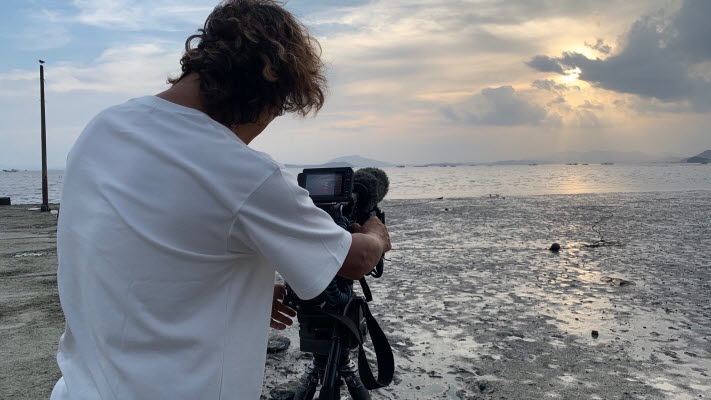
South Korean documentary “Sura: A Love Song” vividly and powerfully reminds me of how precious and beautiful nature can really be. Closely following the longtime civilian efforts for recording and saving the natural environment of the tidal flats of the Saemangeum area on the west coast of the Korean Peninsula, the documentary makes a very strong case on the devastating environmental damages caused by the Saemangeum Seawall Project at present, and I assure you that you will come to reflect more on its urgent environmental issues as its end credits roll.
I thought I was well aware of the environmental issues surrounding the Saemangeum Seawall Project, but the documentary shows me that the environmental damages from that utterly useless development project have been much more serious than I ever thought. Planned and then authorized in the late 1980s, the Saemangeum Seawall Project was supposed to provide new lands for more industrial development via building an extensive seawall across its coastal area. The South Korean government claimed that this ambitious long-term development project would stimulate the local economy in addition to bringing considerable benefits to the local residents in the end, but it eventually turned out that this project only caused lots of harm to local nature and residents instead of benefiting either of them in any possible way. For example, numerous fishing folks came to lose their main source of income to their despair and frustration, and I must tell you that it is really painful to see how their lives and villages became quite barren and miserable during next three decades.
In addition, the Saemangeum Seawall Project was bound to cause a considerable environmental change to the wide tidal flat areas to be blocked by its extensive seawall. These tidal flat areas were natural habitats for millions of many different animals and plants, and they were particularly important for various kinds of migratory birds as places where these birds can rest and eat for a while in the middle of their seasonal migrations.

We hear about how the South Korean government has willfully neglected the environmental importance of the tidal flat areas from the very beginning of the Saemangeum Seawall Project. For instance, its official preliminary report on the ecology of the tidal flat areas grossly omitted a bunch of endangered species inhabiting in the tidal flat areas just for getting the project authorized as soon as possible, and the following lawsuit by the local civilian groups was casually dismissed even at the Supreme Court.
Thousands of local fishing folks and civil activists really tried hard to stop the project during the 1990s ~ 2000s, but their desperate protests were ignored by the South Korean government as before, and it kept pushing the project without any kind of consideration or moderation. The seawall was eventually completed in 2006, and the tidal flat areas blocked by the seawall soon began to show considerable environmental damages within a short period of time. First, the areas became much drier than before, and that consequently led to the death of not only millions of various marine animals but also thousands of many different birds above them in the food chain system of the tidal flat areas.
Director Hwang Yoon closely recorded the situation surrounding the tidal flat areas for a while during that period, but then she came to quit her filmmaking process due to understandable persona reasons. Several years later, she and her family happened to move to a local city associated with the project, and that was how she resumed her connection with the Citizen’s Survey Group on Saemangeum, which has focused more on recording the environmental changes of the tidal flat areas since that period.

The documentary closely follows the ongoing personal project of several members of the organization including a middle-aged man named Oh Dong-pil. Having always been passionate about the environment of the tidal flat areas, Oh has been focusing mainly on monitoring and recording the wild life of the tidal flat areas. He is especially interested in many different bird species inhabiting in the tidal flat areas, and he gladly shows us their considerable diversity, which will definitely marvel you in many ways. I especially like a certain local bird species whose male members change the color of their head during the mating season, and I must tell you that the documentary presents this and many other bird species of the tidal flat areas as vividly as National Geographic documentaries.
And these bird species and many other different animal and plant species of the tidal flat areas gave some hope and motivation to the organization. Sure, the seawall is still blocking and damaging the tidal flat areas even at this point, but the tidal flat areas still have the possibility of restoration and preservation at least, and that was indubitably proven when the South Korean government eventually allowed the occasional opening of the seawall. As a result, much more fresh sea water was flown into the tidal flat areas, and Oh and his colleagues were delighted to see several crucial signs of environmental recoveries, though they still have lots of things to do for protecting and preserving the tidal flat areas.
In conclusion, “Sura: A Love Song”, whose title incidentally comes from the name of one of the tidal flat areas, is memorable for not only its strong environmental message for us but also its deep affection toward to its main subject and several good people associated with that, and its haunting poetic beauty generated from its main subject still lingers on my mind even at this point. Yes, we often ruin nature a lot, but we can also restore it if we really try, and the documentary touchingly reminds that to me.


 Seongyong's Private Place
Pingback: 10 movies of 2023 – and more: Part 3 | Seongyong's Private Place