
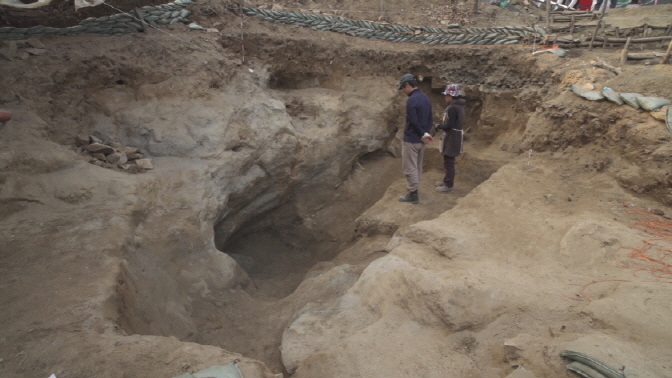
South Korean documentary film “206: Unearthed” illuminates one tragic fact of the Korean War, which I and other South Koreans should remember as long as possible. During that dark and dangerous period, millions of innocent civilians were massacred around the country just because of being labeled as communists or collaborators, and there are actually more than 100 spots in South Korea where the bodies of those massacred people were buried for many years.
The documentary follows the efforts of a small organization of civilians and volunteers willing to do some hard work for locating and then excavating the remains of those massacred people. Although too many years have passed since the end of the Korean War, the members of the organization are ready to do their best for bringing some solace to not only those massacred people but also their family members, and the documentary often closely observes how the members of the organization work at their numerous excavation sites. Sometimes they do not get much result in the end, but they are not daunted at all, and they keep going for wherever they can possibly excavate another tragedy of the Korean War.
As shown in the middle of the documentary, there were actually considerable efforts for finding the remains of those massacred people during the early 1960s, though that did not last that long to the sadness and frustration of their family members. Once President Syngman Rhee, who was one of several figures chiefly responsible for the civilian massacres during the Korean War, was ousted thanks to the April Revolution in 1960, the South Korean government belatedly began to look into the civilian massacres during the Korean War, but, alas, the following efforts were soon blocked due to the military coup in 1961, and nobody dared to talk about that during next three decades.

When the Truth and Reconciliation Commission was established by the South Korean government in 2005, there was some hope for the family members of those massacred people, but, again, their hope was dashed only 5 years later as the commission was disassembled. Nevertheless, activists and bereaved families decided to keep trying to locate and excavate the remains of those massacred people, and their efforts mean a lot to director Huh Chul-nyoung because his grandmother, who passed away several years ago, also had her own sad personal story involved with the civilian massacres during the Korean War. Her husband was one of those massacred people, but then she had to be silent about that just like many other people out there, and she had to keep lots of grief and pain to herself till her death without knowing anything about the whereabouts of her husband’s body.
The documentary occasionally interviews the family members of several massacred people, and they all have each own sad story to tell. In case of one old man, he cannot help but become quite emotional as remembering how his father was taken away from the family in the middle of the war, and we are saddened as he still cannot find his father’s remains despite his active participation in the aforementioned organization.
We also meet several activists and professional experts leading the excavation missions of the organization. They all deeply care about their joint work, and their words remind us of why it is always important for us to remember the past. Yes, we always have to move toward future, but that is only possible when we face and recognize past, and that is why they have been diligently trying to bring more public awareness to their noble cause.
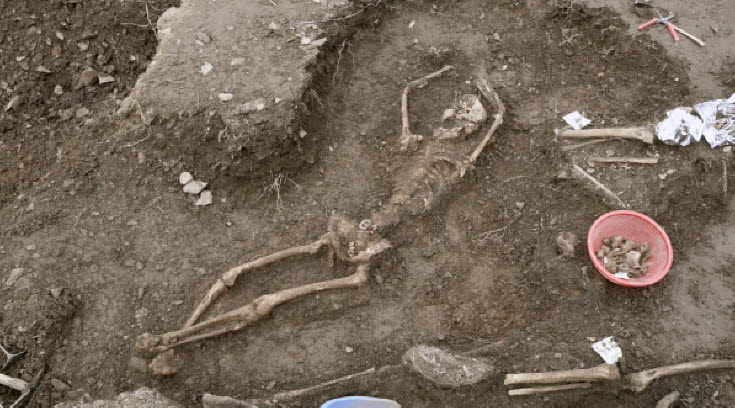
Sometimes they and other organization members come upon a spot with lots of buried remains, and it is both chilling and saddening to observe what they excavate step by step. Besides lots of skulls and bones, there are also heaps of personal stuffs such as shoes and buttons, and I particularly remember a scene where we see a little rusty lighter. On that lighter, a certain name was scratched, and it is quite possible that that is the name of its owner, who was likely one of many people killed on the spot and probably scratched the name on that lighter at the last minute.
We later see how the results of that excavation are systemically sorted out at a special facility. We see lots of many different bones categorized in one group or another, and the documentary tells us how difficult it is to sort out those bones for identifying one massacred person after another. After all, a human body contains no less than 206 bones, and we can only imagine how much time and effort are put into this demanding identification process.
In the end, the remains of each identified massacred person are put into individual boxes to be stored, and then we see the joint funeral service for all of these massacred people. Although many of them remain anonymous, they finally get the closure for themselves at least, and, above all, they will be surely remembered as a part of the history.
Although it feels a bit too plain at times, “206: Unearthed”, which received the Mecenat award when it was shown at the Busan International Film Festival in 2021, handles its important historical issue with considerable care and respect, and I became more interested in its main subject as observing many haunting moments to remember. It could show and tell more in my humble opinion, but it is still a fairly solid documentary on the whole, and I certainly recommend you to check it out if you want to know more about those numerous tragedies of the Korean War.


 Seongyong's Private Place