
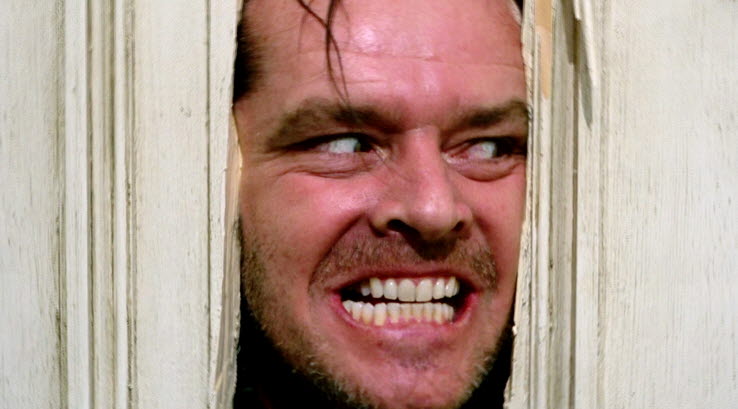
Stanley Kubrick’s “The Shining”, whose 4k remastered version was recently released by a local movie theater chain in South Korea, is utterly eerie for its baroque uncertainty. As its three main characters are hopelessly isolated inside its vast and ominous background, the movie constantly unnerves us with the increasing unreliability of their respective viewpoints, and the result is alternatively baffling and terrifying to the very end.
Noticing again how cold and distant the movie is to the madness and confusion of its main characters, I could not help but think of the last act of Kubrick’s another great film “2001: A Space Odyssey” (1968). In that part, the astronaut hero finds himself isolated inside a coldly decorated room after his fantastic journey across space and time, and his following transformation process in that room looks like being observed by something beyond his (and our) perception. In case of “The Shining”, its three main characters are stuck inside a big hotel located in some remote mountainous area of Colorado, and they sometimes feel like mere test subjects ready to be manipulated by whatever is hovering over the hotel.
Kubrick does not hide his intention at all right from the opening scene. Shrouded in palpable insidiousness with the synthesizer performance of “Dies irea” on the soundtrack, this spooky opening scene steadily looks over a small car driving toward the hotel. It is followed by a dryly banal meeting between the hotel manager and Jack Torrance (Jack Nicholson), a writer who happens to be hired as the caretaker of the hotel during its upcoming closing period. The hotel manager tentatively warns to Jack that the hotel can be completely isolated from the outside world during snowy winter days, and he even mentions a terrible incident involved with a former caretaker of the hotel. Jack assures to the hotel manager that he and his family will be all right: “And as far as my wife is concerned, I’m sure she’ll be absolutely fascinated when l tell her. She’s a confirmed ghost story and horror film addict.”

Meanwhile, we also get to know about Jack’s wife Wendy (Shelley Duvall) and their young son Danny (Danny Lloyd). Danny happens to have a sort of psychic power, and his imaginary friend shows him a series of disturbing moments implying what may happen in the hotel. During her following conversation with a doctor who checks on Danny, Wendy casually reveals Jack’s alcoholism – and how this serious human flaw of his led to one traumatic incident for both her and Danny some time ago.
Once Jack and his family come into the hotel, the movie frequently emphasizes how big and wide the hotel looks inside – especially when they are the only people inside the hotel after its closing day. As the camera steadily follows its main characters moving around here and there in the hotel, their surrounding environment often feels as vast as the space background of “2001: A Space Odyssey”. In fact, there seems to be no possible way out for them at times, as reflected by when the camera ominously looks down upon Wendy and Danny wandering inside a big hedge maze right next to the hotel building.
Around that point, Jack is already tumbling down toward madness, so we come to depend more on Danny and Wendy’s viewpoint, but neither of them is very reliable because they become psychologically isolated in each own way just like Jack. After experiencing something scary in a certain room in the hotel, Danny’s mind is much more unsettled than before, and those horrific visions of his soon come quite true to his petrified horror. In case of Wendy, she desperately tries to get things under her meager control, but there inevitably comes a point where she finds herself swept into her own terror and confusion.
Kubrick keeps everything cold and distant just like he did in many of his films, and that makes the movie all the more terrifying. While its three main characters are basically broad caricatures, their descent into madness and confusion is still quite arresting because of the overwhelming sense of claustrophobia surrounding them. Seemingly trapped forever in their isolated status, they come to lose more human qualities along the story, and that was probably why Kubrick deliberately had his two lead performers go over the top in their forthright acting. While Jack Nicholson dials up his familiar manic mode as much as demanded, Shelley Duvall amplifies her own neurotic quality to the extreme, and I must say that her strenuous efforts here in this film deserve to be appreciated more, considering how she was harshly treated by Kubrick during the shooting.
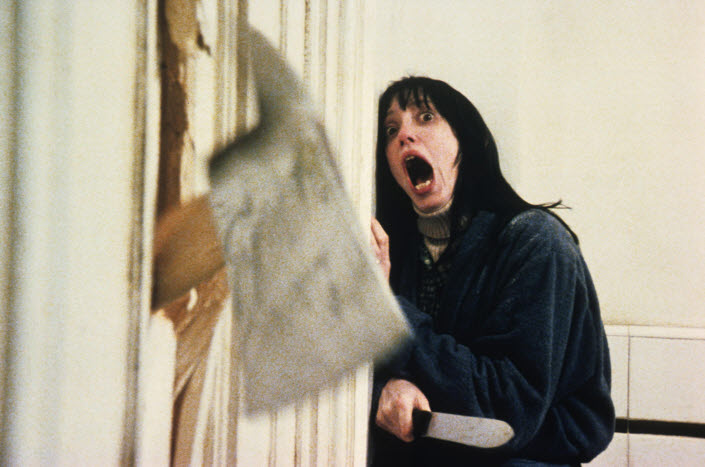
In the meantime, we are also baffled by the ambiguity surrounding the main characters’ feverishly warped viewpoints. Are there actually some supernatural entities in the hotel? Or, are Jack and his family merely experiencing a series of hallucinations fueled by Danny’s psychic power? A key scene later in the story, which is incidentally unfolded inside a storage room, strongly suggests that there are indeed ghosts in the hotel. However, the movie remains ambiguous about their actual existence to the end, with its very last shot raising more doubts and questions.
The movie actually provides a bit of objective viewpoint via Dick Halloran (Scatman Crothers), the chief chef of the hotel who happens to have the same psychic ability Danny has. During his conversation with Danny early in the film, he indirectly recognizes that there is something not so good inside the hotel, and he later comes to the rescue after receiving a psychic SOS from Danny. However, to put it mildly, the movie does not let him clarify the ongoing situation surrounding Danny and his parents.
I forgot to mention that “The Shining” is based on the novel of the same name by Stephen King, who disliked the movie for understandable reasons. To King’s dismay, Kubrick erased most of human depth in the original story while adapting it along with his co-writer Diane Johnson. Instead, he distilled the claustrophobic qualities of King’s story for his single-minded artistic vision, and his achievement has considerably influenced a bunch of subsequent arthouse horror films such as Ari Astor’s debut feature film “Hereditary” (2017), which definitely owes a lot to Kubrick’s movie in more than one way.
By the way, King later attempted to distance his novel further from Kubrick’s film via writing its sequel novel “Doctor Sleep”. However, to our little amusement, the following movie adaptation directed by Mike Flanagan was not free from Kubrick’s film at all – even when it is faithful to King’s sequel novel. That says a lot about the inescapable cinematic power of Kubrick’s film, isn’t it?


 Seongyong's Private Place