
Although I did not watch any of the first three Indiana Jones movies at movie theater, I remember well how I felt both entertained and nostalgic as watching that rather passable fourth film in 2008. Sure, it did not surpass the level of fun and excitement I had when I watched any of the first three films on TV during my childhood years, but it was fairly engaging mainly because Steven Spielberg and his cast and crew had some old fun with that. As a matter of fact, I have never regretted giving it 3 stars while giving “Iron Man” (2008) 2.5 stars, and I will likely stand by my preference for the rest of my life.
In case of “Indiana Jones and the Dial of Destiny”, it certainly made me feel nostalgic again as expected, but I am sad to report here that there is not much fun and excitement for you here. It surely tries its best for following the footsteps of its three predecessors besides attempting several new things, but the result is often lackluster without generating enough interest and thrill to hold our attention, and that is a shame considering some game efforts from some of its notable cast and crew members.
The story is mainly set in 1969, and the early part of the film shows us how things have been quite depressing for Professor Henry Jones Jr. (Harrison Ford), who is also known as, yes, Indiana Jones. He has been separated from his wife since their certain personal loss, and now he is living alone in a shabby apartment in New York City while trying to continue to teach despite the apparent lack of enthusiasm from his students.

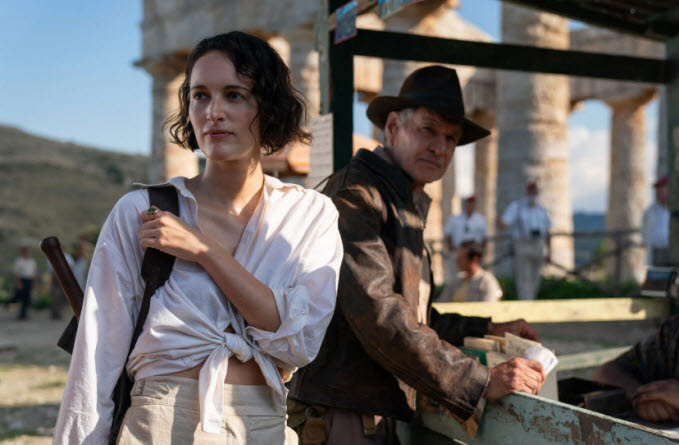
And then he is approached by a young British woman named Helena Shaw (Phoebe Waller-Bridge), who is incidentally Jones’ goddaughter. As shown in the prologue set around the end of the World War II, Jones once worked along with Helena’s father Basil (Toby Jones) while trying to retrieve those valuable artifacts stolen by Nazi soldiers, and Helena is particularly interested in a certain special artifact invented by a well-known Greek scientist around two thousand years ago. Although he seems disinterested at first, Jones eventually comes to show Helena that he actually has a little secret behind his back, and that is how he inadvertently gets himself into her problematic current situation.
Helena has actually been chased by Jürgen Voller (Mads Mikkelsen), an evil former Nazi scientist who has been involved with the US government for its space program. He has also been quite interested in obtaining that special artifact, and he and his several nasty henchmen are certainly ready to do anything for their final goal to be fulfilled via that special artifact.
Naturally, Jones and Helena try to get ahead of Voller and his Nazi cronies as much as possible, and we see them hopping from one spot to another around the world while sometimes assisted by several associates of theirs. While Jones have Sallah (John Rhys-Davies) and Renaldo (Antonio Banderas), Helena has a street-smart urchin named Teddy Kumar (Ethann Isidore), which surely reminds you of Ke Huy Quan’s similar supporting character in “Indiana Jones and the Temple of Doom” (1984).
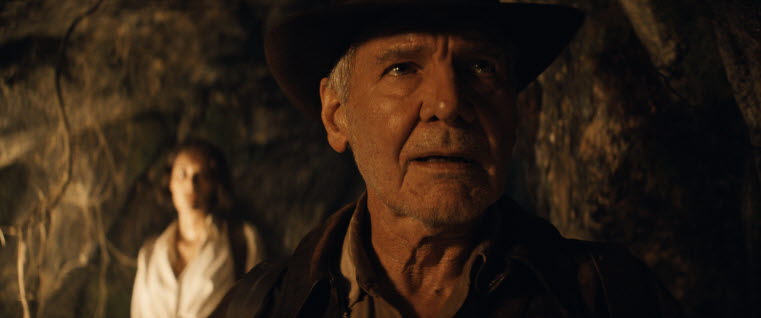
In the meantime, the movie expectedly serves us a number of big action sequences along the story, but, despite the fairly competent efforts form director/co-writer James Mangold and his crew members including cinematographer Phedon Papamichael, these action sequences do not impress us that much on the whole. They are certainly fast and quick on the surface, but they also somehow feel rather pedestrian without having any sense of unadulterated fun we had from the previous four films. To be frank with you, even John Williams’ score seems less spirited and exciting this time, though, as usual, he reminds us again that we are very lucky considering he is still working despite being over 90 at present.
In case of Harrison Ford, he is surely glad to play one of his famous roles again just like he was in “Star Wars: The Force Awakens” (2015) and “Blade Runner 2049” (2017). Although he is going to have his 81st birthday in this year, he still shows his undeniable presence which has endured for more than 45 years, and he mostly looks believable in those key action sequences in the film, though he is indubitably aided by lots of CGI and stunt men due to his age and safety.
The supporting cast members in the film are rather wasted in contrast. While Antonio Banderas, John Rhys-Davies, and Toby Jones simply come and then go, Mads Mikkelsen is unfortunately limited by his villain role which looks much less colorful than those memorable Nazi villains in “Raiders of the Lost Ark” (1981), and young performer Ethann Isidore sadly struggles with his mediocre supporting part. At least, Phoebe Waller-Bridge, who has been known for her acclaimed TV comedy series “Fleebag”, often brings some spirit and energy into the screen, and she is certainly the best part of the film besides Williams’ excellent score.
Overall, “Indiana Hones and the Dial of Destiny” is not as terrible as I and others feared, but I observed its story, character, and action from the distance throughout its overlong running time (154 minutes), and that was a dissatisfying experience to say the least. While its last scene is a bit poignant for good sentimental reasons, that comes too late in my humble opinion, and now I am hoping to see any of the first three Indiana Jones films at movie theater.


 Seongyong's Private Place
Pingback: My Prediction on the 96th Academy Awards | Seongyong's Private Place