
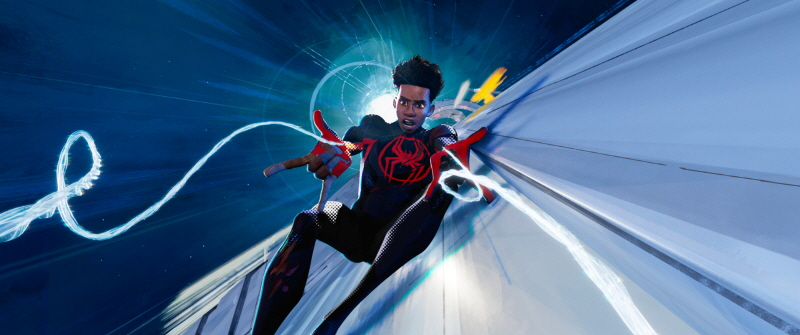
Animation film “Spider-Man: Across the Spider-Verse”, the sequel to its Oscar-winning predecessor “Spider-Man: Into the Spider-Verse”, is a busily rich experience I am willing to revisit for more fun and appreciation. Yes, as many of you already know, this is essentially a 140-minute warmup process for whatever we will get in the next year, but it is steadily pulsating with a tremendous amount of style and substance from the beginning to the end. Around the time when it eventually arrives at its expected cliffhanger ending, you will come to have some expectation after having so much fun and excitement, though you may also wonder how the next film can possibly top all the wonder and energy presented during more than 2 hours.
After the extended opening part set in the world of Gwen Stacy / Spider-Woman (voiced by Haileee Steinfeld), the film shows how things have been rather complicated in the world of Miles Morale / Spider-Man (voiced by Shameik Moore). Because his parents still do not know about his secret identity, there has been some conflict between him and his parents, and he even considers revealing his secret to them, though that is not easy at all considering that his policeman father will soon get promoted in his precinct.
Meanwhile, there comes another problem in his city via Dr. Jonathan Ohnn / The Spot (voiced by Jason Schwartzman), who may look ridiculous but turns out to be more dangerous than expected. Because of what happened during the climax of the previous film, this guy comes to have the power to create holes in the dimension of time and space, and we accordingly get a frantic but undeniably entertaining scene where Miles tries to stop and catch this guy.
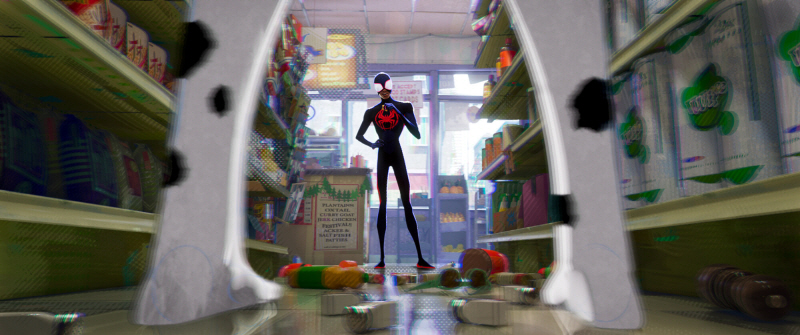
Anyway, this latest trouble of Miles leads to the unexpected return of Gwen, who is now a part of the team operating over numerous alternative worlds out there. Under the command of Miguel O’Hara / Spider-Man 2099 (voiced by Oscar Isaac), she has worked with a number of different versions of Spider-Man, and I will let you behold one by one for yourself without spoiling anything, though I must say that several notable voice cast members of the film are having a juicy fun with their respective parts.
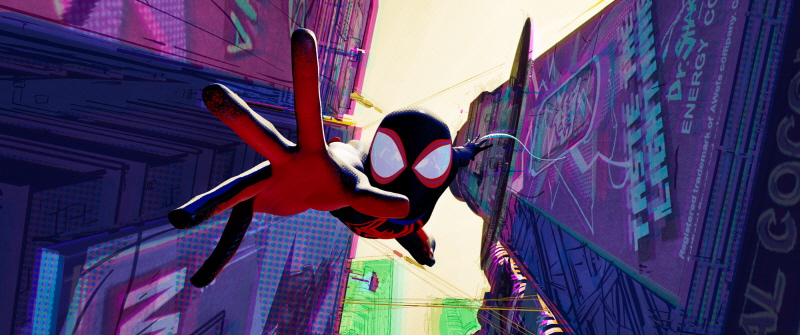
Along with these new characters, the film freely expands its fantasy background with more imagination and creativity, and the result has much more surprise and entertainment than most of those superhero flicks during last several years. As an animation film, it can afford to have a lot more style and atmosphere than live-action films, and you will savor its various visual details even when it briskly hops from one moment to another like flipping through comic book pages. For instance, I particularly like an unabashedly exotic version of New York City associated with one certain version of Spider-Man, and I was also amused by another unexpected version of Spider-Man who is as anti-establishment as he looks.
While so frantically juggling lots of stuffs in the air, the screenplay by Phil Lord, Christopher Miller, and Dave Callaham also generates enough depth and gravitas to hold us amidst its swirling mix of mood, style, and humor. While the conflict between Gwen and her policeman father turns out to be more than a mere subplot, Miles’ increasingly strained relationship with his parents also functions as a crucial part of the story, and the film occasionally becomes poignant as paying some attention to how Miles and Gwen tentatively respond to their mutual feelings as two loners who really know and understand each other.

Above all, the main plot of the film is compelling as working as a sort of meta-critique on the current status of its genre. While occasionally peppering the screen with bits of intellectual properties, the film throws an interesting question involved with the very existence of its main background, and that eventually becomes a serious issue of conflict between Miles and Spider-Man 2099, who is quite determined to correct any problem in the vast network of the Spider-Verse by any means necessary. I will not go into details about their dynamic conflict here, but I can tell you instead that what the film achieves through this definitely surpasses whatever “Doctor Strange in the Multiverse of Madness” (2022) or “The Flash” (2023) attempted to do.
In addition, the voice cast members of the film are simply fantastic. While Shameik Moore ably balances humor and drama as you can expect from a Spider-Man, Hailee Steinfeld holds her own place well as her character comes to show more of her spirit and vulnerability along the story, and Jake Johnson, who reprises his role in the previous film, is solid in his droll voice performance. In case of several other substantial voice members, Oscar Issac, Jason Schwartzman, Issa Rae, Brian Tyree Henry, Luna Lauren Vélez, Shea Whigham, Karan Soni, and Daniel Kaluuya are terrific in their colorful voice acting, and it will be interesting to see how the next film will utilize more of this various bunch of talented performers.
On the whole, “Spider-Man: Across the Spider-Verse”, directed by Joaquim Dos Santos, Kemp Powers, and Justin K. Thompson, frequently surpasses its predecessor’s achievement level as jumping and leaping as high as possible, but I still give it 3.5 stars instead of 4 stars due to my inconsequential reservation. It is surely ambitious besides wildly entertaining to say the least, but will the next film meet or exceed our expectations from that? Well, we will see.


 Seongyong's Private Place
Pingback: 10 movies of 2023 – and more: Part 2 | Seongyong's Private Place
Pingback: My Prediction on the 96th Academy Awards | Seongyong's Private Place