

“Chevalier”, which is currently available on Disney+ in South Korea, is the story about one fascinating real-life black musician who deserves to be known more for good reasons. Although it is basically a conventional period drama, the movie still engages us via its solid storytelling, and it is also often galvanized by the energetic presence of its talented lead actor.
Kelvin Harrison Jr., who has steadily advanced since I noticed him for the first time via his good supporting turn in Trey Edward Shults’s “It Comes at Night” (2017), plays Joseph Bologne, Chevalier de Saint-Georges (1745-1799), a French-Caribbean musician who was the illegitimate son of a wealthy plantation owner and his African slave mistress. Because of his exceptional musical talent, young Joseph was sent to a prestigious boarding school in France by his father after being separated from his mother, and he was certainly discriminated a lot due to his racial background right from his first day, but he subsequently distinguishes himself in not only music but also many other things including poetry and swordsmanship. After winning in one big fencing match held in front of many noblemen and noblewomen besides the king and queen of France, he deservedly becomes a man of noble title, and that certainly boosts his considerable reputation in public.
As becoming one of notable figures favored by Queen Marie Antoinette (Lucy Boynton), Bologne surely feels like being at the top of the world, but then there comes a big reminder of his race background. After he is notified of his father’s death, his African mother, who is now officially free after his father’s death, comes to Paris, but she is not so impressed by her son’s affluent lifestyle full of hedonistic extravagance, and Bologne is not so comfortable to be around his mother either.
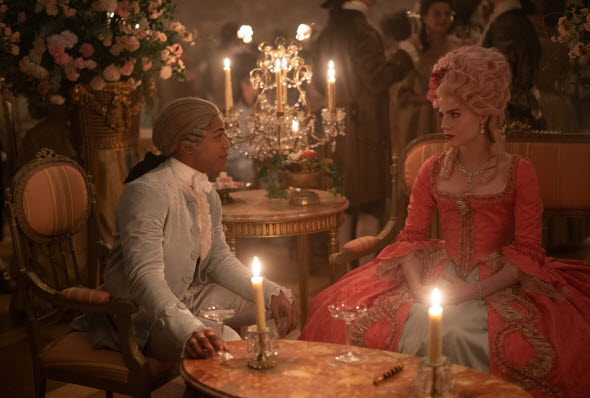
Meanwhile, there comes another big chance to elevate Bologne’s social status further. The Paris Opera happens to need a new principal conductor, and it looks like Bologne can step into that prestigious position via his undeniable talent and popularity as well as his close connection with the queen, though there is a prominent Austrian composer who emerges as his main competitor (No, he is not Wolfgang Amadeus Mozart, who incidentally appears in the opening scene). Bologne and his competitor are ordered to compose and produce each own original opera production, and the board of the Paris Opera will then decide who is the winner and then will become its new conductor.
Naturally quite confident about this competition, Bologne instantly works on his opera production, and he has already decided who will be his lead female performer. He previously noticed the considerable singing talent of Marie-Josephine de Montalembert (Samara Weaving), and, thanks to a close associate of his, he soon visits the manor belonging to her and her powerful nobleman husband. Right from when they meet, something sparks between them, and Marie-Josephine is quite willing to join his opera production even though her rather possessive husband does not approve of that at all.
Anyway, Marie-Josephine and Bologne soon work together while her husband is conveniently absent, and that inevitably leads to a risky liaison between them. Even while knowing well that there is not any future for their romantic relationship, Bologne comes to love Marie-Josephine than expected, but he is also often reminded of the wide gap between them in terms of class and race. In case of Marie-Josephine, she surely appreciates him for bringing more fun and freedom to her boring daily life, but she has to be quite discreet as often being limited a lot by her social position.

In the meantime, things gradually get volatile in the outside world as the French Revolution is about to be started. After reminded again that he will be never fully accepted by the world he has tried to enter for years, Bologne decides to become truer to his racial identity as reflected by one musical scene where he joins his fellow Caribbean people along with his mother. Sincerely supported by a progressive nobleman friend of his, he also prepares himself for doing something bold and defiant in public, and, not so surprisingly, the queen is not amused by this.
The screenplay by Stefani Robinson, who also participated in the production of the film, stumbles more than once during its last act, but the story is still held together well thanks to Harrison’s intense performance. Besides looking believable in several musical performance scenes, he fills his character with a considerable amount of life and personality, and it certainly helps that he and Samara Weaving generate enough romantic heat during their several key scenes. In case of several other main cast members, Lucy Boynton, Marton Csokas, Alex Fitzalan, Sian Clifford, and Minnie Driver are well-cast in their respective supporting parts, and the special mention goes to Ronke Adekoluejo, who holds her own small place well around Harrison as Bologne’s mother.
In conclusion, “Chevalier” is an earnest but engaging period drama to be appreciated for several good things including Harrison’s solid performance, and director Stephen Williams, who won an Emmy for acclaimed HBO TV miniseries “Watchmen”, did a competent job on the whole. I think the movie could delve more into Bologne’s life and career, but the overall result is fairly satisfying at least, so I will not grumble for now.


 Seongyong's Private Place