

South Korean queer animation film “The Summer” gives us a simple but bittersweet presentation of one summer romance and its aftermath. As tenderly and sensitively observing the start, development, and end of romantic relationship between its two different lead characters, the movie often gives us some lovely visual moments to enjoy and appreciate, and it is all the more precious to me and other moviegoers in South Korea, considering how we rarely come across something like that.
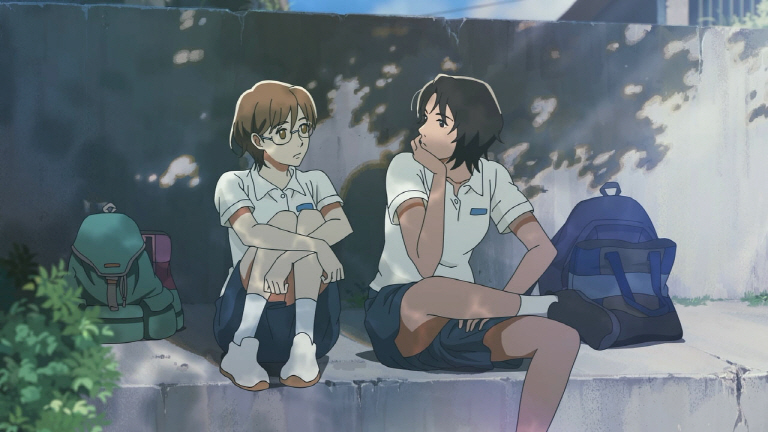
The story is mainly unfolded via the viewpoint of Lee-kyeong (voiced by Yoon Ah-young), and the early part of the film shows us how she came to befriend Soo-i (voiced by Song Ha-rim) during their last high school year. On one hot and bright summer day, Lee-kyeong happens to be struck by a ball Soo-i tries to catch during her soccer practice on the school playground. After promptly apologizing to Lee-kyeong, Soo-i shows a bit more consideration to Lee-kyeong during next several days, and Lee-kyeong soon finds herself quite attracted to Soo-i, though she understandably hesitates to show her growing feelings toward this confident girl.
Anyway, these two young girls come to spend more time together, and it gradually becomes apparent that Soo-i has also been attracted to Lee-kyeong. Eventually, they recognize the mutual feeling between them in private, and they cannot help but delighted and excited as they fall more in love with each other, though they also must hide their homosexual relationship from others around them. Both of them know too well how much they can be ridiculed or ostracized if their relationship gets ever exposed to others, and, despite her confident attitude, Soo-i is particularly sensitive about showing affection outside.
It looks like they will be happier with more freedom after their subsequent graduation, but their situation becomes more complicated. Both of them go to Seoul, but Lee-kyeong gets enrolled in a college for more study while Soo-i chooses to prepare herself for becoming a car mechanic after her hope of becoming a soccer player is unfortunately dashed in the end. Although both of them try to spend time with each other as much as possible, the gap between them comes to grow day by day – even after Lee-kyeong moves into Soo-i’s new residence.
In addition, their personality difference becomes all the more evident to both of them. While Soo-i is not that social to say the least, Lee-kyeong is often eager to meet others like them, and she even comes to work as a part-time employee at a small lesbian bar just because she wants to hang around with other lesbians. Usually busier than Lee-kyeong, Soo-i is not so much interested in hanging around with Lee-kyeong’s new friends, and there is a very awkward moment between Soo-i and others when she casually tells others at one point that she does not study in college unlike Lee-yeong.
Meanwhile, frustrated more and more with her communication problem with Soo-i, Lee-kyeong finds her eyes drawn toward one of the frequent customers of that lesbian bar. When she comes across this young lady at some other place, this young lady seems interested in getting closer to Lee-kyeong at first, but her attitude is quickly changed later when Lee-kyeong talks a bit about her current relationship with Soo-i.

Around that narrative point, we clearly see where the story is heading as noticing more nuance in Lee-kyeong’s seemingly phlegmatic narration. What inevitably follows next is depicted with genuine emotions to engage us to the end, and the finale is poignant as Lee-kyeong comes to reflect more on how much her life is shaped by that summer romance with Soo-i – and how much her mind is still haunted by that.
Under director Han Ji-won’s competent direction, the film is an earnest visual pleasure mainly thanks to its good cell animation. While it is evidently influenced by the style and mood of recent Japanese animation films such as “Suzume” (2022), it still distinguishes itself enough via small and big local details to cherish, and the resulting mix is fairly enjoyable for on the whole. Like superhero stories, romance stories usually fit much better to animation in my humble opinion because animation allows more artistic freedom in not only action but also emotion, and several intimate scenes in the film certainly exemplify that well. Although their characters are basically more or less than archetypes, Yoon Ah-young and Song Ha-rim are wonderful in their good voice acting as effortlessly generating enough romantic chemistry between their characters, and that is another reason why the movie works well on the emotional level.
Overall, “The Summer” is rather modest within its short running time (61 minutes), but it is surely another interesting South Korean animation film of this year after “Mother Land” (2022). While “Mother Land” distinguishes itself as one of a very few stop-motion animation films in South Korea during last several decades, the sensitive and charming queer romance of “The Summer” adds another new fresh air of diversity to South Korean animation film, and I sincerely hope that the critical success of these two animation films may lead to more good stuffs for me and others in South Korea.


 Seongyong's Private Place