

Wes Anderson’s latest film “Asteroid City” impresses us mainly because of how many notable performers he has in his pockets at present as various human dolls to play. As usual, the movie is highly stylized in terms of mood and details while also filled with lots of Anderson’s own whimsical sense of deadpan humor, and he and his cast and crew members are clearly having a fun with that, though the movie may feel a little too dry and offbeat for you.
In the beginning, the artificial aspects of the film are directly emphasized to us via a TV host played by Bryan Cranston, and he flatly presents a televised theatrical production of a famous play written by a fictional playwright played by Edward Norton. Almost every detail of this televised theatrical production is enumerated at first, but the movie soon comes to widen its background much more as delving further into the story and characters of that fictional play, and cinematographer Robert Yeoman’s camera smoothly establishes the widened main background as precisely panning from one point to another.
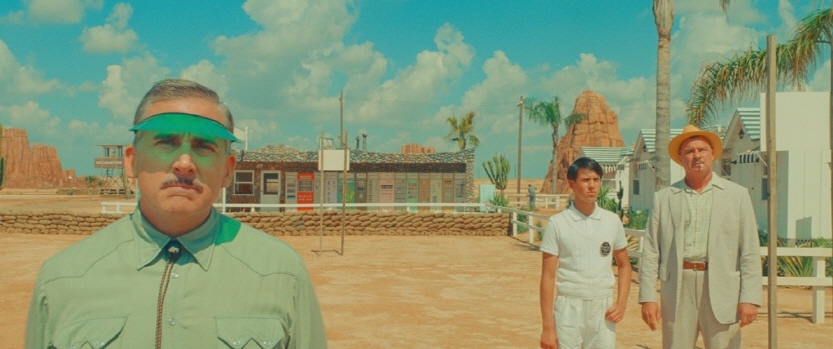
The main story is set in a little remote desert town called, yes, Asteroid City. Although its population is less than 100, it has been known well for not only its big meteor crater but also a big government facility associated with space research, and the town and its residents and visitors are about to have its own special day of commemoration.
On that day, several prodigious adolescents will be recognized for their little but distinguished scientific works. When a war photographer named Augie Steenbeck (Jason Schwartzman) comes along with his four kids, it looks like they simply drop by the town due to some mechanic problem of their car, but it turns out later that his adolescent son is one of those bright kids to be awarded, though both he and his son are mostly phlegmatic about this upcoming moment of commendation as your typical Wes Anderson movie characters.
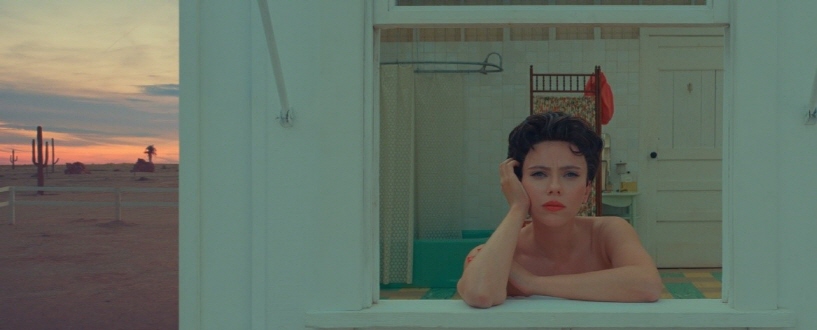
Meanwhile, a group of many other characters arrive in the town for each own reason. When a famous Hollywood actress named Midge Campbell (Scarlett Johansson) arrives along with her adolescent daughter, she certainly draws some attention, but the main reason of her unexpected visit is her daughter who will be awarded along with Augie’s son and other two kids. Later in the story, a bunch of elementary school kids arrive under the guidance of their young female teacher, and she is not so pleased when one of her students commits a little act of transgression thanks to a bunch of cowboy musicians who happen to stay in the town for a while.
They and many other main characters stay in the local motel, and its manager, played by Steve Carell, often cheerfully presents what his motel can provide to its guests. For example, there are a series of different vending machines which look as colorful as you can expect from a Wes Anderson film, and one of them is so preposterous that we are reminded more of the artificial qualities of the movie.
Anyway, things get a little more interesting when everyone in the story gathers at the center of the meteor crater as scheduled. Something not so far from Steven Spielberg’s “Close Encounters of the Third Kind” (1977) suddenly happens right in front of their eyes, and the town is quickly quarantined by General Grif Gibson (Jeffrey Wright) as ordered by the US president and his government.

Even at that point, the film maintains its detached attitude as before, and that is more accentuated by the formal narrative structure of the main story. Consisting of the three acts and the epilogue, the main story is sometimes intercut with the background tales involved with the original theatrical production of that fictional play, and the screenplay by Anderson and his co-writer Roman Coppola willingly adds additional narrative layers on the main story for more complexity and amusement. I do not think their attempt is wholly successful as jamming a bit too many materials into the rather short running time (105 minutes), but the movie is still a pleasure to watch for numerous distinctive artistic touches from Anderson, and he also utilizes well several old songs, which are fairly mixed well with the score by Alexandre Desplat.
Above all, it is difficult not to be entertained by the presence of all those performers assembled here for the film. Besides several notable performers mentioned above, we have Tilda Swinton, Adrien Brody, Liev Schreiber, Hope Davis, Stephen Park, Rupert Friend, Maya Hawke, Matt Dillon, Hong Chau, Willem Dafoe, Margot Robbie, Tony Revolori, Jeff Goldblum, Rita Wilson, Bob Balaban, and Tom Hanks, and I must say that Hanks’ understated comic performance here in this film is much better than his recent awkward acting in “Elvis” (2022) and “A Man Called Otto” (2022).
Being rather self-repetitive at times, “Asteroid City” is not that satisfying compared to Anderson’s recent works such as “The Grand Hotel Budapest” (2015) or “The French Dispatch” (2021), but I still appreciate Anderson’s deft handling of style and mood as well as his impressive big cast. Yes, I wish he shared more artistic fun and excitement of his cinematic dollhouse play with us here, but it is interesting enough at least, and I certainly recommend you to check it out if you enjoyed his previous films.


 Seongyong's Private Place
Pingback: 10 movies of 2023 – and more: Part 2 | Seongyong's Private Place